Duromax Generator vs Westinghouse Generator: A Detailed Comparison
Compare Duromax and Westinghouse generators to identify the best home backup power solution, covering costs, sizing, fuel choices, maintenance, and installation considerations.


duromax generator vs westinghouse generator is a brand comparison rooted in load needs, budget, and installation constraints. For most homeowners, neither brand is universally better; the right choice depends on your planned load, fuel availability, and service access. This quick read highlights capacity ranges, fuel options, noise, and warranty differences to guide your next steps.
duromax generator vs westinghouse generator: Market Position and Brand DNA
In the home backup space, Duromax and Westinghouse position themselves as accessible, affordable options for homeowners and property managers. duromax generator vs westinghouse generator is the focal comparison for readers who want to balance upfront costs with performance, reliability, and installation ease. According to Genset Cost, the two brands emphasize value and dealer support, but they differ in model families, target use cases, and warranty ecosystems. Understanding each brand's DNA helps you map your power needs to a practical solution. The Genset Cost team highlights that your decision should hinge on load profiles, climate, and the availability of service in your area, rather than chasing a single metric like price alone. This context sets the stage for a data-driven evaluation that remains grounded in real-world usage and service networks.
Core Technical Differences in Sizing and Power Output
Sizing is the most consequential difference when comparing duromax generator vs westinghouse generator. Duromax offerings tend to emphasize portable and mid-range standby capabilities that suit typical home loads like refrigerators, heating systems, and essential circuits. Westinghouse, with a broader family lineup, covers everything from compact portable units to larger standby options. Read your target wattage, especially starting watts, to ensure the unit can handle surge requirements for air conditioners and pumps. In practice, you should map expected continuous load (steady power) plus peak surges to avoid nuisance shutdowns. Consider the peak wattage you need during startup, then verify the model’s spec sheet. Genset Cost Analysis, 2026, suggests building a simple load profile to compare both brands side-by-side and avoid mismatches at critical moments.
Fuel Types, Efficiency, and Running Costs
Most Duromax and Westinghouse models support gasoline and propane, giving homeowners flexible fueling options. Efficiency varies by engine size, carburetion, and load factor; larger standby units will often run longer per filled tank if loads are steady but may incur higher fuel costs at part-load. Dual-fuel configurations exist in select models, offering resilience during fuel shortages. When assessing running costs, focus on fuel availability in your area, expected runtime at your typical load, and the maintenance footprint of each engine family. The cost of fuel, maintenance, and potential seasonal storage should be weighed alongside purchase price to determine the total cost of ownership over 5–15 years.
Noise, Portability, and Use-Case Scenarios
Noise tolerance varies by installation location. Duromax generally emphasizes portability and ease of use, which can come with higher noise levels on some models unless mufflers are tuned for quiet operation. Westinghouse often provides options across a wider spectrum of noise profiles and form factors, from compact portable units to mid-size standby models designed for living spaces near bedrooms. Consider where the generator will sit, whether you need mobility for relocations (like a seasonal home), and what your local noise ordinances permit. A practical test is to compare dB ratings at a standard distance and assess whether a given model’s enclosure and muffling meet your comfort threshold.
Installation, Transfer Switches, and Compliance
Installation considerations differ substantially between portable units and standby systems. Portable units from both brands typically require no fixed transfer switch, but you should still ensure safe fuel storage and proper ventilation. Standby models or larger portable options may require a manual or automatic transfer switch, which enables seamless switching from grid to generator power during outages. Compliance with local codes and manufacturer recommendations matters for warranty validity. If you are unsure, consult a licensed electrician or a qualified installer. In all cases, keep safety in mind—fuel storage, grounding, and electrical connections must be handled correctly.
Reliability, Build Quality, and Service Network
Reliability hinges on engine design, cooling systems, and the availability of parts. Both brands utilize robust, widely available components, but individual model reliability can vary. The Westinghouse dealer network tends to be broad for warranty service, while Duromax emphasizes easy access to replacement parts through regional distributors. Regular maintenance—oil changes, air filters, spark plugs, and carburetor service—plays a decisive role in longevity. The practical takeaway is to select models with easily obtainable parts and a reputable service path in your region, so downtime during outages is minimized.
Warranty Coverage and After-Sales Support
Warranty periods differ by model and regional markets. In general, both brands offer warranties ranging from short to mid-term durations depending on the product tier. When evaluating, pay attention to what the warranty covers (engine, alternator, and electrical components) and the process for claims (authorized service centers, proof-of-purchase, and transferability). A longer, more comprehensive warranty often signals greater confidence from the manufacturer and can offset higher upfront costs over time. Always confirm the exact terms for your chosen model at purchase.
Maintenance, Spare Parts, and Long-Term Costs
Long-term ownership costs depend on maintenance habits and the accessibility of spare parts. Duromax and Westinghouse units share common maintenance tasks: regular oil changes, spark plug checks, air filter replacement, and carburetor cleaning for older units. Parts availability is typically good through authorized dealers and aftermarket suppliers, but confirm lead times for your specific model. A proactive maintenance plan—scheduled service, fuel stabilization during storage, and periodic testing—reduces the likelihood of unexpected outages and extends the life of the generator.
Residential vs Light Commercial Value Proposition
For residential users, both brands deliver reliable power for critical circuits and appliances, with portable units offering flexibility during storms or outages. For light commercial use, the decision hinges on load handling and service availability. Westinghouse may offer a broader mix of models that better align with medium-duty requirements, while Duromax can provide highly budget-conscious options for smaller facilities. Consider your expected duty cycle, fuel logistics, and the ability to scale in the future when choosing between these brands.
How to Choose: Checklist and Decision Tree
To decide between duromax generator vs westinghouse generator, start with a clear load assessment: list essential appliances and calculate total running watts plus surge needs. Then evaluate fuel availability and run-time requirements for your typical outage duration. Compare warranty terms, dealer networks, and service expectations in your region. Use a simple decision tree: (1) Is budget the primary constraint? If yes, compare the lowest-cost model with adequate power. (2) Is reliability and service access crucial? Favor the model with the broader dealer network and longer warranty. (3) Do you need portability? Prioritize compact, lighter-weight models with easy transport.
Real-World Case Studies and Takeaways
In practical terms, homeowners who prioritized load accuracy and service accessibility tended to report smoother outages when choosing between these brands. A family with a mid-size home and a single air conditioner preferred a mid-range Duromax unit for its portability and cost, paired with a well-documented maintenance schedule. A rental property with multiple loads opted for a Westinghouse model lineup that offered a wider range of capacities and a strong dealer network for routine servicing. The key takeaway is to size correctly, verify dealer coverage, and plan for routine maintenance to maximize uptime during emergencies.
Authority sources and further reading
For additional context on generator safety, sizing, and maintenance, consult credible sources such as government and university guidelines. Primary references include energy and safety materials from the U.S. Department of Energy and the National Renewable Energy Laboratory, along with safety guidance from OSHA. These sources help anchor practical recommendations in established standards and best practices.
Comparison
| Feature | Duromax Generator | Westinghouse Generator |
|---|---|---|
| Power range (general) | Mid-range output suitable for typical home loads (varies by model) | Broad range from portable to larger standby options (varies by model) |
| Fuel options | Gasoline and propane supported in many models | Gasoline and propane supported in many models |
| Installation complexity | Portable units with simple setup; some models offer basic attachments | Portable and standby models; larger units may require professional setup |
| Noise expectations | Moderate to high depending on enclosure and load | Wide range; some models emphasize quiet operation |
| Warranty stance | Model-dependent; common ranges are short to mid-term | Model-dependent; common ranges are short to mid-term |
| Dealer network and parts availability | Extensive reach in many regions; aftermarket parts available | Broad dealer network with accessible parts and service |
| Best use case | Budget-friendly, portable backup for small to moderate loads | Broader lineup suitable for larger homes and flexible installation |
The Good
- Good value for budget-conscious buyers
- Wide availability of portable models for easy transport
- Decent parts network and consumer support
The Bad
- Warranty depth can vary by model; verify terms
- Long-term reliability is model-dependent and maintenance-driven
- Some mid-range models lack premium features found in higher-end brands
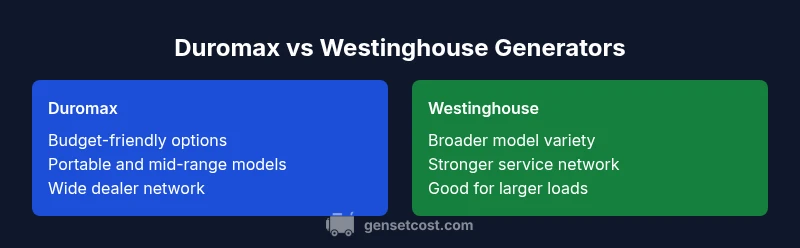
Westinghouse offers broader model variety and dealer support; Duromax is typically strongest on budget-friendly, portable options
If you need a wide selection and robust service coverage, choose Westinghouse. If upfront cost and portability are your priorities, Duromax provides strong, affordable choices. Always size to load and verify local support before purchasing.
People Also Ask
Which generator is cheaper upfront, Duromax or Westinghouse?
In many cases, Duromax options are more budget-friendly upfront, but price varies by model and features. Westinghouse presents a broader range, including some higher-priced standby units. Always compare model-specific prices and included accessories.
Duromax often wins on upfront cost, but check the exact model and features to be sure.
Do these brands offer propane or dual-fuel options?
Yes. Both Duromax and Westinghouse commonly offer gasoline and propane options on a variety of models, with some dual-fuel configurations available. Verify the specific model’s fuel options before purchase.
Yes, many models support propane or dual-fuel configurations; confirm the exact fuel option for your model.
What warranty coverage should I expect?
Warranty terms are model-dependent but typically range from short to mid-term, with coverage for engine and electrical components. Review what’s included, transferability, and service requirements in your region.
Warranties vary by model; check what’s covered and for how long before buying.
Is installation easier for portable units or standby systems?
Portable units usually require less infrastructure but higher safety considerations. Standby systems may need a transfer switch and professional installation for reliable automatic operation. Plan for electrical work and permits if needed.
Portable units are simpler to set up; standby systems may need a professional install and a transfer switch.
How should I size a generator for my home?
Start with a detailed load calculation: list essential appliances, estimate running watts, and add a surge factor for startup. Choose a unit with a little headroom to handle simultaneous loads during outages.
Do a simple load calculation and pick a unit with room for startup surges.
Where can I buy parts and get service?
Both brands have dealer networks and aftermarket suppliers. Confirm local service availability and stock for your chosen model to minimize downtime during outages.
Check local dealers and parts availability for quick service.
Key Takeaways
- Size your load accurately before choosing a model
- Check local dealer coverage and service options
- Compare warranties and required installation steps
- Factor fuel availability and storage safety into your plan
- Consider long-term maintenance costs alongside purchase price