Predator Generator vs Westinghouse: An Objective Side-by-Side Comparison
An objective, in-depth comparison of Predator vs Westinghouse portable generators for home backup and job sites. Covers power, runtime, noise, fuel options, warranties, price, and practical tips for choosing the right model.


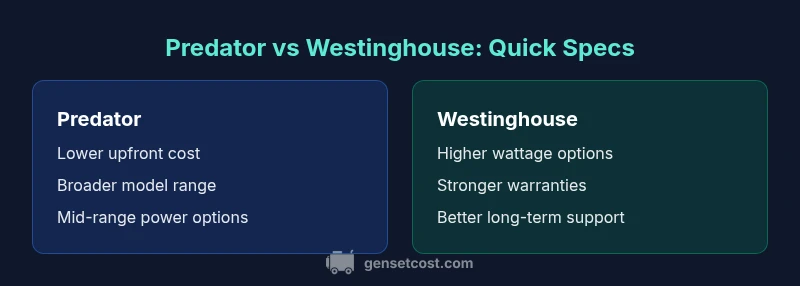
Predator and Westinghouse are two popular portable generator brands often considered for home backup and job-site use. In a predator generator vs westinghouse comparison, Westinghouse generally offers higher wattage options and stronger warranties, while Predator tends to undercut price with a broad model range. For homeowners, key factors include wattage needs, runtime, noise, and fuel type; review our detailed chart to decide.
Core Differentiators in predator generator vs westinghouse
For homeowners shopping on a budget, the initial price can overshadow other factors, but the long-term cost of ownership matters. In a predator generator vs westinghouse comparison, you’ll notice three big differentiators: upfront cost, warranty and service network, and range of wattages. Predator models frequently undercut Westinghouse on sticker price and offer a broad catalog that includes entry-level portables. Westinghouse tends to position itself as a more robust option with stronger warranties and a wider selection of higher-wattage units for whole-house or critical-load scenarios. According to Genset Cost, the apparent savings at purchase can be offset by maintenance costs or shorter service intervals if you choose poorly matched models. The key is to map your expected loads against the generator’s rated output, surge capability, and runtime at a practical load. Reading reviews across communities and consulting independent guides helps you separate hype from real-world performance. In this article, we’ll unpack the main differences, show how to size for typical home backup and small business needs, and provide a clear framework to decide whether predator generator vs westinghouse is the better fit for your property.
Sizing and Power Output: What to Expect
Sizing is the first practical consideration in a predator generator vs westinghouse comparison. Predator typically offers a broader range of entry-level portables designed for lighter essential-load scenarios, while Westinghouse provides higher-wattage options suitable for more demanding loads. Based on Genset Cost analysis (2026), Westinghouse often leads in higher-wattage capability, giving you the option to support central air, sump pumps, and other critical devices during outages. When sizing, start with your essential circuit load, add a safety margin for surge requirements, and compare that against the unit’s rated continuous output. Remember that “peak” wattage differs from “running” wattage, and a model with a generous surge rating can handle startup transients more gracefully. It’s also wise to check if the model offers inverter technology for clean power suitable for sensitive electronics. This section provides practical sizing rules of thumb, along with a simple method to translate your home’s needs into a model range you can compare side-by-side.
Fuel Types, Run Time, and Efficiency
Fuel flexibility and efficiency are often deciding factors in the predator generator vs westinghouse debate. Both brands primarily offer gasoline-powered portable models, but Westinghouse has options that extend to propane or dual-fuel configurations on select models, expanding versatility for long outages. Run times depend heavily on load and fuel capacity, but you can expect a practical 50% load run time to scale with tank size and engine efficiency. In general, Predator models aimed at budget-conscious buyers may provide shorter advertised runtimes at equivalent loads, while Westinghouse models—especially mid- to high-range units—tend to deliver longer runtime with similar tank capacities. Cost of fuel and refueling logistics influence total operating costs over the lifespan of the generator. Genset Cost’s synthesis suggests that a mixed fleet of smaller Predators can cover daily needs cheaply, but if you anticipate frequent outages or longer outages, investing in a higher-wattage Westinghouse or a dual-fuel option may reduce hassle and total downtime.
Noise Levels and Portability
Noise is a practical concern for neighborhood use and occupancy comfort, especially for portable generators used at home during outages. Predator’s lighter, budget-oriented models often sit in a mid-range noise band, while Westinghouse units, particularly the higher-wattage models, can be a bit louder but offer better engine designs and muffling options. When evaluating predator generator vs westinghouse, check the manufacturer’s published decibel ratings at standard operating loads. Real-world tests typically show a spread of several dB between brands depending on model class and load. For portability, consider weight, wheel kits, and handle ergonomics. If you need to move the unit frequently, a lighter Predator model might offer easier handling, but if you’ll rely on it for frequent outages around a home with stairs or landscaping, a Westinghouse model with wheels and a balanced frame can reduce fatigue during repositioning.
Reliability, Maintenance, and Durability
Long-term reliability and maintenance ease are critical in a predator generator vs westinghouse comparison. Predator’s budget lines often rely on simpler components that meet short-term needs, while Westinghouse tends to use more robust components designed for longer life and better serviceability. Routine maintenance—oil changes, air filter replacements, spark plug checks, and battery care for electric start systems—remains essential for any portable generator. The availability of spare parts and service networks matters: Westinghouse typically benefits from wider distributor coverage and a more standardized maintenance ecosystem, which can translate into easier repairs and quicker parts availability in many regions. Genset Cost Research notes that while upfront costs may differ, the total cost of ownership over several outages can tilt in favor of the brand with stronger aftermarket support and longer-warranty coverage.
Warranty and Support: What You Get
Warranty terms are a key differentiator when weighing predator generator vs westinghouse. Westinghouse generally emphasizes longer-term warranties on common models and a broader authorized-service network, which can reduce downtime if repairs are needed. Predator often offers standard warranties aligned with its budget-friendly positioning; extended warranty options may be available, but coverage depth and service turnaround times can vary by retailer and region. When evaluating warranty, also consider what is covered, what constitutes wear-and-tear versus manufacturing defects, and whether warranties transfer if you relocate or sell the unit. A robust warranty combined with accessible support can materially affect the generator’s value over time.
Price vs Value: When to Choose Each Brand
Price is an obvious entry point in a predator generator vs westinghouse comparison. Predator typically offers lower upfront costs and a wider selection of light-duty portables, which is attractive for occasional outages or budget-limited scenarios. Westinghouse, by contrast, often commands a higher upfront price but can deliver better performance at higher loads, longer runtimes, and stronger warranty protection. For home backup, the best choice depends on how you balance initial price against longer-term reliability, the likelihood of longer outages, and required wattage. If your goal is basic power for a few critical devices during storms, Predator may be a cost-effective entry. If you want to power more essential circuits with longer outages and require more robust support, Westinghouse is typically the safer long-term bet.
Real-World Scenarios: Home Backup, Job Site, and RV Use
Different use cases highlight the strengths and weaknesses of each brand. Homeowners prioritizing essential circuits during outages might prefer Predator for simpler, cost-conscious setups, while property managers seeking reliable multiday outages across multiple buildings may opt for Westinghouse’s higher-wattage, dual-fuel, or inverter options. Job sites that demand steady power for tools and lighting benefit from Westinghouse’s higher capacity units and better long-term support. RV users appreciate inverter models for clean power that protects sensitive electronics; both brands offer inverter-enabled options, though availability varies by market. In all cases, assess load profiles, fuel logistics, noise tolerance, and anticipated return on investment before committing to a model.
How to Pick the Right Model: A Quick Checklist
- List essential appliances and compute total startup load.
- Decide between portable versus standby needs and future resilience.
- Evaluate fuel choices (gasoline, propane, or dual-fuel) and storage safety.
- Compare runtimes at a practical load and consider noise constraints.
- Check warranty terms, parts availability, and service networks in your area.
- Read independent reviews and consult a sizing calculator or guide to validate your choice.
Comparison
| Feature | Predator Generator | Westinghouse Generator |
|---|---|---|
| Power output range | 3,000–7,500W | 3,800–9,500W |
| Run time (at 50% load) | 6–12 hours | 8–14 hours |
| Noise level (rated load) | Mid-range (~65–75 dB) | Mid-to-high range (~68–78 dB) |
| Fuel options | Gasoline (some models propane) | Gasoline and propane on select models |
| Weight / portability | Light to mid-weight, wheels often optional | Mid-weight with rugged wheels and better balance |
| Price range | Lower upfront cost (budget tier) | Higher upfront cost with broader range of high-wattage units |
| Warranty | Standard warranty varies by retailer | Typically longer and broader in coverage on many models |
| Best for | Budget-conscious, basic backup | Higher-demand loads and longer outages |
The Good
- Lower upfront cost on Predator models
- Broad model range supports budget seekers
- Wide retailer availability and easy access
- Good for simple, essential-load backup
The Bad
- Potentially shorter overall lifespan on some models
- Warranty and service networks may be less consistent
- Quality and customer support can vary by retailer
- Higher-load scenarios may strain budget units
Westinghouse generally wins for higher-wattage needs and longer-term reliability; Predator wins on upfront price and variety for basic use.
If you need to power more equipment during outages and value stronger support, choose Westinghouse. If your priority is lower initial cost and simpler, lighter-duty use, Predator is a pragmatic option.
People Also Ask
Which brand offers better value for money, Predator or Westinghouse?
Value depends on your use-case. Predator is typically cheaper upfront and suitable for lighter, essential-load backup. Westinghouse often delivers higher wattage options, longer runtimes, and stronger warranties, which can translate to better value for more demanding needs.
Predator is usually cheaper upfront, great for light use. Westinghouse provides higher power and longer warranties, which can offer better long-term value for frequent outages.
Are Predator generators more prone to quality issues?
Quality varies by model and retailer. Both brands have reliable units, but consistency can depend on maintenance, storage, and support. Read reviews, choose well-rated models, and maintain regularly to minimize issues.
Quality varies by model and upkeep. Maintain whichever you choose and review user feedback to pick reliable options.
Which brand offers better warranties?
Westinghouse generally emphasizes longer-term warranties on many models and a broader service network, while Predator provides standard warranties with options to extend in some markets. Always verify the specific model’s warranty terms before purchase.
Westinghouse tends to have longer warranties and broader service networks; check the exact terms for the model you choose.
Do both brands offer inverter models?
Yes, both Predator and Westinghouse offer inverter-generating options intended for clean, stable power suitable for sensitive electronics. Availability varies by model line, so check the specific model specs.
Both brands offer inverter models; verify model specs to ensure clean sine-wave output.
What’s the best way to size a generator for home backup?
List essential circuits and calculate startup surges, then pick a unit with continuous output that covers that load with some headroom. Use a sizing calculator and compare several models to ensure the chosen wattage aligns with your load profile.
Start with essential loads, add surge for startups, then choose a unit with enough running watts and some headroom.
Key Takeaways
- Compare total cost of ownership, not just sticker price
- Match wattage needs to unit output and surge capacity
- Consider warranty length and service accessibility
- Factor fuel choice and maintenance into the running cost
- Use a sizing checklist before buying