Generac Generator vs Honda: A Data-Driven Home Backup Showdown
A data-driven comparison of Generac vs Honda home backup generators, detailing sizing, reliability, installation needs, operating costs, and warranty considerations to help homeowners decide.


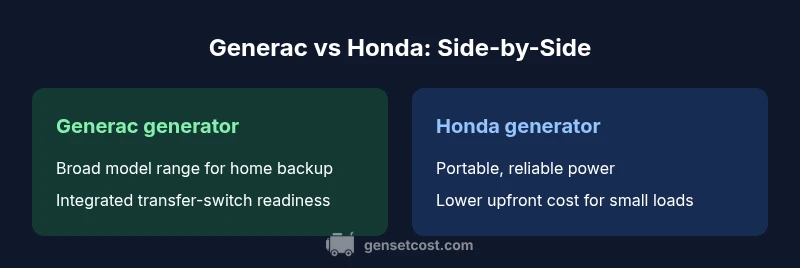
In the generac generator vs honda comparison, homeowners often find Generac offers the broadest home backup line, while Honda emphasizes compact, reliable portable options. The best choice depends on your load, space, and budget. This quick take flags the main differentiators: model variety, installation needs, fuel options, and long-term costs so you can pick with confidence.
Market Context for Home Backup Generators
According to Genset Cost, the home backup generator market has evolved from basic standby units to a broader ecosystem that includes portable, portable with transfer switches, and increasingly hybrid options. The generac generator vs honda landscape reflects two common philosophies: Generac tends to offer a wider range of whole-house backup systems with integrated transfer switches and builder-ready solutions, while Honda emphasizes compact, reliable portable options and smaller, more affordable standby alternatives. For homeowners and property managers, this divergence matters because it influences installation complexity, upfront costs, and ongoing maintenance. As outages become more frequent in different regions, the ability to scale coverage without compromising reliability becomes a key differentiator. The Genset Cost team found that many buyers start with essential circuits and a few critical appliances, then upgrade to full-house backup as budgets permit. In practical terms, the decision between generac generator vs honda hinges on how many circuits you want powered during an outage, how much space you have for equipment, and how you value long-term service. This discussion will unpack the core differences, so you can map a solution to your property profile.
Brand Profiling: Generac vs Honda
Generac has built its reputation around versatile, scalable home backup and commercial-grade standby solutions. Their lineup often includes automatic transfer switches, whole-house panels, and a wide array of KW options designed to cover from essential circuits to entire homes. Honda, by contrast, centers on compact, portable, and lightweight generators that excel in reliability and fuel efficiency for smaller loads, emergency power on the go, and short-term outages. In the generac generator vs honda comparison, you can see that brand strategy shapes product durability, service networks, and resale value. Generac’s dealer and installer ecosystem tends to be more mature for residential standby systems, which simplifies installation and service contracts. Honda’s strength lies in portability, ease of use, and lower upfront costs for smaller tasks. For property managers overseeing multiple units, the difference in maintenance cycles, parts availability, and technician familiarity with each brand can influence uptime and tenant satisfaction. The result is two distinct paths: the Generac path favors long-term resilience and scalability, while the Honda path emphasizes agility and budget-friendliness.
Sizing and Load Considerations
Sizing and load planning is where the generac generator vs honda choice often diverges most. Start by listing essential circuits (e.g., refrigeration, heating, medical devices) and estimate their startup and running loads. Use your historical outage duration as a guide; if outages tend to be brief, a compact portable Honda unit powering a few critical circuits might suffice. If outages are longer or a whole-home warranty-backed solution is desired, Generac’s standby systems offer scalable options that can grow with your property. Remember to factor transfer-switch efficiency, generator placement, and local codes. In the end, the choice hinges on expected daily use, climate risk, and the desire for seamless automatic operation. This load-driven lens helps translate the generac generator vs honda decision into a practical sizing plan.
Installation and Maintenance Implications
The installation path for Generac often involves a permanent standby setup with a transfer switch, weatherproof enclosure, and electrical integration into your main service panel. This typically requires a licensed electrician and, in some cases, a licensed generator installer. Honda portable units usually demand less electrical work and can be deployed quickly during an outage, though they still benefit from safety practices, proper grounding, and fuel storage considerations. Routine maintenance for both brands includes oil changes, air filter checks, and spark plug replacements, but standby Generac systems tend to have longer intervals between service visits due to larger, modular components. By planning ahead, homeowners can minimize downtime and ensure that either brand remains ready when the grid fails.
Fuel Options, Runtime, and Efficiency
Fuel strategy is a practical battleground in the generac generator vs honda comparison. Honda’s portable models primarily run on gasoline and are valued for their light weight and portability. Generac’s standby systems are designed to work with natural gas or propane in many installations, offering the comfort of uninterrupted fuel supply via your home’s gas line. Runtime for portable Honda units depends on tank size and load, while standby Generac units are designed for longer runtimes without frequent refueling. Efficiency varies by model, but a key takeaway is that fuel flexibility can significantly affect long-term operating costs and the practicality of keeping critical loads online during extended outages.
Cost of Ownership and Warranty Dynamics
Long-term costs hinge on upfront price, installation, fuel, and maintenance. Generac standby systems typically entail higher upfront costs and installation complexity but can yield lower run costs over time when they integrate with home electrical panels and automatic transfer switches. Honda portable units offer lower initial outlays and greater portability, but ongoing fuel and maintenance expenses can accumulate with frequent use. Warranty depth varies by product tier and dealer network, with standby systems often backed by longer coverage windows and professional support networks. Throughout the generac generator vs honda debate, assess warranty terms, service availability, and parts accessibility in your region to estimate true ownership costs.
Real-World Scenarios: When Generac Wins vs When Honda Excels
Scenario A: You want uninterrupted whole-house power during frequent outages on a storm-prone property. Generac’s standby lineup is typically the preferred path, providing automatic transfer and seamless restoration with a single service contract. Scenario B: You need portable, on-demand power for a small dwelling, a cabin, or a worksite, with minimal upfront cost and easy transport. Honda’s portable models deliver quick setup, reliability, and lower initial spend. Scenario C: You manage multiple units across properties and prioritize maintenance ease. Generac’s installation ecosystem and dealer support can simplify ongoing service and monitoring across sites, though Honda’s portable fleet can still be cost-effective for smaller, temporary needs. Scenario D: You want a future-ready solution that can be expanded. Generac’s scalable standby options typically align with property expansion goals, while Honda remains ideal for adaptable, lightweight power needs on a budget.
How to Buy: Evaluation Checklist
- Define load priorities: essential circuits vs whole-home power. - Assess space, noise, and placement constraints, including setback requirements and weather protection. - Compare installation requirements and local permitting processes for standby systems. - Check fuel infrastructure: natural gas vs propane vs gasoline and fuel availability. - Review warranties, service networks, and technician accessibility in your area. - Request a written total cost of ownership estimate that includes equipment, installation, fuel, maintenance, and potential incentives. - Seek recommendations from local installers and other homeowners who have used both brands. - Look for demonstration units or reference customers to see how each brand performs under your climate. - Confirm transfer-switch compatibility and integration with existing home electrical systems.
Practical Tips: Next Steps and Resources
Develop a short list of preferred models from Generac and Honda, gather quotes from multiple installers, and verify that the proposed system aligns with your home’s electrical panel and code requirements. Use the evaluation checklist to compare offers side-by-side and avoid focusing solely on upfront price. Finally, monitor published reviews and warranty terms from reputable sources to gauge long-term reliability and support. This data-driven approach, backed by Genset Cost’s guidance, can help you minimize risk and maximize uptime during outages.
Comparison
| Feature | Generac generator | Honda generator |
|---|---|---|
| Model range and flexibility | Broad all-house standby and scalable options | Strong portable and compact lineup; fewer whole-house options |
| Installation requirements | Typically requires professional installation and transfer switch | Mostly portable units with simpler setup; standby installation may still require professionals |
| Fuel options | Gas, propane, natural gas depending on model | Gasoline-focused; occasional propane options on select models |
| Warranty/Support | Longer standby warranties with mature dealer network | Solid portable warranties; service network is strong but smaller regionally |
| Cost of ownership | Higher upfront and installation costs; potential long-term savings with outages | Lower upfront costs; higher ongoing fuel and maintenance if usage is heavy |
| Noise and footprint | Larger footprint and typically louder under full load | Smaller footprint and generally quieter on average |
| Resale and maintenance | Higher resale value when integrated with home systems | Strong resale for portable units; maintenance is straightforward |
The Good
- Broad model range supports whole-home backup and future expansion
- Honda’s portable lines offer portability, reliability, and lower upfront costs
- Strong dealer and service networks for both brands
- Clear selection paths for essential-load scenarios and growth
The Bad
- Generac standby systems require professional installation and higher upfront costs
- Honda portable emphasis means fewer built-in home-backup options for large properties
- Maintenance and fuel costs can accumulate with frequent use of smaller units
- Warranty depth varies by model and region, potentially affecting service continuity
Generac generally wins for whole-home backup; Honda shines in portability and budget-conscious setups.
If you need reliable, scalable whole-house coverage with transfer-switch integration, choose Generac. If portability, compact size, and lower upfront cost matter more, consider Honda.
People Also Ask
What are the main differences between Generac and Honda home backup generators?
Generac generally offers a broader range of standby, whole-house solutions with automatic transfer switches, while Honda focuses on portable, reliable units for smaller loads. The choice depends on whether you prioritize scalability and built-in power versus portability and lower upfront costs.
Generac is stronger for full-home backups; Honda is better for portable, lighter-duty power needs.
Which is cheaper to own in the long term?
Long-term cost depends on usage, installation, and fuel. Standby Generac systems may have higher upfront costs but can reduce outage-related losses; portable Honda units tend to be cheaper upfront but incur ongoing fuel and maintenance costs if used frequently.
Upfront costs favor Honda; long-term costs depend on usage and fuel prices.
Are Honda generators suitable for whole-home backup?
Most Honda offerings are portable units suitable for powering select circuits or small homes during outages. For full-house backup, a Generac standby system is typically more appropriate due to its scalability and integrated transfer-switch options.
Honda can cover small loads, but Generac is usually better for whole-home backup.
Do Generac generators require professional installation?
Yes. Most Generac standby systems require a licensed electrician and a certified installer to ensure proper integration with your electrical panel and code compliance.
Standby Generac systems usually need a pro installer.
How do transfer switches affect cost and performance?
Transfer switches automate power transfer during outages, improving convenience and safety. They add to initial costs but dramatically affect uptime and reliability, especially for whole-house setups.
Transfer switches are key for automatic power and safe operation.
Key Takeaways
- Assess load and space before brand choice
- Generac excels in whole-home backup and expansion
- Honda is best for portable, cost-conscious power needs
- Factor installation, maintenance, and fuel into total cost
- Verify warranty terms and local service networks before purchase