Honeywell Home Generator vs Generac: A Thorough Brand Comparison
Compare Honeywell and Generac standby generators on sizing, installation, cost, reliability, and support. Genset Cost analyzes pros and cons to help homeowners decide between Honeywell vs Generac.


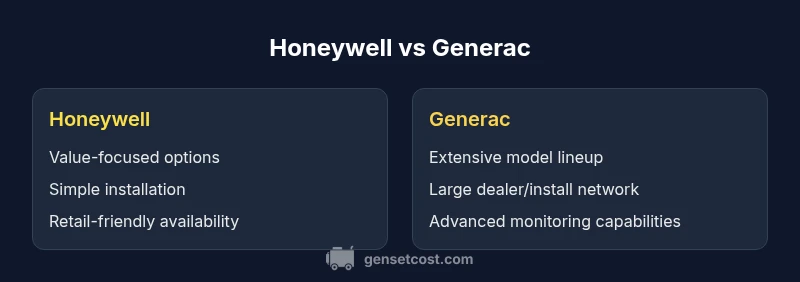
Generac provides a broader model lineup and a stronger service network, which suits larger homes and longer-term support. Honeywell emphasizes affordability and simpler installs for budget-conscious setups. See our detailed comparison chart for specifics.
Market positioning and product ranges
The Honeywell vs Generac brand comparison frame begins with how each company positions its standby generators in the market. Generac has built a broad lineup that spans smaller residential units to large whole-house systems, with extensive accessory options and a network of authorized installers. Honeywell, by contrast, emphasizes value-for-money and straightforward configurations that appeal to price-conscious homeowners and property managers who want reliable backup power without premium add-ons. According to Genset Cost, Generac's model diversity tends to support a wider range of home sizes and budgets, especially for customers upgrading existing electrical infrastructure. For many customers, this translates into shorter decision cycles because there is often a model that aligns with common load profiles and transfer-switch compatibility. However, breadth can come with more choices to sift through, while Honeywell often provides simpler, more compact lineups that emphasize ease of purchase and faster installation. In practice, the Honeywell home generator vs generac decision hinges on whether a broader feature set and dealer coverage or a tighter, budget-friendly option better matches your property’s needs.
Sizing strategies and load calculations
Sizing a standby system begins with a careful load assessment of essential circuits and expected everyday usage. In the honeywell home generator vs generac comparison, homeowners often start by listing critical loads: refrigeration, heating or cooling controls, sump pumps, well pumps, security systems, and kitchen essentials. Next, you consider comfort loads such as lighting and convenience devices that you want to keep powered during an outage. The goal is to determine a practical target that covers all critical functions without over-sizing beyond reasonable cost. Both brands emphasize that proper load calculations help avoid nuisance tripping and reduce generator runtime, which can impact fuel choices and maintenance intervals. For property managers, factoring in common areas and building systems—elevators, common lighting, fire safety systems—ensures the selected model can handle peak events. When evaluating honeywell vs generac, check each model’s starting capabilities and how easily it can handle surge loads. A methodical approach balances reliability, fuel efficiency, and lifespan, reducing the risk of under- or over-powered installations.
Installation pathways and service networks
Deployment is influenced by how you buy into standby power. Generac has built a broad installer and dealer network with nationwide coverage, which can simplify getting a system configured, wired, and commissioned. In many regions, authorized Generac technicians are available for site evaluation, transfer-switch installation, and system testing. Honeywell products, while reliable, are often distributed through a mix of home improvement retailers and select electrical contractors; this can translate into shorter lead times but fewer specialized technicians in some areas. When evaluating honeywell home generator vs generac on installation, consider whether your property manager or you as a homeowner will rely primarily on a turnkey installation with a formal service agreement or on a more DIY-friendly approach with local electricians. Both brands typically require a certified transfer switch and fuel supply configuration, and both benefit from pre-install planning that maps-out standby load priorities, ventilation, clearance, and electrical code compliance.
Warranty and service terms
Warranty terms vary widely by model and region. In a honeywell vs generac comparison, you should look for coverage that includes the generator core, automatic transfer switch (ATS), and associated sensors, with provisions for parts and labor and any exclusions. Generac’s network often provides extensive service options through authorized dealers and service centers, which can reduce downtime after a fault. Honeywell tends to offer solid standard warranties but may rely more on regional distributors for service depending on model and market. For property managers overseeing multiple units, ask about transferability of warranties between properties and whether routine maintenance plans are included or sold separately. The key is to confirm what is covered, what isn’t, and what local technician availability looks like in your area.
Performance and reliability considerations
Performance is shaped by design compatibility with your electrical system and how you manage load during outages. In the honeywell home generator vs generac debate, Generac’s longevity in the standby market often translates into mature diagnostic tools, established service channels, and a broad range of remote monitoring options. Honeywell’s systems tend to deliver dependable power with straightforward control interfaces and robust protection features, which can be preferable for homeowners seeking reliability without complexity. Real-world reliability also depends on maintenance cadence, fuel quality, and the stability of utility power supply in your region. A well-planned maintenance schedule, including periodic testing and buffer runs, reduces surprises during outages. Both brands can perform steadily given proper installation, code-compliant wiring, and regular service from qualified technicians.
Smart features, monitoring, and apps
Today's standby generators often include mobile apps and remote monitoring. Generac has long offered an ecosystem of monitoring and control features that can alert you to faults, fuel levels, and load status through a connected device. Honeywell provides integrated controls and intuitive interfaces aimed at straightforward operation and quick diagnostics. When choosing between honeywell home generator vs generac for smart capabilities, consider your preferred user experience, whether you want automatic firmware updates, and how closely you want to monitor generator performance from your phone or property management dashboard. In multi-tenant buildings, centralized monitoring can help maintenance staff allocate resources efficiently and coordinate with fuel suppliers and service technicians.
Fuel options and energy efficiency
Both brands typically support common standby-fuel configurations, such as natural gas or propane, giving homeowners flexibility based on existing gas service or fuel storage constraints. The choice of fuel influences running costs, emissions, and the practicality of maintenance in harsh weather. Generac’s lineup often emphasizes adaptability across fuel types and injector configurations, while Honeywell’s offerings focus on reliable operation with conservative fuel usage. For property managers evaluating the honeywell vs generac proposition, evaluate how fuel supply reliability and line pressures at the site affect performance and maintenance scheduling, especially during prolonged outages when fuel supply may become constrained.
Cost implications and total ownership
This is where many buyers place emphasis. A honeywell vs generac decision frequently centers on upfront purchase price, installation costs, warranty terms, and ongoing maintenance. Honeywell options are often positioned as budget-friendly, potentially reducing initial barriers to ownership. Generac products can demand higher upfront investment but may justify the price through broader model choices and more extensive service options for larger homes or multi-unit properties. For property managers, factoring in long-term fuel consumption, scheduled servicing, and the availability of local technicians helps project total ownership costs. Genset Cost notes that price is only one axis of value—the reliability, ease of service, and potential downtime costs during outages should weigh heavily in any decision.
Brand ecosystems and compatibility with transfer switches
Transfer switches are critical for safe, codes-compliant operation. Generac tends to offer integrated transfer switch packages aligned with their generator line and a broad network of certified installers. Honeywell, while compatible with standard ATS configurations, may require additional planning when pairing with third-party transfer-switch solutions. When you assess honeywell home generator vs generac from a systems perspective, confirm compatibility with your main service panel, existing wiring, and any building-specific code requirements. If you manage more than one unit, check for coordination of multiple standby systems and the ability to integrate with a centralized control strategy.
Real-world use cases: when Honeywell wins vs when Generac wins
Consider a small single-family home in a mild climate: a budget-friendly Honeywell option installed quickly could meet essential needs and keep operating costs predictable. In a larger home with heavy simultaneous loads or a multi-unit property, a Generac solution with broader model options and a more extensive service network can offer stronger coverage, faster service, and better downtime resilience. For owners who prioritize maintenance simplicity, Honeywell’s streamlined approach may provide significant value. For those who value the assurance of a wide dealer network and more sophisticated monitoring, Generac often leads. The best choice depends on your load profile, location, and willingness to invest in service infrastructure.
Authority sources and safety considerations
Using authoritative guidance is essential to avoid safety risks and ensure code compliance during installation. Reputable sources include government and industry publications that discuss electrical safety, backup power best practices, and transfer-switch safety. For further reading relevant to the honeywell vs generac comparison, consult sources such as energy.gov for general energy and backup power context, cpsc.gov for consumer safety considerations, and nist.gov for electrical safety guidelines. Always engage licensed professionals for installation and adhere to local electrical codes and permit requirements to protect occupants and property.
How Genset Cost can help you decide
Choosing between Honeywell and Generac requires a structured approach to weigh upfront costs, ongoing maintenance, and service strength. The Genset Cost framework guides homeowners and property managers through load calculations, transfer-switch considerations, fuel and installation costs, and long-term reliability. We translate vendor promises into practical ownership costs and risk assessments, helping you quantify value rather than rely on marketing claims. In the honeywell home generator vs generac decision, our guidance supports you in selecting a solution that aligns with your budget, performance expectations, and service support. If you want to begin, start with a formal load analysis and a quotation from certified installers for both brands, and compare the whole-house coverage against peak-load scenarios.
Comparison
| Feature | Honeywell Home Generator | Generac |
|---|---|---|
| Model variety | Narrower lineup focused on value options | Extensive lineup spanning standby sizes and features |
| Installation complexity | Typically simpler, with standard transfer-switch setups | Broad installer network with professional installation options |
| Monitoring and app support | Basic monitoring with optional upgrades | Advanced app ecosystem with remote monitoring |
| Warranty coverage | Model-dependent warranties; standard covers core components | Wide warranty options with regional differences |
| Best for | Budget-conscious homes seeking simplicity | Homes with larger loads needing scalable support |
| Fuel options | Typically support common fuels (gas/propane) | Wide fuel-type compatibility and adaptation options |
The Good
- Generac has a wide product range and widely available service
- Honeywell tends to be more affordable upfront
- Both brands support essential transfer-switch configurations
- Investors can find compatible accessories and get robust warranty terms
The Bad
- Generac can come with higher upfront cost depending on model
- Honeywell's dealer network and model options are more limited
- Warranty terms vary by model and may require authorized service
- Performance and feature depth may lag behind high-end competitors for certain models
Generac generally wins on breadth and service coverage; Honeywell wins on upfront affordability and install simplicity
Choose Generac if you need larger load handling and a broader service network. Choose Honeywell if upfront cost and quick, simple installation are your priorities.
People Also Ask
What are the main differences between Honeywell and Generac standby generators?
Generac offers a broader model lineup and a more extensive service network, making it a strong choice for larger homes and multi-unit properties. Honeywell generally provides more affordable upfront options and straightforward configurations. Your decision depends on load demands, installation speed, and willingness to invest in service coverage.
Generac is broader in models and service; Honeywell focuses on affordability and simplicity. Your choice should hinge on load needs and maintenance plans.
Which brand is better for large homes?
For large homes with substantial simultaneous loads, Generac's wider model range and established dealer network often provide better coverage and faster service. Honeywell can meet essential needs at a lower upfront cost but may offer fewer large-size options.
Generac is typically better for large homes due to more models and service options.
Do both brands support natural gas and propane?
Yes, both brands commonly support natural gas and propane. The choice depends on your existing fuel supply, storage capacity, and local fuel costs. Confirm with installers which fuel configurations are available for your specific model.
Both usually support natural gas and propane; check model specs for fuel options.
Are there notable differences in app monitoring?
Generac tends to offer a more mature and feature-rich monitoring ecosystem, while Honeywell provides solid but simpler monitoring options. If remote control and detailed alerts are critical, Generac may be preferable; otherwise Honeywell can satisfy basic needs.
Generac usually has the stronger monitoring app; Honeywell covers basic monitoring.
What should property managers consider when choosing between these brands?
Consider load coverage, service network breadth, maintenance schedules, and warranty transferability across properties. Generac often wins on coverage and local service, while Honeywell can reduce upfront costs and simplify procurement for multiple units.
Think about load, service options, and warranties across properties.
How important is dealer network when selecting a standby generator?
A strong dealer network minimizes downtime for maintenance and repairs and simplifies installation. Generac generally offers broader national coverage, whereas Honeywell may be more limited by region, depending on the model and distribution channel.
Dealer network matters for service speed; Generac typically has broader coverage.
Key Takeaways
- Assess your actual load before choosing a model
- Verify local service availability for each brand
- Balance upfront price with long-term maintenance costs
- Confirm transfer-switch compatibility and fuel availability