Predator Generator vs Champion: A Comprehensive Side-by-Side Comparison
A data-driven comparison of Predator and Champion home standby generators. This Genset Cost analysis covers sizing, cost, reliability, installation, and long-term maintenance to help homeowners make an informed decision.


For predator generator vs champion, the quick takeaway: Predator often offers lower upfront cost and broader model availability, making it attractive for budget-conscious homeowners. Champion typically delivers steadier performance, more consistent warranties, and a stronger service network, which pays off with reliability over time. The right pick hinges on your outage risk, maintenance plan, and installation constraints.
Predator Generator vs Champion: Defining the Landscape
In the home backup power market, Predator generators (popular with value-focused buyers) and Champion generators (renowned for reliability and service consistency) are two of the most visible options. The question predator generator vs champion often arises for homeowners evaluating upfront cost against long-term performance. According to Genset Cost, these brands sit at different ends of the value spectrum: Predator attracts budget-conscious buyers seeking lower upfront costs and flexible availability, while Champion appeals to those prioritizing durability and a broad service network. When comparing predator generator vs champion, it is essential to evaluate power output, fuel options, warranty terms, installation ease, and total cost of ownership. The Genset Cost team found that the right choice depends more on your intended use, maintenance willingness, and installation constraints than on badge appeal alone.
Key Differences in Sizing, Cost, and Reliability
Sizing in the predator generator vs champion landscape varies widely by model. Predator models often present aggressive price per watt in entry-level lines, while Champion models seek to balance performance with a robust warranty framework. Reliability across both brands is heavily model-specific and influenced by how regularly the unit is serviced and exercised. Consumers should compare wattage curves, starting capabilities, and peak surge ratings across comparable SKUs, rather than relying on brand reputation alone. From a cost perspective, the upfront price is a strong differentiator, but long-term costs—driven by fuel efficiency, maintenance, and replacement parts—are decisive for homeowners planning a multi-year investment. In the predator generator vs champion debate, think of it as a trade-off between initial affordability and predictable, dependable operation over time.
Cost Narrative: Upfront vs Long-Term Value
The predator generator vs champion decision commonly centers on total cost of ownership. Predator units may offer cheaper initial installations, which helps families with tight budgets get power quickly. Champion models, while often pricier at purchase, frequently deliver steadier performance and a more consistent parts and service ecosystem, reducing downtime and maintenance surprises later. Genset Cost analysis emphasizes that real-world value hinges on how often the unit runs, how it’s maintained, and whether you factor in professional installation costs and transfer-switch requirements. Buyers should build a simple TCO model that includes purchase price, installation, fuel, maintenance, and potential outages avoided. For typical homeowners, the choice should align with expected outage frequency and the willingness to invest in professional service when needed.
Warranty, Support, and Spare Parts Considerations
Warranty terms vary by model and retailer within predator generator vs champion comparisons. Predator units may offer shorter or region-dependent warranties, while Champion models often come with longer coverage windows and a broader official support network. Regardless of brand, read the fine print on what the warranty covers (emergency repairs, parts, labor) and for how long. Consider the accessibility of service centers and the ease of obtaining replacement parts in your region. A reliable warranty can significantly reduce life-cycle anxiety, especially if outages are frequent in your area. From Genset Cost’s perspective, a robust warranty paired with a strong service network usually translates to lower downtime and a better long-term experience.
Installation and Transfer: Practical Realities
Installation complexity in predator generator vs champion scenarios typically centers on proper transfer-switch integration, venting, and adherence to local electrical codes. In most markets, hiring a licensed electrician to install a standby generator and a transfer switch is essential for safety and compliance. Consider space for ventilation, fuel storage, and weather protection. Ensure the installation permits are obtained if required, and plan for routine access to fuel and maintenance supplies. The overall impact on your home’s electrical system is substantial, so a clear assessment of load requirements and generator placement is crucial before purchasing.
Fuel Types and Efficiency
Fuel technology often differentiates predator generator vs champion options. Most Predator and Champion residential standby units run on gasoline, with some Champion models offering dual-fuel configurations (gasoline and propane) depending on the market and model. Dual-fuel capability can improve resilience during fuel shortages, but it may come with higher upfront costs and more complex maintenance. Consider your fuel availability, storage space, and local fuel costs when evaluating running costs. Efficiency relates not only to gallons consumed per hour but also to how you operate the unit (load factors, maintenance quality, and regular exercise).
Noise, Emissions, and Footprint
Noise levels and emissions are practical concerns that buyers should weigh when comparing predator generator vs champion. Most home standby units are required to meet local noise ordinances and emissions standards, but individual models vary. A quieter unit with efficient fuel use can reduce neighbor disturbance and long-term wear on critical components. This is particularly important for multi-family properties or homes close to property lines. Remember that installation location, enclosure design, and proper maintenance all influence real-world noise and emissions performance.
Maintenance and Longevity
Maintenance frequency and quality are central to how long a predator generator vs champion unit lasts in service. Routine tasks—oil changes, air-filter replacements, spark plug checks, battery maintenance, and transfer-switch inspections—should be scheduled according to the manufacturer’s guidelines. A habit of exercising the generator monthly and keeping it fueled with fresh gasoline or stabilized fuel can prolong life. The longevity of either brand depends on model quality and the owner’s commitment to upkeep; neglect dramatically shortens usable life and raises the risk of failure during outages.
Real-World Use Scenarios: When to Choose Which
Scenario 1 (Moderate Outage Risk): If your area experiences occasional outages and you want fast access to backup power at a lower upfront cost, predator generator vs champion may tilt toward Predator. Scenario 2 (High Reliability Needs): If outages are frequent or critical appliances must stay online, Champion’s network and warranty framework often justify the higher upfront investment. A blended approach—selecting the best-fit model within each brand’s lineup and budgeting for installation—can deliver steady performance without overpaying. Genset Cost’s evaluation suggests aligning the choice with real-world risk and the capacity to maintain the unit.
The Buying Process: How to Compare Models
Start with a detailed load assessment to identify the minimum wattage and surge requirements. Narrow to models that meet or exceed these needs, then compare warranty terms, service networks, and installation costs. Review fuel type options, run-time at typical loads, and thermal management (enclosures, heat dissipation). Check the model’s weight, footprint, and placement constraints to ensure a safe, code-compliant setup. Finally, request a formal quote that breaks down hardware, installation, transfer-switch, and any required permits. In predator generator vs champion decisions, rely on documented specs and verified customer reviews rather than marketing claims alone.
Risk Factors and Common Pitfalls
Beware models with unusually low prices that come with weak warranties or sparse service support. Don’t overestimate your power needs to avoid overspending on a unit with insufficient surge capacity. Failing to account for transfer-switch costs or ignoring local code requirements can turn a bargain into a problem. Also, beware inconsistent maintenance cadence; a well-maintained unit fails less often than a poorly cared-for one. In the predator generator vs champion comparison, the safest path is to anchor your decision in model-specific specs, verified service availability, and a clear maintenance plan.
Final Recommendation Framework
For most homeowners, the best choice in predator generator vs champion comes down to risk tolerance and maintenance discipline. If upfront cost and quick availability drive your decision, Predator can be compelling; if long-term reliability and service access are paramount, Champion often provides greater peace of mind. The Genset Cost framework recommends selecting a model with clear specifications, a robust warranty, and accessible service, then complementing with a dependable maintenance routine and a well-planned installation. In practice, choose the option that minimizes total cost of ownership while delivering the needed power during outages.
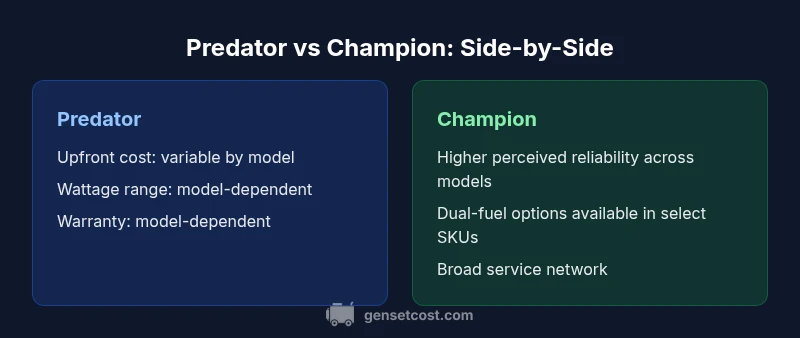
Comparison
| Feature | Predator | Champion |
|---|---|---|
| Typical power range | Model-dependent; compare wattage charts | Model-dependent; compare wattage charts |
| Warranty coverage | Model-dependent; check retailer | Model-dependent; check model |
| Service network & parts availability | Depends on retailer and region | Broad official distributor network (region dependent) |
| Installation complexity | Similar; requires transfer switch and proper ventilation | Similar; requires transfer switch and proper ventilation |
| Upfront cost vs long-term value | Often lower upfront price (model-dependent) | Typically higher upfront but with stronger long-term support |
| Fuel flexibility | Gasoline, some models are dual-fuel in certain markets | Gasoline; some models offer dual-fuel (gas/propane) in select SKUs |
The Good
- Potentially lower upfront cost
- Wide availability of models and sizes
- Good value in entry-level segments
- Faster route to power for budget-conscious buyers
The Bad
- Quality and reliability vary by model
- Warranty terms can be inconsistent
- Service and parts access depend on retailer and region
Champion generally suits reliability-focused buyers; Predator suits cost-conscious shoppers.
If you value long-term reliability and a robust service network, Champion is often the safer choice. If upfront affordability and quick availability drive your decision, Predator can be compelling, provided you choose a model with solid specs and a credible warranty.
People Also Ask
What is the main difference between Predator and Champion generators?
Predator targets budget-focused buyers with lower upfront costs, while Champion emphasizes reliability and a broader service network. The predator generator vs champion decision hinges on your risk tolerance, maintenance willingness, and installation constraints. Always compare model-specific specs rather than brand reputation alone.
Predator is usually cheaper upfront, while Champion emphasizes reliability and service. Check the exact model specs to decide which fits your needs.
Is Predator suitable for home backup?
Yes, for many homes Predator units can provide adequate backup power during outages, especially for light-to-moderate loads. Ensure you match wattage to your essential circuits and plan for proper installation with a transfer switch.
Predator can work for home backup if you pick the right size and install it correctly.
Which is cheaper upfront, Predator or Champion?
Typically, Predator models have a lower upfront price than Champion models. However, you should compare current retailer prices, installation costs, and warranty terms to understand true relative value.
Predator usually costs less upfront, but compare total costs including installation and warranty.
Do both brands offer dual-fuel options?
Many Champion models offer dual-fuel configurations (gasoline and propane) in select SKUs. Predator offerings vary by market and retailer, so check model specs to confirm fuel options.
Champion often has dual-fuel models; check Predator specs for your area.
What installation considerations matter most?
Plan for a transfer switch, proper ventilation, and compliance with local codes. Hire a licensed electrician to ensure a safe, legal installation and to minimize future troubleshooting.
Get a licensed electrician to handle transfer switches and code compliance.
How should I evaluate warranty and service?
Compare length and coverage of parts and labor, plus the availability of service centers in your region. A stronger service network reduces downtime during outages.
Look for solid warranty terms and easy access to service centers.
Key Takeaways
- Assess load needs before selecting a model
- Budget upfront vs long-term reliability balance
- Verify warranty terms and service availability
- Factor installation and transfer-switch costs
- Prioritize model-specific specs over brand reputation