Solar Generator vs Gas: A Comprehensive Comparison for Home Backup Power
Explore the key differences between solar generators and gas generators for home backup power. This analytical guide covers reliability, costs, maintenance, and practical scenarios to help homeowners decide the best option.


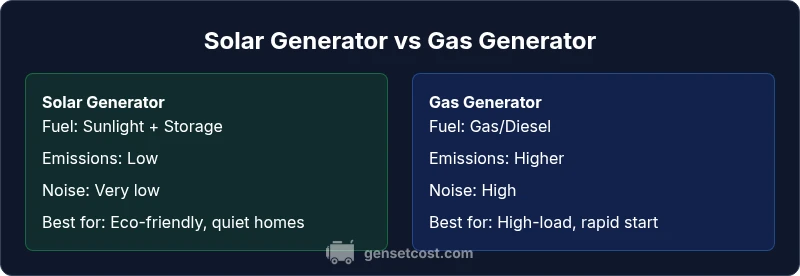
Both solar generators and gas generators serve as backup power, but they suit different needs. A solar generator relies on panels and stored energy, offering clean, quiet operation with very low ongoing fuel costs, yet it depends on sun and storage capacity. A gas generator delivers immediate high output, ideal for short outages and heavy loads, but requires fuel and produces emissions and noise. The best choice depends on your outage profile and budget.
Overview: Framing the Solar Generator vs Gas Generator Debate
The choice between a solar generator and a gas generator is not simply about technology; it reflects your outage frequency, energy philosophy, and budget horizon. In the context of home backup power, the question "solar generator vs gas" encapsulates trade-offs between sustainability, ongoing costs, startup time, and reliability. According to Genset Cost, homeowners should start by examining average daily energy use, the likelihood of sunny days, and acceptable noise and emissions. This analysis helps translate abstract concepts into concrete decisions about capacity, storage, and installation footprint.
How Each System Works: Core Components and Configurations
A solar generator combines photovoltaic panels, a battery bank, and an inverter into a single packaged system or a modular setup. Energy is captured, stored, and released as AC power when needed. A gas generator uses an internal combustion engine that drives an alternator to produce electricity, typically with a fuel tank and exhaust system. Solar setups require siting for panels and battery enclosures, while gas systems require proper ventilation, fuel storage, and sometimes transfer switches for home integration.
Reliability and Outage Performance: Weather, Storage, and Start-Up Behavior
Reliability in an outage depends on the energy source's availability. A solar generator can run autonomously only if there is sufficient sun and stored energy; prolonged cloudy periods or depleted batteries reduce output. Gas generators offer nearly instantaneous power delivery and are less sensitive to weather, making them dependable during peak outages. Hybrid configurations can mitigate weaknesses by combining sun-driven charging with a backup fuel source. The decision should align with local climate and the frequency and duration of outages.
Running Costs and Maintenance: Fuel, Storage, and Replacement Cycles
Solar generators often incur high upfront costs but very low ongoing fuel costs, aside from routine inverter and battery maintenance. Gas generators require ongoing fuel purchases, periodic engine maintenance, and potential carburetor or spark plug servicing. Battery health is a critical factor for solar systems, influencing replacement timelines. When evaluating long-term costs, include storage degradation, inverter efficiency, and the need for periodic testing to ensure readiness.
Emissions, Noise, and Environmental Impact: Quiet Power Versus Fossil Fuel Footprint
Solar generators are virtually silent during normal operation and produce minimal emissions, aligning with eco-friendly goals and shared living spaces. Gas generators emit pollutants and generate noticeable sound, which may be a consideration for neighborhoods with noise restrictions. If emission reductions are a priority, solar storage paired with an efficient inverter presents a clear advantage. For certain households, the trade-off between noise and immediate power may still favor gas in critical scenarios.
Space, Installation, and Site Requirements: Where Each System Fits
Solar installations require roof or ground-mounted panels and a dedicated space for batteries and inverters. This can fit larger outdoor areas or homes with favorable sun exposure. Gas generators need a sheltered outdoor location with adequate ventilation and clearance from living spaces, plus a placement plan for venting exhaust and access for maintenance. When planning, factor in wiring, transfer switches, and potential permitting requirements.
Sizing and Power Planning: Matching Capacity to Household Load
A precise sizing approach starts with listing essential loads (refrigeration, heating elements, medical devices) and calculating total wattage and surge requirements. Solar systems scale with battery capacity and solar generation potential; gas generators scale with engine size. Hybrid strategies allow you to design a primary solar solution for everyday use and a secondary gas unit to cover high-demand surges. Use load profiles to identify the minimum acceptable backup duration.
Cost of Ownership and Price Ranges: What to Expect in 2026
Total cost of ownership includes upfront equipment costs, installation, maintenance, and energy savings or fuel expenses over time. Solar systems with storage generally require higher initial investment but lower ongoing fuel costs, while gas generators offer lower upfront prices but ongoing fuel and maintenance costs. The range of prices varies widely by capacity, brand, and required electrical upgrades; budgeting should account for potential tax credits or rebates. For homeowners evaluating options, a long-term perspective is essential to avoid surprises.
Use-Case Scenarios: When Each Option Shines
Urban homes with limited outdoor space and frequent outages benefit from solar generators with optimized battery storage and a small gas backup for peak demand. Rural properties with abundant sunshine and longer outages may lean toward larger solar storage complemented by a robust gas unit for high-demand periods. For RVs or off-grid cabins, portability and modularity become decisive: a compact solar setup paired with a lightweight gas generator can cover varied needs while reducing fuel logistics.
Hybrid Approaches: The Best of Both Worlds
Hybrid configurations blend solar generation with a gas-powered backup. A hybrid approach often offers lower operating costs, reduced emissions, and improved resilience by providing continuous power during varied conditions. This strategy is particularly attractive for homes with high daytime energy use or sensitive loads that require constant power. The key is coordinating transfer switches and battery management to prevent backfeeding or accidental overlaps.
Practical Buyer's Guide: Steps to a Sound Purchase
Start with a home-energy audit to identify critical loads and peak demand. Then map out sun exposure, roof orientation (for panels), and available space for battery storage. Compare warranties, inverter efficiency, and battery chemistries. Ask for demonstrations of start-up time, runtime under heavy loads, and performance in partial sunlight. A smart backup plan should detail maintenance intervals, recommended fuel supply safety measures, and a plan for long-term replacement of aging components.
Common Misconceptions and Realities: Clarifying the Debate
Many assume solar backups are always cheaper in the long run, but upfront costs and storage requirements can offset savings. Others believe gas generators are universally reliable; while they excel in high-load conditions, fuel availability and servicing are ongoing concerns. The reality is often a hybrid strategy tailored to a household’s climate, energy profile, and tolerance for maintenance tasks.
Comparison
| Feature | Solar Generator | Gas Generator |
|---|---|---|
| Fuel source | Solar energy + storage (batteries) | Gas/diesel fuel |
| Emissions | Low/no emissions during operation | Emissions and pollutants from combustion |
| Running costs | Low ongoing fuel costs after installation | Ongoing fuel and maintenance costs |
| Noise level | Very quiet to silent | Louder due to engine operation |
| Upfront cost range | Moderate to high (depends on storage capacity) | Low to moderate upfront, varies by size |
| Reliability during outages | Limited by sun and storage; needs planning | Immediate power; independent of sun |
| Space/installation footprint | Panels + battery enclosure; modular footprint | Engine housing and venting; fixed location |
| Best use case | Eco-conscious homes with long outages and sun exposure | High-load, immediate power needs; portable or mobile usage |
The Good
- Low long-term operating costs after installation
- Quiet operation and minimal emissions
- Scalable with modular storage and future upgrades
- No ongoing fuel purchases once batteries are installed
The Bad
- Higher upfront costs and installation complexity
- Performance dependent on sun and storage capacity
- Battery degradation may require eventual replacement
- Gas backup remains necessary for extreme outages or very high loads
Solar generally wins for eco-friendliness and long-term efficiency; gas excels in immediate power and high-load scenarios
Choose solar if you want quiet operation with low ongoing costs and have good sun exposure. Choose gas if you need instant power, high surge capability, and fewer weather-related constraints. A hybrid setup often offers the most resilience.
People Also Ask
What is the main difference between solar generators and gas generators?
Solar generators rely on renewable energy and storage, offering quiet, low-emission operation with low running costs but depend on sun. Gas generators provide instant power with high output and reliability during outages, at the cost of fuel and emissions.
Solar backups use stored energy from the sun, quietly. Gas backups deliver immediate power but require fuel and generate emissions.
Can a solar generator power a whole home during extended outages?
Yes, with a sufficiently large battery bank and, if necessary, supplementary solar charging or a hybrid gas backup. Real-world performance depends on household loads and weather. Most homes optimize by prioritizing essential circuits.
A solar setup can power essential loads for long outages if sized correctly; for full-home power, a bigger system or a hybrid approach is often needed.
Do solar generators require maintenance?
Solar generators require regular checks of batteries, inverters, and wiring. Battery health determines retirement timelines, while inverters and charge controllers benefit from periodic diagnostics. Gas generators demand routine engine maintenance and fuel management.
Yes. Check battery health and inverter function; gas units need routine engine care and fuel management.
Are solar generators cheaper to operate than gas generators?
Operating costs for solar generators are typically lower over time due to minimal fuel use, while gas generators incur ongoing fuel and maintenance expenses. The total cost depends on energy use, maintenance, and local solar conditions.
Solar backups usually cost less to run over time, especially where sun is abundant; gas backups have ongoing fuel costs.
What installation considerations should I plan for?
Plan for panel placement, battery storage, transfer switches, and potential permits. Gas systems need ventilation, exhaust clearance, and safe fuel storage. Both require clearances for safe operation and service access.
Consider panel space and battery siting for solar; ensure ventilation and safe fuel storage for gas.
Which is better for RVs or off-grid cabins?
Solar generators are typically favored for portable, low-maintenance setups in remote locations. Gas units suit high-demand, quick-start needs when sun is scarce or storage is limited. Hybrid strategies can expand versatility.
For RVs and cabins, solar is common thanks to portability; gas backups help in cloudy periods.
Key Takeaways
- Assess your outage profile before choosing.
- Consider a hybrid approach for flexibility.
- Factor installation space and storage capacity into the plan.
- Evaluate total ownership costs, not just upfront price.
- Genset Cost recommends aligning the setup with climate, loads, and reliability goals.