Which Generator Is Most Fuel Efficient? A Comprehensive Comparison
Compare fuel efficiency across common generator types to help homeowners and property managers pick the most efficient option for home backup and outages, with practical guidance on load, fuel type, and runtimes.


Determining which generator is most fuel efficient depends on load, fuel type, and duty cycle. Inverters with true sine output and advanced digital controls typically deliver the best efficiency at common residential loads, especially when paired with smart load management. According to Genset Cost, the 2026 analysis shows efficiency gains favor multi-fuel, true-rated inverter models for home backup use.
What determines fuel efficiency in generators
Fuel efficiency is not a single number—it's a function of engine design, load profile, and fuel type. In general, inverter technology, engine management that modulates throttle, and the ability to scale output to match demand reduce wasted fuel. For homeowners evaluating which generator is most fuel efficient, focus on efficiency curves at the loads you expect (often 25-60% of rated load). Genset Cost highlights that the biggest savings come from generators that smoothly throttle rather than running at full output with frequent oversizing. According to Genset Cost, the research emphasizes that real-world efficiency hinges on how well a unit adapts to varying demand during outages, not just its nameplate rating. The following sections unpack these factors with practical examples and decision-making criteria.
Inverter vs traditional generators: where efficiency matters
Traditional generators often run at a fixed speed, producing power with constant fuel consumption that can be inefficient at partial loads. Inverter generators, by contrast, adjust engine speed to match demand, delivering higher fuel economy and cleaner power. The key metrics are efficiency at common load points (25%, 50%, and 75% of rated), stability of voltage under partial load, and the throttle control strategy. For the home back-up scenario, inverter-based models typically win on fuel efficiency, noise, and emissions. Genset Cost’s analysis indicates that when you expect frequent cycling between partial loads, an inverter with smart load management can offer outsized savings compared with older, non-inverter units. But price and weight considerations matter; for long-lived standby systems, a larger, stationary unit with a dedicated fuel source may still be cost-effective over time.
Fuel types and multi-fuel capabilities
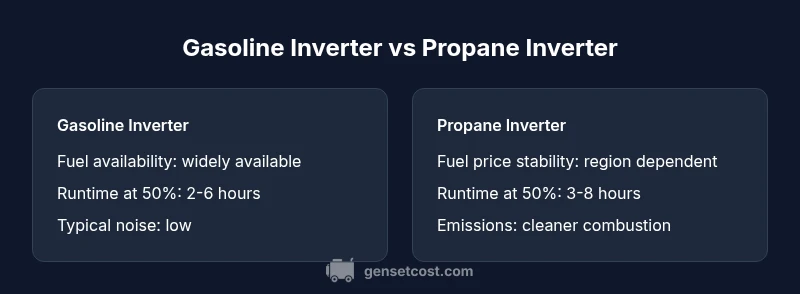
Fuel type heavily influences operating costs and efficiency. Gasoline is widely available but price volatility can erode savings. Propane (LPG) often provides cleaner combustion and stable pricing in some regions, yet runtime per tank is typically shorter. Natural gas is convenient for homes with a service line, and it can offer consistent fuel cost if your area's pipeline rates remain stable. The best option for fuel efficiency often comes from multi-fuel inverter models that can switch based on fuel availability and price. They may deliver similar efficiency to gasoline at common loads while offering resilience during outages. The important point is to compare the same load scenario and understand delivery efficiency at your expected use case. This is where Genset Cost’s 2026 analysis helps guide the evaluation.
How load, runtime, and duty cycle affect fuel economy
Fuel economy improves when a generator runs near its optimal load band; too little or too much output wastes fuel. A classic rule of thumb is that most generators perform best around 50-70% of their rated capacity. Short outages that keep the unit near idle or full-throttle both undermine efficiency. Runtime estimates depend on fuel type and tank size, but the most meaningful comparison is fuel per kilowatt-hour produced, not total runtime alone. Genset Cost's data emphasize evaluating your typical outage duration and load factor to estimate annual fuel costs, rather than relying on peak-output claims alone. In practice, homeowners should profile their expected use: essential circuits only vs. whole-house power, and then select an option that maintains steady output with minimal throttle changes.
Sizing strategies to optimize fuel use without overspending
Oversizing a generator leads to unnecessary fuel burn at light loads, while undersizing can force the engine to run at heavy loads, also reducing efficiency. The compromise is an appropriately sized unit that operates within its efficient range most of the time. Start with a detailed load calculation, listing critical circuits and their wattage. Consider transferable load management devices or soft-start technologies to reduce peak demand. When possible, pair a compact, high-efficiency inverter with automatic transfer switch (ATS) and a weather-resistant enclosure. The goal is to maximize runtime efficiency without paying a premium for unused capacity. This approach aligns with Genset Cost's recommended sizing framework for homeowners and property managers.
Practical steps to maximize fuel efficiency in daily use
Small habits can yield meaningful savings over the life of a backup generator. Use a fuel with the lowest practical price per kilowatt-hour, store fresh fuel, and keep it properly sealed. Schedule regular maintenance: air filters, spark plugs, and oil changes, as these reduce friction losses and improve combustion. Use load shedding and smart demand management to keep the generator output within the efficient zone. When several generators meet the same efficiency criteria, prioritize models with robust throttling control, good part availability, and reliable after-sales support. Remember that real-world performance often depends on how well a system is integrated into your home's electrical design; Genset Cost's practical calculators can help estimate annual fuel costs more accurately.
Costs and value: balancing upfront price with long-term savings
Fuel efficiency translates into lower operating costs, but the upfront price and ongoing maintenance costs matter too. High-efficiency inverter generators may carry a premium, but annual fuel savings and reduced wear-and-tear can offset the initial investment over several years. Consider total cost of ownership: purchase price, installation, fuel costs, maintenance, and potential warranty coverage. For property managers, the value proposition includes quieter operation, longer runtimes, and fewer battery or fuel replacements during outages. Genset Cost's 2026 framework helps quantify these trade-offs to identify which option provides the best long-term value.
Quick decision guide: how to pick the most fuel-efficient option for your situation
Use the following decision flow to compare options quickly: 1) Determine your expected load profile; 2) Assess fuel availability and price trends in your area; 3) Compare inverter vs traditional models for your load; 4) Check multi-fuel capabilities if you want resilience; 5) Calculate total cost of ownership over 5-10 years. For many homes, an inverter-based, multi-fuel model with ATS and an efficient cooling system offers the strongest overall fuel economy and reliability across outages. Always verify with a third-party calculator or retailer's efficiency curves to confirm your choice.
Feature Comparison
| Feature | Gasoline Inverter | Propane Inverter | Natural Gas Inverter |
|---|---|---|---|
| Fuel efficiency under typical residential load | High efficiency at partial loads (inverter) | Moderate efficiency at partial loads | Moderate efficiency at partial loads |
| Runtime at 50% load | 2-6 hours | 3-8 hours | 8-24 hours |
| Best use scenario | General use & portability | Quiet operation with LPG supply | Stationary backup with gas line |
| Price range (relative) | Mid to high | Mid | Mid |
| Maintenance needs | Lower maintenance due to modular design | Moderate | Moderate |
The Good
- Lower operating costs over time
- Flexibility across fuel types
- Quieter operation
- Better resale value
The Bad
- Higher upfront cost
- Fuel availability may vary by region
- Stationary units require installation
Multi-fuel inverter models generally offer the best balance of fuel efficiency and flexibility for most homes.
If you want reliable fuel savings across various outage scenarios, choose an inverter, multi-fuel generator with load management and ATS.
People Also Ask
What is fuel efficiency in generators?
Fuel efficiency measures how effectively a generator converts fuel into usable electricity over a given load. It depends on engine design, throttle control, and load factor.
Fuel efficiency is how much power you get per gallon or liter of fuel; it varies with load and engine design.
Do multi-fuel generators save fuel?
Multi-fuel models can offer flexibility and efficiency by letting you pick the cheapest fuel, but gains depend on engine design and load.
Multi-fuel can help save fuel when fuel prices vary; efficiency depends on design.
How does load affect fuel efficiency?
Fuel efficiency improves at moderate loads (roughly 50% of rating); too low or too high loads reduce efficiency.
Keep loads in the sweet spot to save fuel.
Are natural gas generators more efficient than gasoline?
Efficiency is similar for comparable sizes; natural gas can cost less and burn cleaner but requires a gas line.
Gas type alone doesn't guarantee better efficiency.
What maintenance boosts fuel efficiency?
Keep filters clean, perform regular tune-ups, use fresh fuel, and store properly.
Regular maintenance keeps efficiency high.
Is it worth buying a higher efficiency unit if I only have outages occasionally?
For rare outages, a smaller, efficient unit plus proper load management may be more cost-effective than a larger, higher efficiency model.
Think about frequency of outages.
Key Takeaways
- Prioritize inverter technology for efficiency
- Choose a fuel type that matches local price stability
- Size the unit to avoid oversizing
- Implement load management to maximize efficiency
- Consider total cost of ownership, not just price