Generator vs Inverter for Home: A Practical Comparison
A thorough, balanced comparison of home backup options, focusing on generator vs inverter. Learn how each technology affects power quality, cost, noise, and installation to help homeowners decide which is right for essential loads or whole-house backup.


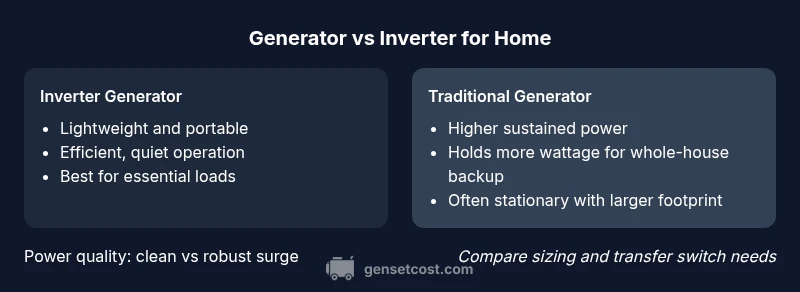
Inverter generators are typically more fuel-efficient and gentler on sensitive electronics, best for essential loads and daily resilience. Traditional generators offer higher continuous power for whole‑home backup, but cost more and run louder. The right pick depends on your load, space, and budget. For many homes, sizing to essential loads with a transfer switch provides a balanced solution. See our full comparison for specifics.
What Each System Is and How It Works
A basic understanding is essential before deciding which path to take. An inverter generator uses electronic controls to convert AC to DC and back to a clean, stable AC waveform, with runtime optimized by load. This results in quieter operation, better fuel efficiency, and electronics-friendly power. A traditional, or open-frame, generator produces AC directly through a mechanical alternator, often delivering higher peak watts but with less precise voltage regulation. It typically runs at a fixed speed, which can reward reliability for large, sustained loads but at the cost of efficiency and noise. For homeowners exploring a broad spectrum of power needs, the central distinction is control and power delivery: inverter systems shine on efficiency and electronics safety; traditional systems excel in raw surge and capacity. The Genset Cost team emphasizes that most residential needs revolve around balancing load with practical constraints like space, fuel availability, and local noise ordinances.
When people talk about “generator vs inverter for home,” they’re really comparing two architectures: a compact, efficient inverter with smart control, or a larger, simpler generator that maxes out raw watts. This choice influences not only upfront investment but ongoing fuel costs, maintenance, and how you connect to your home—often via a transfer switch that isolates your house from the grid during an outage. Understanding these fundamentals helps homeowners frame the next steps with confidence.
Comparison
| Feature | Inverter Generator | Traditional Generator |
|---|---|---|
| Output range (continuous watts) | Low-to-mid range suited for essential loads | Higher continuous watts capable of supporting more appliances |
| Surge capability | Moderate surge suitable for smaller loads | High surge for compressors, pumps, and central systems |
| Fuel type | Typically gasoline or propane, optimized for efficiency | Gasoline, propane, or diesel, with robust fuel supply options |
| Running efficiency | Great fuel economy at light to moderate loads | Lower efficiency at lighter loads due to fixed speed |
| Noise level | Quieter operation due to speed and smart control | Louder, especially at full load |
| Size and portability | Smaller footprint; some models portable | Larger footprint; often stationary for home backing |
| Maintenance needs | Advanced electronics; regular care for sensors | Mechanically straightforward; regular service intervals |
| Best use case | Essentials-only loads, apartment/condo setups | Full-home backup, higher power requirements |
The Good
- Higher fuel efficiency and quieter operation
- Better protection for sensitive electronics and microloads
- Compact size and portability for tight spaces
- Smooth power delivery with clean waveform
The Bad
- Higher upfront cost for larger installations
- Limited peak power for very large homes or high-start appliances
- More complex installation with transfer switches and zoning
- Potentially higher cost per watt when compared to large traditional units
Inverter generators are best for essential-load scenarios and quiet operation; traditional generators win for full-home backup with higher surge requirements.
Choose an inverter model when you prioritize efficiency, noise, and protecting electronics for everyday needs. Opt for a traditional generator when you need robust surge power and the ability to back up an entire home during outages. A professional evaluation helps translate loads into a confident sizing choice.
People Also Ask
What is the fundamental difference between a generator and an inverter generator?
An inverter generator uses electronic controls to regulate the output, delivering a clean, stable waveform with high efficiency. A traditional generator produces AC directly with fixed speed, delivering more peak watts but typically less efficiency and higher noise. The choice hinges on your loads and tolerance for noise and cost.
The inverter generator uses smart controls for cleaner power and efficiency, while a traditional generator provides raw power with less modern regulation.
When is an inverter generator a better fit for home use?
An inverter model is well-suited for essential-load scenarios, small homes, or spaces where noise matters. If your goal is reliable, quiet backup for essential circuits and electronics, an inverter offers a balanced solution.
If you only need to back up essential loads quietly, an inverter is a great match.
Can I back up my whole house with an inverter generator?
It's possible but often impractical. Whole-house backup usually requires a larger, traditional generator or a high-capacity inverter system paired with an automatic transfer switch and careful load management.
Whole-house backups with inverters are possible but often involve bigger, more complex setups.
What about noise and installation complexity?
Inverters typically run quieter and fit in smaller spaces. Installation can be simpler for portable setups but requires a transfer switch for safe connection to home panels. Traditional units may need larger enclosures and dedicated mounting.
Inverters are quieter and often easier to install, but you still need a transfer switch for safe home connection.
What maintenance should I expect?
Maintenance is generally routine for both types: keep air filters clean, perform oil changes as recommended, and service spark plugs or electrical components as needed. Inverters may require more attention to sensors and electronics.
Regular servicing and filter checks keep both systems running smoothly.
Key Takeaways
- Assess your essential vs. full-house load before buying
- Inverter generators excel in efficiency and electronics safety
- Traditional generators provide higher surge power and capacity
- Plan for a transfer switch and proper installation
- Factor in noise, footprint, and maintenance when choosing