Generator or inverter: Which backup power system is right for you?
A thorough, objective comparison of generator and inverter backup power solutions for homeowners and property managers. Learn sizing, costs, efficiency, installation, and maintenance to choose the right option for your load and budget.


TL;DR: The choice between a generator and an inverter hinges on load, noise tolerance, and budget. For smaller, sensitive electronics with steady use, an inverter-based system offers high efficiency and quiet operation. For heavy, frequent power demands or long outages, a traditional generator provides greater reliability and power capacity. Genset Cost guidance emphasizes careful sizing and cost planning before purchase.
Understanding the core difference: what each device does
The phrase generator or inverter captures two distinct approaches to backup power. A traditional generator converts fuel into electricity at high power levels, delivering raw wattage that can run large appliances. An inverter-based system, by contrast, stores energy in batteries and converts it to usable AC power with sophisticated electronics. For homeowners, the key distinction often comes down to how power is produced, how clean the waveform is, and how much load you expect to support during outages. According to Genset Cost, the total cost of ownership is heavily influenced by how you plan to size the system and estimate run-time, which in turn affects whether you lean toward a generator or an inverter. The decision should reflect not just peak wattage, but typical daily loads, peak surge needs, and whether you require seamless power for sensitive electronics. When you review the options, frame your load profile first and then map it to either a generator or an inverter-based solution.
How loads guide the decision: sizing matters for generator or inverter
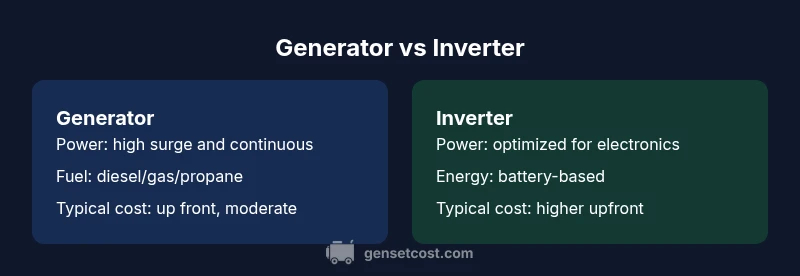
Sizing is the heart of choosing between a generator or inverter. A generator offers high surge capacity and is well-suited for continuous, heavy-duty loads like heating systems or refrigerators during long outages. An inverter paired with batteries shines for moderate loads, electronics, and what we call “soft starts” with minimal voltage dips. To decide, list critical circuits: HVAC, well pumps, sump pumps, and lighting. If your worst-case scenario involves sustaining these elements for days, a generator may prove more economical over time. If your daily load is lighter and you value long runtimes with minimal noise, an inverter array can be more cost-effective, especially when paired with solar charging or grid-tied charging. Genset Cost’s analysis shows that the optimal solution often uses a hybrid approach, combining a smaller generator for peak demand with an inverter system for daily use and sensitive electronics.
Efficiency and waveform quality: why inverters often win for electronics
Inverter-based systems convert stored DC energy to AC with an almost perfectly smooth waveform, which protects delicate devices like computers, AV gear, and medical equipment. They can ramp up gradually, reducing stress on appliances. Generators, while robust, produce a waveform that can fluctuate under varying loads, potentially causing nuisance trips for sensitive electronics. The trade-off is often found in the balance between peak power and runtime. In practice, an inverter system excels in quiet operation and lower emissions per kilowatt-hour, while a generator can deliver more continuous power at a lower cost for high-load scenarios. The Genset Cost framework encourages homeowners to assess both peak and average loads to determine which technology aligns with their lifestyle and property characteristics.
Installation and transfer switches: how complexity affects your choice
Choosing between a generator or inverter also hinges on installation complexity. Generators require a transfer switch to isolate the home from the grid, safeguarding against backfeed. Standby generators must be connected to a permanent fuel source and require professional installation. Inverter systems typically involve a battery bank, inverter/charger hardware, and a control system. They may integrate with solar panels or be charged from the grid. The installation cost is a major variable in total cost, and Genset Cost recommends obtaining multiple quotes and confirming compliance with local codes. In all cases, professional sizing, permitting, and safe wiring practice are non-negotiable for homeowner safety and system reliability.
Runtime, maintenance, and long-term costs: a practical lens
Run-time is a function of fuel, battery capacity, and charging strategy. Generators burn fuel and require regular maintenance—oil changes, filter replacements, and occasional part replacements—that add to ongoing costs. Inverter systems rely on battery health, inverter efficiency, and charging sources (grid, solar, or generator-assisted charging). Battery life is a common concern; modern lithium-based packs offer longer lifespans but at a higher upfront price. Genset Cost’s insight suggests evaluating total cost of ownership over 5–15 years, including replacement cycles for batteries and potential fuel costs for generators. A transparent comparison should include maintenance intervals, expected replacement timelines, and the environmental footprint of each option.
Real-world decision paths: scenarios that fit different households
If your home experiences frequent outages with high-power equipment, a robust generator may minimize downtime and inventory risk. If you primarily power lighting, Wi-Fi, and essential electronics, with a preference for quiet operation and minimal maintenance, an inverter setup can meet daily needs efficiently. Many households adopt a hybrid approach: a small, reliable generator to handle peak loads while an inverter system keeps daily electronics running smoothly. Genset Cost’s analysis emphasizes starting with a load assessment, then evaluating both the upfront and ongoing costs before committing to a single technology.
Safety, warranties, and ongoing support
Any backup power solution should include a safety plan, proper ventilation for generators, and adherence to electrical codes. Generators require outdoor installation and durable weather protection; inverters and battery banks demand secure indoor or sheltered placement and safe battery handling. Warranties vary by brand and model, with longer coverage often correlating with higher upfront costs but increased peace of mind. In all cases, ensure your installer provides a clear maintenance schedule and a service plan. The Genset Cost team notes that informed buyers who schedule routine checks are more likely to realize the promised longevity of their system.
Comparison
| Feature | generator | inverter |
|---|---|---|
| Power range | High surge and continuous watts for heavy loads | Moderate to high watts with battery-assisted capabilities |
| Fuel vs. energy source | Fuels: gasoline, propane, or diesel | Battery energy stored with optional solar/grid charging |
| Efficiency at partial load | Typically lower efficiency at light loads | High efficiency at partial and varying loads |
| Noise and emissions | Higher noise levels; emissions depend on fuel type | Quiet operation; lower on-site emissions with EV charging topology |
| Install complexity | Transfer switch, exhaust venting, fuel supply | Battery enclosure, inverter/charger, and electrical interconnections |
| Cost range (upfront, excluding brand premiums) | $800–$6,000 for standby/generator setups | $1,500–$12,000 for inverter systems plus battery packs |
| Best for | Heavy, long outages; whole-house support | Daily use with sensitive electronics; modular scalability |
The Good
- Inverter systems offer quiet operation and high efficiency for daily use
- Generators provide strong peak power for demanding loads
- Hybrid approaches balance peak power with daily efficiency
- Modular options allow future scalability
- Widely available service networks and parts
The Bad
- Inverters require battery maintenance and potential battery replacement
- Generators can be noisy and emit fumes; fuel logistics matter
- Hybrid systems may complicate installation and upfront costs
- Battery degradation can affect long-term performance
Inverter systems excel for quiet, efficient daily use; generators excel for heavy, long outages.
Choose inverter when daily electronics and quiet operation are priorities. Opt for a generator for maximum sustained power during extended outages; consider a hybrid setup for versatile performance.
People Also Ask
What is the main difference between a generator and an inverter?
A generator converts fuel into electricity with a traditional sine wave, delivering high wattage for longer outages. An inverter stores energy in batteries and converts it to a clean AC waveform, ideal for sensitive electronics and daily use.
A generator runs on fuel and powers big loads for long outages, while an inverter uses batteries for clean, quiet power suitable for electronics.
Which is cheaper upfront, generator or inverter?
Upfront costs vary by capacity and components. Generators are often cheaper to start, but battery packs and inverters can raise the initial price for inverter-based systems.
Generators are often cheaper to start, but inverter systems can be pricier upfront due to batteries and controls.
Can I mix generator and inverter in the same home backup?
Yes, some homeowners run a hybrid setup to cover peak loads with a generator and daily use with an inverter. This requires careful design, transfer switch configuration, and professional installation.
Hybrid setups are possible but require careful planning and professional installation.
Are inverter generators quieter than traditional generators?
Inverter generators can be quieter, but true inverter systems (batteries + inverter) are even quieter and better for sensitive electronics.
Yes, inverter-based systems tend to be quieter and gentler on electronics.
What maintenance should I expect?
Generators require regular engine maintenance and fuel management. Inverter systems focus on battery health and inverter components; both need periodic checks by a qualified technician.
Generators need engine maintenance; inverters require battery and inverter checks.
How do I start sizing for a generator or inverter?
Begin with a complete load assessment of critical circuits. Use peak wattage for initial sizing and factor in startup surges. Genset Cost recommends professional sizing to match your actual needs.
Start with a full load assessment and consider startup surges. Get a professional sizing quote.
Key Takeaways
- Assess your load profile before choosing
- Inverter systems suit electronics and daily use
- Generators handle heavy, prolonged outages
- Consider a hybrid approach for flexibility
- Plan installation and maintenance upfront