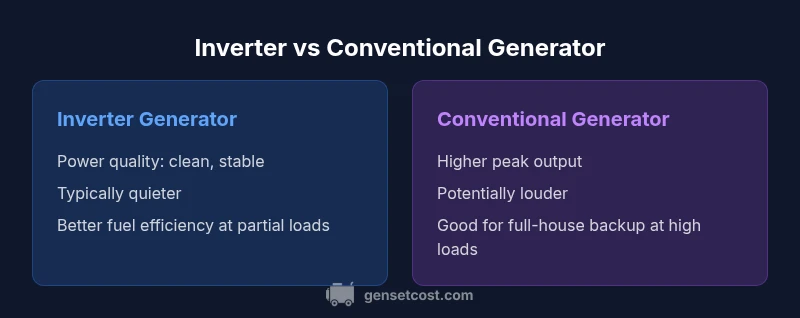
Generator Inverter vs Regular: A Clear Home Backup Guide
Compare generator inverter vs regular units with a practical, data-backed guide for homeowners and property managers evaluating backup power options, costs, performance, and safety.


According to Genset Cost, inverter-based generators deliver clean power and efficient fuel use, while conventional (regular) generators emphasize raw horsepower for big loads. The choice hinges on load size, runtime needs, and budget. This comparison explains when an inverter unit makes sense for home backup and when a traditional generator is more suitable for whole-house support.
Understanding generator inverter vs regular: Core concepts
The term generator inverter vs regular refers to two broad approaches to producing backup electricity: inverter generators, which use electronics to regulate output, and traditional standby or portable generators, which rely on a direct engine-to-alternator setup. For homeowners and property managers evaluating Genset Cost options, the distinction matters because it affects power quality, runtime efficiency, noise, and how the unit integrates with transfer switches and household circuits. In everyday terms, inverter generators are designed to produce a clean, consistent sine wave even as engine speed fluctuates, while conventional units may throttle engine speed more aggressively to meet demand. This difference drives compatibility with sensitive electronics, fuel use patterns, and long-term maintenance costs. The ultimate goal is reliable power without overpaying for watts you do not need. According to Genset Cost, your choice should align with expected load profiles and installation constraints.
How inverters work compared to traditional alternators
Inverter generators pair an engine with a computerized control system and a high-efficiency alternator. The engine drives an alternator that produces AC power, which is then converted to DC and re-inverted to a stable AC waveform. This two-stage process allows the system to adjust engine speed to match demand, reducing fuel use and heat. Traditional standby generators run at a fixed speed and modulate output by switching the engine on and off or by crude governor control. The result is a sometimes variable power quality that can fluctuate under partial load. In real-world terms, inverter designs tend to feel smoother in operation and are less likely to trip sensitive electronics like computers, TV sets, and HVAC controls.
Key performance metrics: power quality, efficiency, and THD
Power quality refers to how clean the electricity is, particularly how close the waveform stays to a pure sine wave. Inverter systems are engineered to deliver near-ideal sine waves with low total harmonic distortion (THD), even as you step through loads. Conventional generators are adequate for simple appliances but can experience voltage dips when many devices start at once. Efficiency gains for inverter units come from intelligent engine control, variable-speed operation, and better idle management. When selecting, homeowners should consider how often loads fluctuate, since the efficiency advantage grows with partial-load use.
Sizing your home backup: watts, starting watts, and load profiles
Choosing the right size means distinguishing running watts from starting watts and mapping typical daily load. Inverter generators excel at mid-range, fluctuating loads—think refrigerators, lights, routers, a few small tools—while larger features like well pumps or central air conditioning may push an inverter to its higher end. Conventional units can push tens of kilowatts and are commonly used for full-house backup in larger homes or multi-unit properties. The sizing exercise should also account for future expansion, such as adding a sub-panel or smarter energy management. A transfer switch or a whole-house automatic switch is often required for safe, hands-free operation.
Fuel types, consumption, and runtime
Inverter models frequently use gasoline or propane and are well-suited for frequent start–stop operation due to efficient fuel use at partial loads. Conventional generators may run on gasoline, diesel, or propane, depending on model, and can deliver long runtimes at steady loads, but their efficiency is more sensitive to load swings. The fuel choice influences running costs, maintenance intervals, and emissions. For property managers, fuel availability and delivery logistics matter, especially during outages when storage and refueling windows influence how long backup power can be maintained.
Noise, emissions, and user comfort
One of the most immediate differentiators is noise. Inverter generators typically operate more quietly due to speed modulation and compact design; many residents notice a softer hum rather than a loud rumble. Conventional units are often louder, especially when working near their rated capacity. Emissions profiles align with fuel type and engine design; reputable models adhere to current standards, but the practical effect is a quieter, less intrusive backup option with an inverter. For apartment buildings or neighborhoods with noise restrictions, inverter units usually offer a clear advantage.
Budget and total cost of ownership
Upfront cost per watt tends to be higher for inverter generators, reflecting the electronics and premium components. Conventional generators may offer lower initial purchase prices for the same wattage but sometimes require additional investment in transfer switches, weatherproof enclosures, and maintenance. Over time, the fuel efficiency and longer runtimes of inverter models can reduce operating costs, which matters for frequent outages. When evaluating cost, consider maintenance, warranty terms, and potential repair expenses, not just sticker price.
Safety features and installation considerations
Safety is central to generator selection. Inverter and conventional units both require proper grounding, carbon monoxide detectors, and secure mounting for outdoor installations. Automatic transfer switches (ATS) and manual transfer switches are critical for safe operation with the home electrical system. Inverter units often pair with dedicated sub-panels for critical circuits; conventional standby systems may include integrated enclosures and more robust weatherproofing. A licensed electrician should evaluate site requirements, venting, clearance, and compliance with local codes.
Practical scenarios: small loads, partial-home, whole-house
For a condo or small home with essential circuits only (refrigerator, router, lights), an inverter generator in the 2- to 5-kW range is typically sufficient, offering quiet operation and good efficiency. For partial-home backup (one or two rooms plus fridge and HVAC controls), an inverter model near 6-10 kW can balance performance and noise. For full-home backup at large properties, a conventional standby system in the 10+ kW range with an ATS may be more appropriate. Consider hybrid solutions that combine an inverter for daily use with a larger standby for outages.
Maintenance and longevity: what to expect
Regular maintenance extends life for any generator. Inverter units require routine checks of the electronics, cooling system, spark plugs, oil changes, and fuel stabilization if gasoline is stored; they are typically robust but can be more sensitive to prolonged stalling if not exercised. Conventional generators demand similar routine care but may benefit from a more straightforward mechanical maintenance schedule. Keeping an outage-specific maintenance plan with a qualified technician helps ensure reliable operation and compliance with warranty terms.
Common myths and misconceptions
Many shoppers assume inverter generators are fragile or unreliable; in reality, the electronics are proven and durable when properly manufactured. Others believe bigger wattage always equals better performance; size must match your actual load and generator type. A frequent myth is that conventional units always start automatically during an outage; many setups require an ATS or manual activation. Separate maintenance costs are often overlooked.
How to choose: a decision framework
Start by listing essential loads and their loads, then determine whether you need clean power for electronics. If you frequently experience outages with modest loads, a well-mated inverter with appropriate surge capacity often yields the best balance of cost and comfort. For heavier loads or whole-house backup, a conventional standby system paired with an ATS is a proven approach. Finally, factor in installation constraints, space, and fuel availability, and consult a qualified installer.
Future trends and warranties: reading the small print
Manufacturers are incorporating smarter controls, remote monitoring, and longer warranties, which can improve peace of mind for property managers and homeowners. When reading warranty terms, understand what is covered for electronics vs mechanical components, and whether maintenance is included. Consider service networks and parts availability, as these influence total cost of ownership and downtime during service.
Comparison
| Feature | Inverter Generator | Conventional Generator |
|---|---|---|
| Power output range | Mid-to-small loads (hundreds to a few thousand watts) | High continuous output (tens of kilowatts) |
| Power quality / THD | Near-ideal sine wave with low THD under varying loads | Adequate power but potential variability at partial loads |
| Fuel efficiency | High efficiency at partial loads due to variable-speed operation | Steady fuel use with less efficiency gains at light loads |
| Noise level | Quieter operation due to speed modulation | Typically louder, especially under high load |
| Weight/portability | Lighter and portable designs | Heavier, often designed for stationary installation |
| Initial cost | Higher upfront per watt due to electronics | Lower upfront per watt for basic wattage |
| Best use case | Essentials and electronics-friendly loads, portability | Whole-house backup and high-load scenarios |
The Good
- Better fuel efficiency at partial loads
- Quieter operation suitable for residential use
- Cleaner power for electronics and appliances
- Longer-term operating cost savings
The Bad
- Higher upfront cost per watt
- Limited high-end peak output for very large loads
- More complex maintenance due to electronics
Inverter generators are generally the better choice for most homes and small businesses seeking quiet, efficient backup power.
They deliver clean power with better fuel efficiency and are ideal for essential circuits. Conventional generators remain preferable for full-house, high-load scenarios; choose based on actual load and space.
People Also Ask
What is the main difference between generator inverter and regular generators?
The main difference lies in how they regulate output. Inverter generators use electronic controls to maintain a clean sine wave and adapt engine speed, while regular generators run at a fixed speed and adjust output by gating fuel or alternator settings.
The inverter uses electronics for a stable, clean sine wave; traditional generators run at a fixed speed and adjust output more simply.
Are inverter generators better for sensitive electronics?
Yes, inverter generators are generally better for sensitive devices because they maintain a stable voltage and low THD. This reduces the risk of data loss or damage to computers and TVs compared with some traditional generators.
Yes. Inverter generators typically provide cleaner power, which is gentler on sensitive electronics.
Do conventional generators provide more power for full-house back-up?
Conventional generators can deliver higher continuous wattage, which is useful for powering an entire home during outages. However, your actual needs and the transfer-switch setup determine whether they’re the right choice.
Yes, conventional units often deliver higher watts for full-house backup, depending on load and wiring.
What size do I need for a typical home?
Load calculation is essential. Start with essential circuits, and then add expected discretionary loads. If you expect to power HVAC or water pumps, you may need a larger system. Consult a professional to size the system safely.
Size depends on your essential loads; a professional can help determine the exact wattage you need.
Are inverter generators more expensive to maintain?
Maintenance costs depend on usage and model. Inverter units include electronic components that require care, but overall maintenance is comparable to traditional units if you follow the manufacturer's schedule.
Maintenance is similar overall; electronics may need occasional checks, but regular service keeps both types running.
Is it true that inverter generators are only for camping?
Not at all. Inverter generators are widely used for home backup, offices, and job sites due to efficiency and power quality, while camping units that are small and portable also exist. Choose according to your load and space.
Inverter generators aren’t just for camping—their efficiency and clean power suit home and work use too.
How loud are inverter vs conventional generators?
In general, inverter models run quieter at typical loads thanks to variable-speed operation; conventional units can be louder, especially under heavy load.
Inverter units are usually quieter, especially at partial loads.
Key Takeaways
- Ask for essential-load first to determine size
- Inverter units excel for electronics and quiet operation
- Conventional units suit full-house backup and high-load needs
- Plan for a transfer switch to safely connect to home circuits