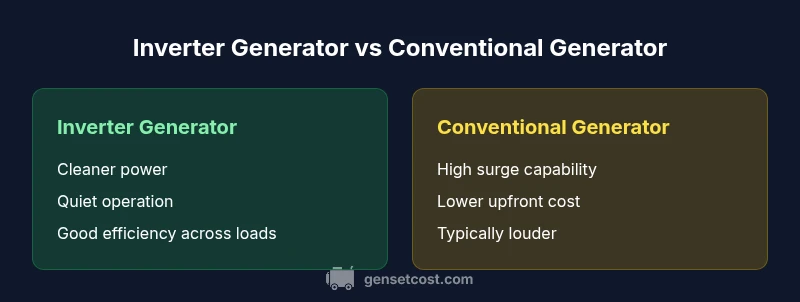
Inverter Generator vs Generator: Side-by-Side Comparison
Compare inverter generators and traditional generators to determine which is best for home backup power, with guidance on cost, performance, and installation.


According to Genset Cost, inverter generators deliver cleaner power with tighter voltage regulation and better fuel efficiency, while traditional generators provide high surge capacity at a lower upfront price. This quick comparison highlights core differences, typical maintenance needs, and installation considerations to help homeowners choose the right backup solution.
what is an inverter generator vs generator
The term inverter generator refers to a generator style that first converts engine-driven AC output to DC, then uses a small inverter to recreate a clean, stable AC waveform. A traditional, or conventional, generator typically powers an alternator directly at the engine’s fixed speed, producing AC power that can vary with load. In practical terms, inverter models deliver regulated voltage and frequency across a wider load range, while conventional units rely on constant engine speed to maintain output. For homeowners evaluating backup power, the distinction matters for protecting sensitive electronics and managing running costs. The overall question remains: which approach aligns with your loads, budget, and installation constraints? The Genset Cost team emphasizes that proper sizing and a reliable transfer switch are critical regardless of the choice.
How inverter technology shapes performance
Inverter generators use an engine to generate AC, then convert to DC and back to a clean sine wave with a microprocessor-controlled inverter. This permits throttle-based speed control, which means the engine runs at variable RPMs to meet demand rather than always at full speed. The result is smoother voltage, lower noise, and reduced fuel consumption at partial loads. Because the inverter adjusts output to match the actual load, electronics are exposed to steadier power, minimizing spikes that can damage devices. For homeowners, this means safer operation for devices like computers, TVs, and chargers, especially during brownouts or partial-load conditions.
Noise, emissions, and fuel economy implications
Noise and emissions are major differentiators. Inverter models often operate at lower RPMs under typical loads, producing noticeably quieter operation and lower heat buildup. Emissions are generally lower on modern inverter generators due to more efficient combustion and electronic controls. Fuel economy improves as the engine throttles up or down to match demand, translating to longer runtimes between refueling. For a household, this can mean less disturbance during nighttime operation and a smaller environmental footprint, while still delivering adequate power for essential circuits.
Power quality, surge handling, and electronics safety
Power quality refers to how cleanly the generator delivers voltage and frequency. Inverter generators maintain a stable sine wave across a broad load range, which reduces the risk of damaged electronics from voltage sags or spikes. Conventional generators may deliver good power at a steady RPM, but voltage can swing with changes in load, especially when starting inductive loads like compressors or sump pumps. The stronger surge handling of some conventional models can be beneficial for motors that require a brief burst of power, though many modern inverters now offer competitive surge capacity as well. Homeowners should assess their critical electronics, sensitive equipment, and start-up loads to determine which approach minimizes risk at startup.
Sizing and load calculation for home backup
To determine which type suits your home, start with a load assessment. List essential circuits (refrigerator, furnace, sump pump, lights, modem/router) and add their wattage, then compare to the continuous and peak output ratings of the generator. Inverter models excel at running a broad mix of small to moderate loads with excellent efficiency, while traditional generators shine when you need sustained high surge power for larger loads like well pumps or central air systems. A professional sizing calculation, sometimes supported by a transfer switch, helps ensure you don’t under- or over-size the system. The Genset Cost guidance is to err on the side of a little extra capacity for future upgrades and to plan for safe outdoor placement and ventilation.
Cost, value, and total cost of ownership considerations
Inverter generators typically command a higher upfront price than their conventional counterparts, reflecting their advanced electronics and quieter operation. However, the total cost of ownership can be favorable due to better fuel economy, longer maintenance intervals, and longer engine life when operated with proper load. Conventional generators may offer a lower initial price and simpler parts, but they can incur higher running costs over time if used heavily or run at higher RPMs. When evaluating cost, consider not just the sticker price but also fuel consumption, maintenance, potential warranty coverage, and the cost of installation components like automatic transfer switches and proper venting.
Use-case scenarios for residential backup
Small to mid-sized homes with essential-load priorities benefit from inverter generators due to their quiet operation and clean power. If your goal is a whole-house solution with automatic transfer and a heavy emphasis on surge capability, a conventional generator may still fit certain configurations, especially where budget constraints limit upfront expenditure. In many cases, homeowners opt for a hybrid approach: an inverter-based system for daily power needs and a larger conventional unit to handle peak surges for HVAC or well pumps during extreme events. The key is to match the generator’s characteristics to your loads and your tolerance for noise and fuel use, then pair it with a transfer switch that fits your electrical panel.
Installation considerations and safety for home backup installations
Safe installation includes proper siting outdoors with adequate clearance, correct ventilation, and secure mounting. A certified electrician should connect a transfer switch to isolate your home from the grid and auto-start the generator when power is lost. Both inverter and conventional models benefit from efficient air intake and exhaust routing, as well as routine maintenance like oil changes and spark plug checks. When selecting a model, verify compliance with local codes and consider fuel storage safety and accessibility for refueling. For complex setups, a professional consultation is invaluable to prevent back-feed and electrical hazards.
Common myths and misconceptions about inverter vs generator power
Myth: Inverter generators can’t handle large loads. Fact: They can handle sizable total load, but it depends on model rating and load distribution. Myth: Conventional generators are always louder. Fact: High-end conventional models with modern exhaust systems can be quieter than older inverter units. Myth: You must choose one type and stick with it. Fact: Many homes use multiple units to cover diverse loads and budgets, with proper transfer equipment. Myth: All inverters need premium fuel. Fact: Most operate well on standard fuels, but some advanced models perform best with higher-octane or stabilized fuel. Practical truth: Your exact needs, not generalized beliefs, determine the best pairing.
Authority sources
- https://www.energy.gov/
- https://www.epa.gov/
- https://www.osha.gov/
Additional considerations for ongoing reliability
Maintenance schedules, fuel quality, and proper storage practices influence long-term reliability. Even the best inverter or conventional generator benefits from regular testing and periodic service, especially before the Start of Season readiness checks. Genset Cost recommends annual inspections with a qualified technician and a pre-winter readiness tune-up to ensure clean power delivery and safe operation.
Comparison
| Feature | Inverter Generator | Conventional Generator |
|---|---|---|
| Power stability | True sine-wave output across varying loads | Stable at fixed RPM, may vary with load changes |
| Surge capacity | Excellent for electronics due to regulated output | Strong surge at rated RPM; some models excel with motor starts |
| Noise level | Quieter due to variable-speed operation | Often louder, especially under heavy load |
| Fuel efficiency | Higher efficiency at partial load with throttle control | Depends on model; can be less efficient at light loads |
| Weight/portability | Typically lighter and more compact | Tends to be heavier at higher wattages |
| Initial cost | Higher upfront price | Lower upfront price on many models |
The Good
- Cleaner power suitable for electronics
- Quieter operation enhances home life
- Better fuel efficiency at partial loads
- Compact, portable options available
- Smooth power delivery reduces flicker and trips
The Bad
- Higher upfront cost than many conventional models
- Limited peak surge on some entries
- Maintenance can be more complex for electronics
- Service networks may vary by region
Inverter generators win for home backup when quiet operation and electronics safety matter; conventional units win for raw surge power and lower upfront cost.
Choose inverter for electronics safety and daily usability. Choose conventional for maximum peak power and budget constraints; size appropriately and plan with a transfer switch.
People Also Ask
What is the main difference between inverter and conventional generators?
The main difference lies in how power is regulated. Inverter generators convert to DC and re-invert to a clean AC waveform with precise voltage control, even as load changes. Conventional generators produce AC directly at a fixed engine speed, which can result in more voltage fluctuation under varying loads.
Inverter generators regulate power for clean output, while conventional generators rely on fixed engine speed, which can cause more fluctuation under load.
Do inverter generators always cost more upfront than traditional generators?
Not always, but commonly. Inverter models include advanced electronics and quieter operation, which can raise upfront costs. Depending on wattage and features, the price gap can vary, so compare total cost of ownership.
They often cost more upfront because of the advanced parts, but you should compare the full ownership cost.
Can you parallel inverter generators for more power?
Yes, many inverter models are designed to be paralleled with compatible units to increase total available power. Check manufacturer guidance and ensure transfers and wiring are correctly configured by a licensed professional.
Yes, many can be paralleled with matching units for more power, with proper installation.
Is it safe to run electronics on an inverter generator?
Yes. Inverter generators provide a stable, clean sine wave that protects sensitive devices like computers and AV equipment from voltage spikes and power irregularities.
Absolutely—clean power from inverters helps protect sensitive electronics.
What maintenance differences exist between inverter and traditional generators?
Maintenance basics are similar (oil changes, spark plugs, air filters). Inverter models may require more attention to electronic components and regular calibration, while traditional units emphasize carburetor and fuel system upkeep depending on design.
Maintenance is similar, but inverters may need more electronic component checks.
What load sizing rules help ensure reliable backup?
Start with essential circuits and total their wattage, then select a unit with enough continuous and surge capacity to cover those loads with headroom for future needs. A transfer switch simplifies automatic start-up and improves reliability.
Prioritize essential loads and leave room for growth; use a transfer switch for reliability.
Key Takeaways
- Calculate your essential loads before choosing.
- Prioritize inverter models for electronics safety and quiet operation.
- Consider surge needs when selecting a unit.
- Factor in installation costs and transfer switches.
- Review total cost of ownership, not just sticker price.