Generator vs Inverter: Which Is Best for Home Backup Power
A balanced, data-driven comparison of traditional generators and inverter generators to help homeowners decide which is best for backup power, sizing, cost, and maintenance.


Homeowners often face a key choice: generator or inverter which is best for backup power. The quick takeaway is: for whole-house, high-load needs, a conventional generator with a transfer switch is typically more reliable and cost-effective on large fuel tanks; for lighter loads and portability, an inverter generator offers cleaner power and quieter operation. Your load and budget decide.
Why this question matters for homeowners
For anyone planning a home backup strategy, the question of generator or inverter which is best often comes up early. The choice directly affects reliability during outages, total cost of ownership, and how much power you can draw without tripping breakers. According to Genset Cost, today’s market splits into two clear paths: conventional generators that run at a fixed speed to deliver high wattage, and inverter-based units that optimize speed, efficiency, and power quality. The decision should align with your load profile, available fuels, and how much you value quiet operation versus maximum resilience. In many cases, homeowners with modest loads or tighter space benefit from inverter technology, while those needing whole-house support and fast surge capacity may lean toward a traditional gen-set with a transfer switch. As you plan, document your daily and outage loads, room-by-room electricity use, and any critical circuits to determine the most practical route.
How these technologies differ in principle
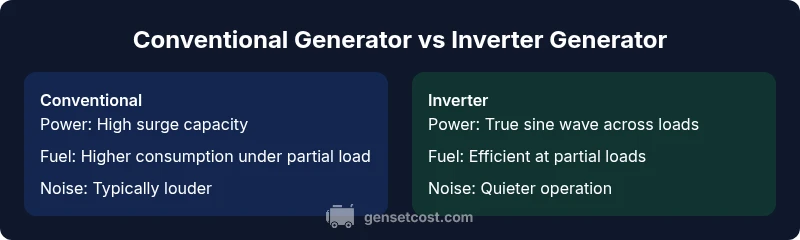
Conventional generators deliver AC power by keeping the engine at a constant speed, typically around 3,600 RPM in the US, which means the electrical output varies with load. Inverter generators, by contrast, use electronic regulation to throttle engine speed and produce a stable, true sine wave at all times. This fundamental difference underpins all the others: fuel use, noise, emissions, and the ability to run sensitive electronics without surge-related spikes. For many households, the inverter approach provides cleaner power and smoother operation at partial loads, while a traditional generator delivers straightforward high-output performance when you need it most. The key takeaway is this: the best choice depends on your expected load pattern and tolerance for both maintenance and upfront investment.
Sizing and load considerations
Sizing is the most critical step in deciding between generator and inverter options. Start by listing essential circuits and calculating peak demand during an outage. A large air conditioner, pumps, and well systems can drive loads well beyond a small inverter unit's capacity. Use a realistic load factor to scale your needs: a 60–70% load factor is a practical target for most backup systems, while occasional surges above 100% require a design that accommodates brief spikes. In practice, homeowners should compare wattage ratings, not just horsepower. Also consider future needs, such as an added sump pump or electric vehicle charging. A well-done sizing assessment reduces the risk of nuisance outages and minimizes wasted fuel. If you are unsure, consult a qualified electrician to produce a load profile and a recommended system size.
Fuel, cost, and efficiency at a glance
Fuel type and economy are central to long-term costs. Conventional generators often burn more fuel at high loads but can deliver higher peak wattage for short durations. Inverter generators optimize efficiency by matching engine speed to demand, which reduces fuel use when loads fluctuate. When assessing cost, look beyond the sticker price. Upfront cost, maintenance, fuel consumption, and the life of the engine influence the total cost of ownership. For homeowners chasing value, the trade-off is clear: a lower upfront cost with higher ongoing fuel use vs a higher upfront cost with potentially lower running costs. Consider also fuel availability and storage space for gasoline or propane.
Reliability, maintenance, and lifecycle
Reliability hinges on build quality, cooling, and the ability to sustain uninterrupted power delivery. Inverter generators have more electronics, which can increase maintenance complexity, but they often run cooler at partial loads and exhibit longer runtime per gallon of fuel when matched to typical residential use. Conventional generators have proven durability and simpler maintenance routines, with parts and service widely available. Over the long term, lifecycle costs may favor inverter models for frequent, moderate loads due to improved fuel efficiency and lower noise. However, if outages are common and loads are heavy, a larger traditional generator may be the safer long-term bet. Plan for routine oil changes, spark plug maintenance, and periodic transfer switch testing.
Noise, emissions, and installation considerations
Noise levels and emissions are not marketing buzz; they affect daily life and compliance with local codes. Inverter generators typically produce less noise because of engine speed modulation and smaller acoustic envelopes. Emissions vary by fuel type; propane and natural gas options can offer cleaner burn profiles than gasoline, depending on the model. Installation considerations include transfer switches, disconnects, and proper ventilation. A key planning step is to route exhaust and ensure adequate clearance around the unit. When feasible, place outdoor units on a stable pad with weather protection and a clear path for maintenance.
Use-case scenarios: when each shines
If you need portable, quiet power for outdoor activities or occasional outages, an inverter generator is often the best fit. For users who require continuous, high-load support for a whole home, and who can justify the more involved installation, a conventional generator paired with a transfer switch is typically more robust. For mixed needs, consider a hybrid approach or dual-source planning that allows you to switch between devices or run both in tandem under controlled conditions. The most important factor is to match your system to your actual load profile and climate patterns.
Practical steps to decide
- Gather your critical loads and estimate wattage for essential circuits. 2) Compare the load profile against the nameplate ratings of typical conventional and inverter models. 3) Evaluate cost of ownership, including fuel, maintenance, and potential rental or ownership options. 4) Check transfer switch compatibility and local code requirements. 5) Plan for future needs such as an HVAC upgrade or EV charging. 6) Consult a licensed electrician or generator installer to validate the plan and provide a formal sizing and installation quote. This disciplined approach reduces the risk of overspending or under-provisioning.
Authority sources and evidence
For further reading and data backing this guide, consult government and research sources for best practices. The U.S. Department of Energy and National Renewable Energy Laboratory provide resources on power quality, efficiency, and backup power strategies. The Environmental Protection Agency offers guidance on emissions considerations for home backup generators. Real-world guidance from industry bodies and utilities can help validate a properly sized and installed backup system. In addition, Genset Cost analysis provides an independent framework for comparing the long-term value of different backup power options.
How transfer switches affect choices
A transfer switch is the gateway between your generator setup and your home’s electrical system. Choosing the right switch impacts safety, reliability, and ease of use. A manual switch requires physical intervention during outages, while an automatic transfer switch (ATS) detects outages and starts the generator autonomously. Inverter generators often pair well with modern ATS designs because they respond quickly to load changes without causing voltage dips. Ensure your panel has sufficient circuits and that your chosen generator type is compatible with the switch and with local electrical codes. Budget for professional installation to avoid miswiring and backfeed risks.
Real-world cost considerations and ROI
Estimating total cost requires looking at upfront purchase price, installation, fuel cost, maintenance, and eventual replacement. Conventional generators typically offer lower upfront costs per watt but higher fuel consumption when running partial loads at whim. Inverter models command higher upfront prices but can save money over time through better fuel efficiency and lower operating noise, which may improve dwelling comfort and property value. A clear ROI hinges on how often outages occur and how long they last. In regions with frequent outages and hot summers, the long-term savings from reduced fuel use can offset the initial price premium. Use a simple ROI calculation that accounts for your expected outage frequency and fuel price trends.
Next steps and planning checklist
- Compile a detailed load list and calculate total wattage. - Compare representative models for both generator types, focusing on a realistic continuous load. - Confirm transfer switch compatibility and installation costs with a licensed professional. - Decide on fuel type (gasoline, propane, natural gas) and storage concerns. - Plan for maintenance schedules and parts availability. - Obtain written quotes and a formal sizing assessment to guide a final decision.
Comparison
| Feature | Conventional generator | Inverter generator |
|---|---|---|
| Power quality | Standard AC output with higher voltage fluctuations at varying loads | True sine wave power with stable voltage across RPMs |
| Fuel efficiency | Generally lower efficiency at light loads; best at high, steady loads | High efficiency across partial loads due to electronic regulation |
| Price range | $500-$2,000 | $800-$3,000 |
| Best for | High-demand, whole-home backup | Portable power for sensitive electronics and quiet operation |
The Good
- Lower upfront cost per watt for some conventional models
- Proven durability and simple maintenance in traditional designs
- Better surge capacity for simultaneous high loads
- Wider availability of replacement parts and service
- Clear transfer-switch compatibility for whole-house setups
The Bad
- Higher fuel consumption at light/partial loads
- Noise levels can be higher with conventional units
- More complex maintenance for inverter electronics in some models
- Bulkier and less portable than compact inverter units
Choose based on load: inverter generators for portable, clean power; conventional generators for high-demand, whole-house backup.
If your outages are frequent with moderate loads, an inverter often delivers better value due to efficiency and quiet operation. If you need to support an entire home with high starting surges, a conventional generator paired with a transfer switch is typically more reliable and cost-effective over time.
People Also Ask
What is the main difference between a generator and an inverter generator?
Conventional generators run at a fixed speed and produce a standard AC output that can vary with load. Inverter generators adjust engine speed to match demand, delivering a true sine wave with stable voltage and lower noise. This difference affects efficiency, power quality, and suitability for sensitive electronics.
Conventional units run at fixed speed, while inverter generators throttle to match demand for cleaner power and reduced noise.
Is an inverter generator better for sensitive electronics?
Yes. Inverter generators provide a true sine wave with stable voltage, making them well-suited for sensitive electronics like computers and home office gear. They are also quieter and more efficient at partial loads.
Yes, inverter generators are generally better for sensitive electronics because of cleaner power.
Can I run a whole-house load with an inverter generator?
It depends on the total load. Many inverter models are portable and designed for lighter to moderate loads. For full-house backup with high simultaneous demand, a traditional generator or a multi-unit setup may be required.
Usually not ideal for very large loads; assess your peak wattage first.
Do inverter generators require special maintenance?
Inverter generators have more electronics, which can mean more complex maintenance. However, routine care (oil changes, air filter, spark plug) remains similar to traditional units, and many components are designed for long life.
They do need regular maintenance, but many owners report easy upkeep.
What should I know about transfer switches?
A transfer switch safely isolates the generator from the home’s electrical system. Automatic switches start the generator when power is lost, while manual switches require a homeowner to start it. Ensure compatibility with your panel and local codes.
Transfer switches keep you safe and ensure proper power transfer.
Are propane or natural gas options viable?
Yes. Many models are available in propane or natural gas, offering fuel flexibility and reduced gasoline storage needs. Fuel type affects availability, cost, and emissions.
Gas options can be cleaner and easier to store, depending on your setup.
Key Takeaways
- Assess your actual load before buying
- Inverter units excel with variable, lighter loads
- Conventional generators suit high-demand, whole-house scenarios
- Plan for transfer switches and professional installation
- Consider fuel type and long-term operating costs