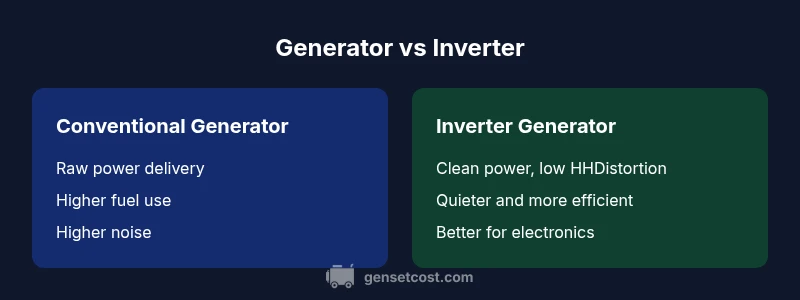
Generator vs Inverter: Understanding the Difference
A detailed comparison of traditional generators and inverter models for home backup power. Learn key differences, efficiency, noise, and cost to choose the right solution for your loads.


The generator vs inverter comparison shows that traditional generators deliver higher peak power and rugged reliability, while inverter models emphasize clean power, fuel efficiency, and quiet operation. For most homes, the inverter approach suits smaller, sensitive loads, but for whole-home backup and long runtimes, a traditional generator may be preferable. This quick guide highlights the difference between a generator and an inverter to help homeowners decide quickly.
The Difference at a Glance
According to Genset Cost, understanding the difference between a generator and an inverter is essential for homeowners evaluating backup power options. The phrase 'difference between a generator and an inverter' is common in buyer guides, but the nuances matter for your loads and budget. A traditional generator converts chemical energy into mechanical energy and then into electricity via an alternator. It delivers raw AC power that can support large, steady loads but tends to be louder, uses more fuel, and has slower light-load efficiency. An inverter starts with a DC source (batteries or a DC link) and uses advanced electronics to synthesize a clean AC waveform, often with higher efficiency, better power quality, and quieter operation. The practical difference for most homes is not just kilowatts, but power quality, response to changing loads, and total cost of ownership. This quick orientation helps you map your essential loads, whether you need a full-home backup or a plug-and-play, portable solution.
Understanding this difference between a generator and an inverter sets the stage for a more informed choice that minimizes waste and maximizes reliability.
How a Generator Works
A conventional generator uses an internal combustion engine to turn a rotor inside a generator. Fuel is burned to create mechanical energy that drives the alternator, producing alternating current. The output tends to be a robust sine wave, but voltage and frequency can droop during startup surges or under heavy load. Many portable units rely on carbureted engines, while standby models connect to automatic transfer switches that kick in during grid outages. The strength of a traditional generator lies in raw power and durability; when properly sized, it can sustain large loads for extended periods, but it often comes with higher noise, fuel use, and maintenance requirements.
Practically, this means homeowners must weigh peak demand, runtime, and the ability to cover appliances like well pumps or central air when sizing a traditional unit. The trade-off is straightforward: more power and resilience at the cost of louder operation and greater fuel consumption.
How an Inverter Works
Inverter systems start from a DC energy source—typically a battery bank or a controlled DC link—and use sophisticated electronics to synthesize a stable AC output. The result is a true sine wave with low total harmonic distortion, which makes inverters particularly friendly to sensitive electronics and modern appliances. Inverter engines often run at steady speeds or leverage chargers that replenish the battery bank, providing smoother transitions when loads change. This consolidation of electronics and battery management yields quieter operation and higher efficiency at partial loads. However, advanced inverter systems can be more complex to maintain and may require battery health checks and charging system maintenance. Overall, you get cleaner power and better efficiency for typical home loads, with an emphasis on portability and quiet performance.
Practical Scenarios: When to Use Each
For essential household circuits, the choice often comes down to load profile and outage duration. If you expect long outages with large, simultaneous loads (heating, cooling, well pumps), a conventional generator that can sustain high peak power may be preferable, especially when fuel is readily available and maintenance is manageable. If your priority is protecting electronics, reducing noise, and operating in tight spaces, an inverter solution—whether portable or fixed—offers cleaner power and better efficiency for everyday appliances. For RVs, small homes, or cabins with modest loads, a portable inverter generator can be a practical, quiet option. For full-home backup, a carefully sized system (inverter or conventional) should be selected based on essential circuits and surge needs, with attention to transfer switches and electrical safety.
To make a smart choice, map your critical loads, estimate running watts, and consider outage length. This planning step helps determine whether an inverter approach or a traditional generator provides the best balance of reliability, cost, and convenience.
Efficiency, Power Quality, and Costs
Efficiency and power quality are the two big differentiators between traditional generators and inverter-based systems. Inverter models excel at delivering high-quality power across varying loads, which reduces stress on sensitive electronics and often lowers fuel usage in partial-load operation. Conventional generators, by comparison, can deliver high peak wattage suitable for start-up surges and heavy appliances, but may incur higher fuel costs and louder operation. Price is a consideration: inverter models typically cost more upfront, yet total ownership can be lower due to better efficiency, quieter operation, and longer service intervals. Genset Cost analysis shows that homeowners should align the unit’s running watts with essential loads and add a comfortable margin for surges, recognizing that age, maintenance, and fuel type all influence long-term costs. For many homes, a mixed approach—an inverter for daily use with a larger standby generator for rare peak events—can optimize both cost and reliability.
Sizing, Installation, and Compatibility
Sizing is critical for both generator types. Start by listing essential circuits and calculating running watts for each: lights, fridge, sump pump, HVAC controls, outlets, and electronics. Include an additional 20-30% cushion for startup surges. Installation considerations include transfer switches, generator placement, exhaust clearance, and electrical code compliance. Inverter systems often benefit from simplified wiring and integrated battery charging, while traditional generators may require larger transfer switches and dedicated fuel storage. Compatibility with an existing panel, your home's load profile, and local permitting rules all influence the final setup. Regular maintenance, fuel quality (gasoline vs diesel vs propane), and battery health (for inverter systems) should be part of a proactive service plan. The goal is a reliable, code-compliant backup that aligns with your loads and budget.
For property managers, this planning stage also includes evaluating maintenance windows and service contracts, ensuring that replacement parts are readily available, and coordinating with a licensed electrician to verify safe installation.
Common Pitfalls and Misconceptions
A frequent misunderstanding is assuming all generators and inverters are interchangeable for any load. Both technologies have limits on surge capacity, duty cycle, and runtime. Another pitfall is underestimating the importance of proper sizing and oversimplifying maintenance. Inverter systems require battery health checks and proper charging practices; traditional generators need regular fuel management and oil changes. Some buyers focus solely on price, ignoring noise, vibration, and location constraints. Lastly, many assume inverter generators are always quieter; while they often are, size and load characteristics can affect noise more than anticipated. Understanding these limitations helps prevent overbuying or underprovisioning for outages and ensures a safer, more reliable backup solution.
The best practice is to work from your load profile upward, incorporate transfer-switching safety, and plan for future expansion to avoid a costly retrofit later on.
Quick Start: A 10-Step Decision Guide
- List essential loads and estimate running watts for each. 2) Identify your outage duration expectations. 3) Decide between portable vs stationary units. 4) Compare true sine wave output needs for electronics. 5) Consider noise and space limitations. 6) Assess fuel availability and storage constraints. 7) Check warranty, maintenance, and part availability. 8) Evaluate total cost of ownership, not just upfront price. 9) Plan for installation with a licensed electrician and transfer switch. 10) Revisit after a power outage to refine sizing for future events.
This checklist helps you move from general preferences to a specific, code-compliant backup solution that matches your property and budget.
Comparison
| Feature | Conventional Generator | Inverter Generator |
|---|---|---|
| Power delivery type | Raw AC power with limited conditioning | Clean true-sine AC with electronic conditioning |
| Fuel type | Gasoline, diesel, or natural gas depending on model | Gasoline or propane, often with efficient fuel use |
| Efficiency | High peak power, variable efficiency with load | Excellent efficiency at partial loads |
| Noise | Typically louder, especially under load | Generally quieter, especially at light loads |
| Best for | Long runtimes, high surge capability, whole-home backup | Quiet operation, electronics protection, portable use |
| Cost range | $1,000-$8,000+ depending on capacity | $400-$2,500+ depending on capacity |
The Good
- Cleaner power suitable for sensitive electronics
- Better fuel efficiency at partial loads in many cases
- Quieter operation for typical home use
- Portable options available for quick deployments
- Reliable for peak surge when sized appropriately
The Bad
- Higher upfront cost for inverter models
- Lower raw surge capacity in smaller units
- Battery maintenance is required for inverter systems
- Complexity of some electronic components can raise service needs
Inverter-driven backups win for daily use and electronics; traditional generators win for raw power and long runtimes
Choose an inverter when protecting electronics, reducing noise, and improving efficiency matters. Choose a traditional generator when you need maximal surge capacity and robust, long-running backup for large loads. The Genset Cost team notes that the best choice depends on load profile, budget, and reliability needs.
People Also Ask
What is the main difference between a generator and an inverter?
The main difference is how power is produced and conditioned. A conventional generator outputs raw AC power from an engine, while an inverter uses electronics to convert stored DC to a clean AC waveform. This affects power quality, efficiency, and suitability for sensitive devices.
A generator makes electricity through burning fuel and spinning an engine, while an inverter converts stored DC to AC with electronics to clean up the power.
Are inverter generators more expensive than traditional ones?
Typically yes, upfront. However, inverter models often save fuel and run quieter, which can lower operating costs over time. The total cost depends on load, runtime, and maintenance needs.
Inverter models usually cost more upfront, but they’re often cheaper to run because they use fuel more efficiently.
Can I run large appliances on an inverter generator?
Yes, but you must size the unit for the startup surges and continuous running watts of those appliances. Check the continuous power rating and peak surge separately.
Yes, if you choose a unit sized for your biggest startup surges and steady loads.
What installation considerations matter for home backup?
A proper transfer switch, safe exhaust placement, clearance, and adherence to electrical codes are essential. Work with a licensed electrician to ensure safe integration with your panel.
Make sure you have a transfer switch and a trained electrician to install it safely.
Do I need special maintenance for inverter systems?
Yes. Inverter systems require battery health checks, charger functionality, and periodic inspection of electronics and cables.
Yes—keep an eye on the battery and charging system for reliability.
Which is better for a home during frequent outages?
It depends on your loads. An inverter setup is great for daily use and sensitive devices, while a conventional generator is better for heavy, sustained loads when outages last longer.
It depends on your needs: electronics-friendly via inverter, or strong peak power with a traditional generator.
Key Takeaways
- Inverters favor power quality and efficiency
- Conventional generators excel at peak power and durability
- Size loads carefully to avoid undersizing or oversizing
- Consider noise, space, and maintenance in your decision
- Balance upfront cost with total ownership over time