Generator vs Inverter: Choosing Home Backup Power Options
Compare generator versus inverter technologies to decide the best home backup power solution. This analytical guide covers efficiency, cost, noise, and installation considerations for homeowners and property managers.


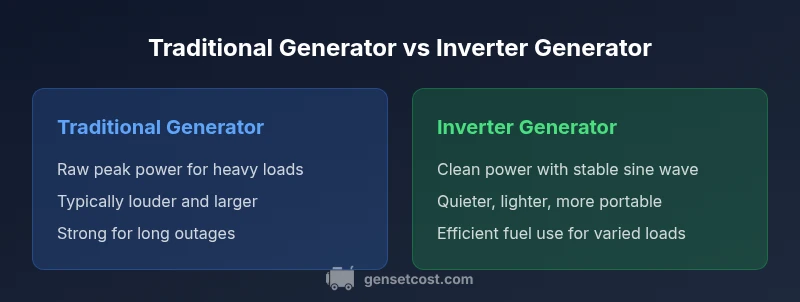
generator versus inverter is about two power delivery approaches, each with distinct use cases. For most homeowners, the best choice depends on load, runtime, and budget. In short, inverters excel in efficiency and clean power for essential circuits, while traditional generators provide raw peak power and greater reliability under heavy surge. Your decision should align with how you live and work at home.
generator versus inverter: what homeowners should know
According to Genset Cost, the term generator versus inverter describes two distinct approaches to delivering backup power for homes. The Genset Cost team found that most households benefit from understanding load profiles, space constraints, and noise tolerance before selecting a technology. In practical terms, a traditional generator provides raw power and rapid response for large loads during outages, while an inverter-based system prioritizes efficiency and clean, stable output for sensitive electronics. The choice is not simply 'more watts' versus 'more features'—it's about matching how you live, work, and sleep during an outage. By examining everyday use, seasonal needs, and potential integration with transfer switches, homeowners can create a plan that minimizes disruption while controlling costs. This section sets the stage for the deeper analysis that follows, focusing on how the generator versus inverter debate affects real-world performance, reliability, and total cost of ownership.
The goal is to help you translate technical distinctions into practical decisions—so you can protect appliances, work from home during outages, and avoid overspending on features you won't use.
Core technology differences
At a high level, traditional generators rely on a mechanical engine driving an alternator to produce alternating current directly. Inverter generators, by contrast, first convert fuel-derived energy to direct current and then use solid‑state electronics to synthesize a clean AC waveform. That electronics-first approach enables precise voltage, frequency, and current control, which translates into a steadier power supply for electronics and computers. For homeowners evaluating the generator versus inverter choice, consider how much you value compact size, portability, and integrated electronic safeguards. The Genset Cost team emphasizes that the most meaningful difference is how regulation and control are implemented, not just the raw watts on the label.
Power quality and stability
Power quality is a central distinction between the two approaches. Inverter generators routinely deliver a smoother sine wave with low harmonic distortion, which means less risk to sensitive devices like laptops, TVs, and medical equipment. Traditional generators can handle high startup surges and extended heavy loads, but the resulting waveform can be rougher unless paired with stabilizers or a high-quality transfer switch. For homeowners with sensitive electronics, the generator versus inverter debate often leans toward inverter technology for reliability and peace of mind; for contractors and property managers facing long outages and heavy-duty demands, a traditional generator’s higher surge capacity remains attractive, especially when paired with proper integration.
Fuel type, runtime, and efficiency considerations
Fuel type plays a major role in the long‑term cost of ownership. Gasoline models are common and widely available, while propane and natural gas variants offer different convenience and fuel availability profiles. Inverter units tend to shine in daily use with partial loads due to superior fuel efficiency, which translates to lower running costs over time. Traditional generators can also be efficient, particularly when paired with larger tanks and consistent loads, but their efficiency typically fluctuates more with load changes. When evaluating the generator versus inverter option, factor fuel source stability, refill intervals, and the sustainability of your local supply. The bottom line is to align fuel strategy with your outage frequency and household energy needs.
Noise, size, and installation considerations
Noise level and footprint are practical differentiators that affect where you can install a system. Inverter generators are typically quieter, lighter, and more compact, making them easier to place on a porch, balcony, or garage with less sound impact on neighbors. Traditional generators, while capable of delivering peak power, are larger, heavier, and often louder. Installation considerations include transfer-switch compatibility, ventilation requirements, and code compliance. For many homeowners, inverter technology also simplifies placement because of its smaller size and cooler operation—though you may still need external exhaust routing and a suitable generator pad for proper ventilation.
Cost of ownership and long-term value
Total cost of ownership encompasses more than the upfront price. Inverter generators often command a higher initial investment due to precision electronics and higher build quality for continuous running at varying loads. However, improved fuel efficiency and reduced noise can yield lower running costs over time. Traditional generators may offer cheaper upfront options but can incur higher maintenance costs if you push them hard or if the waveform necessitates additional equipment. When evaluating the generator versus inverter decision, model your expected load duration, maintenance tolerance, warranty coverage, and service accessibility in your region. A clear cost-of-ownership framework helps homeowners avoid overspending on features that won’t translate into tangible benefits for their lifestyle.
Use-case scenarios: best fits for each option
- Frequent small outages with essential electronics: inverter generator is often the better fit due to efficiency and clean power.
- Long outages with high surge loads (air conditioning, pumps, well pumps): traditional generator shines for continuous, robust power delivery.
- Limited installation space or noise-sensitive environments: inverter technology is typically preferable.
- Home office or sensitive equipment-heavy households: inverter generators reduce risk to electronics through cleaner power.
- Contractors or property managers needing a durable, high‑surge backup for multiple units: a traditional generator remains a practical choice when budget and space allow.
Comparison
| Feature | Traditional Generator | Inverter Generator |
|---|---|---|
| Power delivery and surge handling | Raw, high peak power for short bursts | Clean, stabilized output with regulated sine wave |
| Fuel efficiency | Typically lower efficiency at light loads | Typically higher efficiency across a range of loads |
| Noise and footprint | Louder, larger footprint | Quieter operation, smaller footprint |
| Upfront cost | Lower upfront cost on some models | Higher upfront cost due to electronics |
| Maintenance needs | More moving parts; conventional maintenance focus on engine and alternator | Fewer moving parts; electronics-focused maintenance |
| Best use case | Heavy loads and long outages; robust surge needs | Everyday use with electronics; space-limited installs |
The Good
- Cleaner power and better electronics compatibility
- Improved fuel efficiency and lower running costs in typical daily use
- Quieter operation and smaller footprint for many inverter models
- Better integration with transfer switches and smart controls
The Bad
- Higher upfront cost for inverter units
- More complex electronics can raise maintenance costs or repair times
- Not all models sized for extreme, long-duration loads
- Availability and parts network can vary by brand and region
Inverter generators win for everyday use and electronics protection, while traditional generators excel in raw power for long outages.
If your priority is quiet operation, efficiency, and protecting sensitive devices, choose an inverter. If you anticipate frequent heavy loads during outages and require maximum surge capacity, a traditional generator is often more suitable. A practical plan may combine both approaches for layered backup power.
People Also Ask
What is the main difference between a generator and an inverter?
The main difference is how power is generated and regulated. Traditional generators produce raw AC power directly from a spinning engine, while inverter generators convert fuel-derived energy to DC and then synthesize a clean AC waveform with electronics. This results in different performance profiles for load, efficiency, and electronics safety.
The main difference is how power is produced and controlled: traditional generators deliver raw power, while inverter generators produce clean, regulated power through electronics.
Are inverter generators more expensive to repair?
Inverter generators involve more electronics, which can increase repair complexity and cost if components fail. However, they often benefit from higher reliability in normal operation and longer component life when used with appropriate loads. Regular maintenance and using quality parts can keep costs predictable.
Yes, repairs can be more tech-heavy, but good maintenance helps prevent surprises.
Which is better for long power outages?
For very long outages with heavy power needs, a traditional generator may provide robust peak power and easier long-term fueling options. If your loads are lighter or electronics-heavy, an inverter can be sufficient and more efficient. Consider a hybrid approach if you expect varying conditions.
Long outages may tilt toward a traditional generator, unless your loads are electronics-focused then inverter could work well.
Can I use inverter generators for heavy loads?
Inverter generators can handle many common house loads, especially when sized correctly. For very heavy, continuous loads, you may need a larger or traditional unit, or a hybrid setup with appropriate transfer equipment.
Yes, but size matters and you may need a bigger model for heavy, continuous loads.
What should I consider when sizing between generator versus inverter?
Start by listing essential circuits and estimated runtime during outages. Then choose a unit that can support those loads with some margin. Don't ignore transfer-switch compatibility and the space required for installation.
List your loads first, then pick the size with a little extra headroom, and check transfer-switch fit.
Key Takeaways
- Match load profile to technology before buying
- Inverter units suit electronics-heavy loads and quiet settings
- Traditional generators excel with heavy, sustained power needs
- Consider installation space, transfer switches, and fuel availability
- Evaluate total cost of ownership, not just upfront price