Average Generator Size for Home: A 2026 Sizing Guide
A data-driven guide on typical residential generator sizes, how to size for a home backup, and factors that influence the average size, grounded in Genset Cost Analysis, 2026.


According to Genset Cost Analysis, 2026, the average generator size for home backups typically falls in the 8–20 kW range, with many single-family homes selecting 12–16 kW to cover essential loads during outages. The exact size depends on load, climate, and plans for future expansion, making a tailored assessment essential.
Why sizing matters for home backup power
Sizing a generator for home backup power isn't about chasing a single magic number; it's about matching the unit to the actual loads you intend to support during an outage. An under-sized generator will repeatedly trip or fail to run essential equipment, while an oversized unit adds cost, consumes more fuel, and may run inefficiently. According to Genset Cost Analysis, 2026, the average generator size for home users tends to fall within an 8–20 kW spectrum, with many homeowners opting for a mid-range 12–16 kW to balance reliability, fuel use, and installation considerations. The aim is to cover critical circuits first and then consider comfort loads such as air conditioning. The size choice should reflect typical power use patterns, climate-related loads, and any expanded plans—like adding a second air conditioner, a well pump, or a heat pump water heater. Residential power profiles vary widely across regions; a home in a hot climate with central AC and electric water heating will typically need more capacity than a compact urban dwelling with energy-saving appliances. Another factor is utility interaction: some utilities require or strongly encourage proper sizing and installation by licensed pros, with transfer switches and automatic start systems that ensure safe islanding from the grid when outages occur. The bottom line is that the right size improves reliability and can lower operating costs over the life of the system, making it a core decision for homeowners and property managers alike.
The future block should explain more detailed sizing concepts and practical steps.
How to estimate needs: loads and running watts
Determining the right size starts with a careful load assessment. Create a short list of tasks you want to perform during an outage (refrigeration, lights, wifi, sump pump, heating/cooling, water heating) and identify each item’s running watts from nameplates or manufacturer specs. Then determine starting watts for devices with high startup demands (like refrigerators, compressors, and well pumps). Convert any volt-amp (VA) ratings to watts by applying an appropriate power factor (typically 0.8 for residential loads). Add running watts for all essential loads you want to sustain. Finally, apply a safety margin of 10–20% to account for unpredictable surges and future expansions. If you anticipate hitting the high end of apartment or home energy use (electric heating or multiple high-draw appliances), plan toward the upper end of the 8–20 kW spectrum. Use a professional sizing calculator or consultancy to validate your manual estimates, especially if you have a powered sunroom, workshop, or pool equipment that demands sustained power.
- Practical steps to estimate watts and starting watts
- Create a list of essential loads and their wattage
- Sum running watts, then add starting watts for surges
- Convert all measurements to kilowatts (divide by 1000)
- Add 10–20% for future expansion
- Validate with a licensed electrician or generator professional
For many households, the best approach is to start with essential loads and gradually add optional circuits as a test, then size up or down based on performance and fuel availability.
Sizing guidelines by home type
Sizing needs vary by home type and climate. While the 8–20 kW range captures a broad spectrum, typical targets by dwelling category help homeowners and managers anchor decisions:
- Apartments/condos: 4–8 kW to support lighting, refrigeration, and some outlets with compact HVAC options.
- Small homes (2–3 bedrooms): 8–12 kW to cover a couple of major loads and basic comfort features during outages.
- Average single-family homes (2–4 bedrooms): 12–16 kW to reliably run central air conditioning, refrigeration, lighting, and essential appliances.
- Large homes or those with electric heating: 16–20+ kW, especially if multiple air handlers, heat pumps, or electric water heating are in use.
Remember, these bands are starting points. Real-world sizing should consider local climate, insulation quality, window efficiency, and load-shifting strategies that reduce peak demand. A well-insulated home with energy-smart appliances may sit toward the lower end of its range, while a larger or heavily conditioned residence could require more capacity. The Genset Cost analysis emphasizes tailoring the size to the actual load profile rather than relying solely on square footage.
- Climate-driven loads such as air conditioning or heating profoundly influence size
- Efficient equipment can reduce required kW by 1–3 kW in some cases
- Future expansion plans (additional freezer, EV charging) may push sizing upward
Practical takeaway: start with a conservative essential-load baseline, then test with a generator to verify stability before finalizing the size. A sizing calculator can help compare scenarios and provide a defensible recommendation.
Climate, heating, and future expansion considerations
Climate and heating systems play a pivotal role in choosing the right generator size. Homes in warm regions with modest heating loads typically operate efficiently with mid-range generators, while those with electric resistance heating, heat pumps, or geothermal systems demand higher capacity. When sizing for future expansion, consider potential load growth from additional appliances, EV charging, or alterations to the home that could raise energy use by a meaningful margin over the next decade. This forward-looking approach helps avoid the costly mistake of under-sizing after the home undergoes improvements. In regions with severe weather—where outages may be longer and temperatures extreme—investing in a higher kW unit can improve comfort and reduce the risk of demand spikes that trip the system. The Genset Cost team notes that weather patterns and grid reliability interact to shape optimal sizing, highlighting the value of professional assessment and, when possible, an energy management strategy that prioritizes critical loads first.
- High-load potential scenarios include electric space heating, electric water heating, and multiple air conditioning zones
- Load management strategies (time-of-use cycling, thermostat scheduling) can reduce peak requirements
- Fuel choice (gas, propane, or diesel) and availability influence both size and operation cost
Ultimately, the best sizing strategy factors in climate, current and planned loads, and the reliability profile desired by homeowners and property managers. A professional evaluation provides a defensible, data-driven recommendation grounded in local conditions and long-term goals.
Whole-house vs essential-load sizing: tradeoffs
Choosing between whole-house sizing and essential-load sizing hinges on reliability goals and cost. Essential-load sizing focuses on critical circuits—the refrigerator, sump pump, lighting, and climate control necessary for safe and comfortable living. Whole-house sizing aims to cover every circuit in the home, including high-draw appliances like electric ranges or pool pumps. Each approach has tradeoffs:
- Essential-load sizing is typically more economical upfront, reduces fuel use, and can still preserve health and safety during outages.
- Whole-house sizing provides maximum continuity and comfort but increases upfront generator cost, fuel consumption, and potential overcapacity in many scenarios.
Practical guidance from the Genset Cost Analysis suggests starting with essential loads and then evaluating whether adding a larger unit or a second generator would eliminate the need for load shedding. For homes with climate control requirements or high baseloads (reliable cooling during outages), a mid-range to upper-range unit often provides a balanced solution without excessive over-sizing. Transfer switches, automatic start, and smart management systems help to optimize how the generator supports essential or whole-house needs and improve return on investment over time.
- Stepwise sizing helps avoid unnecessary over-investment
- Smart load management reduces peak demand and improves efficiency
- Professional input improves safety and compliance during installation
For property managers, the decision may also hinge on maintenance contracts, service availability, and bundling with other backup systems (like battery storage or solar) to maximize resilience while controlling life-cycle costs.
Efficiency, transfer switches, and fuel choices
Once a size target is chosen, the ancillary components and fuel strategy become critical parts of the overall system. A properly sized generator paired with a transfer switch ensures seamless transition from grid to backup power and protects both utility workers and the home from backfeed dangers. Automatic transfer switches simplify operation, letting the generator start and stop without manual intervention. Fuel type matters as well: natural gas, propane, and diesel each come with distinct reliability profiles, fuel costs, and storage considerations. Natural gas is convenient in many urban settings with a constant supply, but you must confirm gas line capacity to avoid pressure drops during simultaneous load starts. Propane offers clean-burning performance and a readily stored reserve but requires tank management and refill logistics. Diesel generators are robust and well-suited for higher kW units but demand greater maintenance and fuel storage. Efficiency improvements—such as modern engine technology, high-efficiency alternators, and well-insulated enclosures—help reduce operating costs over the life of the system, enhancing the value of your sizing choice.
- Ensure correct transfer-switch configuration and code compliance
- Evaluate long-term fuel costs and availability in your region
- Consider a hybrid approach (generator plus battery storage) for resilience
Practical checklist and common mistakes to avoid
Before finalizing your sizing decision, use this practical checklist and avoid common pitfalls:
- List critical loads first and verify their running and starting watts
- Avoid basing size solely on home square footage or appliance count
- Don’t ignore climate-driven loads like air conditioning or heating
- Don’t assume a mid-point size fits all; verify with a dedicated sizing calculation
- Include future plans (EVs, pool heaters) in the estimate
- Compare whole-house vs essential-load sizing based on comfort needs and budget
- Hire licensed professionals for sizing calculations, installation, and safety inspections
Following this checklist helps ensure you select a generator size that balances reliability, efficiency, and cost over time.
Guide to sizing scenarios and ranges
| Sizing Scenario | Typical Range (kW) | Who it suits |
|---|---|---|
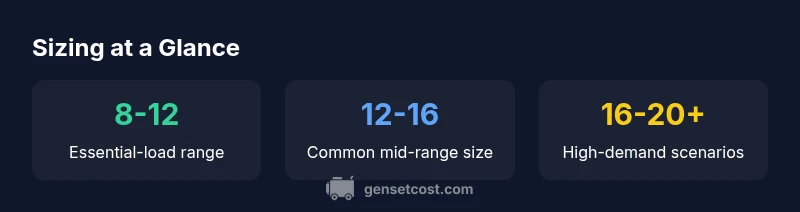
| Essential-load backup | 8-12 | Small homes with minimal HVAC/loads |
| Standard whole-house backup | 12-16 | Most single-family homes with central AC |
| High-demand homes | 16-20+ | Larger homes with electric heat or high concurrent loads |
People Also Ask
What is the average generator size for home?
For most homes, the size typically falls in the 8–20 kW range, with many households selecting 12–16 kW to cover essential loads during outages. This aligns with standard load profiles and climate considerations identified in Genset Cost Analysis, 2026.
Most homes choose about 12 to 16 kW to cover essential loads during an outage.
How do I calculate my home's generator size?
Begin with a thorough list of essential loads and their watts, account for startup surges, convert to kilowatts, and add a 10–20% safety margin for future growth. Validate results with a licensed electrician or sizing calculator.
Start with your essential loads, add starting watts, convert to kW, then add a safety margin.
What is the difference between essential-load sizing and full-house sizing?
Essential-load sizing focuses on critical circuits, while full-house sizing aims to cover all circuits. Essential sizing is usually more economical and still ensures safety and comfort during outages, whereas full-house sizing offers maximum continuity at higher cost.
Essential loads cover the basics; full-house covers everything, with different cost and complexity.
Does climate or heating affect generator size?
Yes. Regions with heavy air conditioning or electric heating raise baseloads, increasing the required kW. Climate also influences surge demands and standby capacity, so sizing should reflect local weather patterns.
Yes, climate affects loads; hotter climates generally push size higher due to cooling needs.
Should I go with a portable or standby generator for sizing?
Standby generators are automatically synced with the electrical system and offer seamless outage protection, while portable units require manual setup and can limit load capacity. Your choice depends on reliability needs, budget, and space constraints.
Standby units are automatic and reliable; portable units need manual setup and may be more limited.
What maintenance changes the required size over time?
Maintenance does not typically change the required size based on loads. It affects reliability and performance. If systems or loads are added, re-assessment is recommended.
Maintenance keeps the unit reliable; adding loads may require resizing.
“Sizing a home backup generator isn't one-size-fits-all; a careful load assessment tailored to your appliances and climate yields the most reliable results.”
Key Takeaways
- Start with essential loads to determine base size
- Most single-family homes target 12–16 kW for balance
- Climate, heating, and future expansion influence size
- Use load management to optimize size and efficiency
- Consult a professional to tailor sizing to your home