Generator Size Chart: How to Choose the Right Home Backup Generator
Learn how a generator size chart helps homeowners estimate backup power needs, compare kilowatt ranges, and avoid over- or under-sizing your home generator.


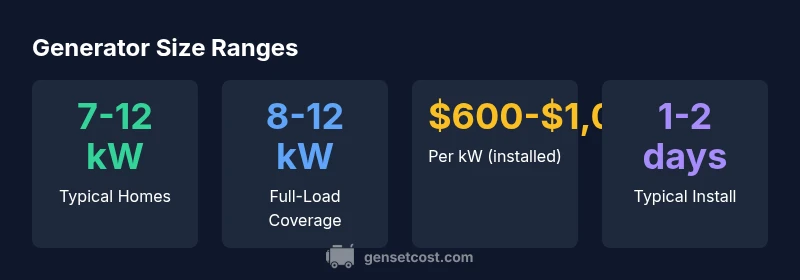
A generator size chart helps homeowners estimate the right unit by translating appliance loads into wattage ranges. For typical residences, a 7-12 kW unit covers essential circuits; larger homes may require 15-20 kW or more. Size charts consider peak load, starting watts, and fuel type. Always validate with a professional, and use a calculator for a precise match.
Why a Generator Size Chart Matters
The generator size chart is the bridge between what your house needs and what a standby system can deliver. It translates everyday load into actionable wattage targets, helping homeowners avoid two costly mistakes: undersizing, which risks nuisance trips or insufficient power during outages, and oversizing, which raises upfront and ongoing costs. By starting with a clear chart, homeowners can quantify their essential circuits (refrigerator, sump pump, lights) and then add discretionary loads (HVAC, water heater) as a function of available capacity. In practice, the chart acts as a budgeting tool and a risk-reduction aid for property managers who juggle multiple units. For the sake of clarity, always cross-check with your local installer and utility requirements; the chart is a starting point, not a substitute for a professional load calculation.
Note on terminology: running watts reflect continuous use, while starting watts show peak demand when appliances start up. Most charts display both values so you can interpret momentary surges without oversizing.
How to Read a Generator Size Chart
A standard chart uses kilowatts (kW) as the primary unit and ties them to common circuits in a home. When reading the chart, follow these steps:
- List your essential loads and estimate running watts for each (e.g., 600-900 W for a fridge, 500-700 W for lighting).
- Sum the running watts, then add a cushion (usually 10-20%) for startup surges.
- Compare the total to the chart’s kW ranges to identify 1-3 candidate sizes.
- Confirm with running wattages from your appliances’ manuals and consider motor loads (air compressors, well pumps).
If you want a more precise target, run a detailed professional load calculation and compare the result to the chart’s suggested range. This ensures you select a unit that can sustain your critical circuits without overbuilding.
Key Load Categories and How They Map to Size
Understanding load categories clarifies why charts show ranges rather than single numbers. Core categories typically include:
- Essential loads: refrigerator, sump pump, security system, lighting. These usually sit in the 3-5 kW range for many homes.
- HVAC and water heating: air conditioning and water heaters can push requirements toward the 7-12 kW window, especially during peak season.
- Major appliances: ranges, dryers, and heat pumps add substantial load and often determine whether you need 12-20 kW.
Sizing becomes a balancing act: you want enough headroom for startup surges without paying for idle capacity. Property managers with multiple units should consider a larger unit in high-demand properties or invest in modular approaches (interconnected generators) to optimize efficiency.
Common Sizing Scenarios
Consider typical scenarios to illustrate sizing logic:
- Small condo or apartment: 5-7 kW unit may cover essential loads and lighting, but must be assessed for HVAC if present.
- Mid-size single-family home: 8-12 kW often provides a comfortable cushion for HVAC, water heating, and lighting during outages.
- Large home or multi-zone property: 15-20 kW or larger units may be necessary to sustain multiple HVAC zones simultaneously.
In all cases, treat the chart as a starting framework. A home energy audit and professional load calculation reveal exact requirements and any local electrical constraints. It's also important to consider future plans (addition of rooms, EV charging) that could alter sizing needs.
Practical tip: consult the chart during a non-emergency period so you’re ready when outages occur.
Incorporating Fuel Type and Efficiency
Fuel type affects efficiency, costs, and retrofit complexity. Natural gas or propane standby units typically run cleaner and with less refueling downtime than gasoline models, but fuel availability and line pressure can influence sizing decisions. Efficiency matters too: newer units with inverter technology or variable speed operation may deliver better usable capacity at peak times than older fixed-speed models. When comparing charts, consider fuel costs, maintenance schedules, and the expected runtime you require during outages. A generator size chart should align not only with wattage but with your preferred fuel type and maintenance plan.
Step-by-Step: Using a Generator Size Chart with a Home Audit
Follow these steps to translate a chart into a practical sizing decision:
- List all receptacle loads and major appliances, noting running watts and starting watts where available.
- Identify essential circuits that must stay powered during an outage (refrigerator, medical devices, sump pump).
- Sum running watts and add a conservative startup cushion (10-20%).
- Check the chart for a size that covers the total with room for startup surges and future expansion.
- Verify with a licensed electrician and the installer’s load calculation method.
If a chart yields multiple viable sizes, prioritize the smallest option that meets essential needs while allowing for peak loads. This minimizes upfront costs and running expenses.
Pro tip: record your final chosen size and its assumed loads so you can revisit it during re-buys, renovations, or major appliance upgrades.
Pitfalls and Limitations
Size charts are valuable, but they have limits. Common pitfalls include:
- Relying solely on a chart without a formal load calculation.
- Underestimating startup surges for high-wattage appliances.
- Overlooking future loads or multi-unit coordination (in rental properties).
- Ignoring local electrical codes or permit requirements that influence installation scope.
To minimize risk, pair your chart with a professional load analysis, especially when you have high-draw equipment like well pumps, spa heaters, or multiple air handlers. Use charts as a guide, not a guarantee.
What to Do Next: From Chart to Installation
After selecting a size from the chart, the next steps are practical and procedural. Gather appliance wattages, confirm utility service compatibility, and obtain an electrical permit if required by your jurisdiction. Schedule an on-site assessment with a licensed electrician or generator installer to perform a formal load calculation and verify wiring, transfer switches, and exhaust routing. Finally, plan for maintenance access, fuel storage, and routine servicing to ensure reliable performance during emergencies.
In short, the chart guides the decision; the professional assessment confirms safety and compliance. Consistency between your chart targets and the installer’s recommendations is key to a dependable home backup system.
Authority sources
https://www.energy.gov/ https://www.eia.gov/ https://www.osha.gov/
Sizing guidelines by load category
| Load Category | Recommended Size Range | Notes |
|---|---|---|
| Essential circuits (refrigerator, lighting, sump pump) | 3-5 kW | Baseline loads |
| HVAC and water heating | 7-12 kW | Peak season considerations |
| Major appliances (range, dryer) | 12-20 kW | Occasional peaks |
People Also Ask
What exactly is a generator size chart?
A generator size chart maps household loads to generator wattage ranges, helping you choose a unit that can power essential circuits during outages. It translates appliance wattage into recommended generator sizes and highlights where start-up surges matter.
A generator size chart helps you map loads to wattage so you pick the right size, focusing on essential circuits and startup surges.
Why should I still hire a professional after using a chart?
Charts provide a starting point, but a professional load calculation confirms the exact requirements, accounts for interdependent loads, and ensures code compliance. This reduces the risk of under- or over-sizing and guarantees safe installation.
The chart is a starting point, but a professional load calculation confirms exact needs and safety compliance.
How do starting watts differ from running watts in sizing?
Starting watts reflect the peak power appliances draw when starting, while running watts are the continuous load. Generators must handle starting watts, not just running watts, to avoid tripping breakers or stalling.
Starting watts are the surge needs; running watts are continuous demand. Size for the surge, not just the steady load.
Can I rely on a chart for solar-powered systems or hybrid setups?
Yes, charts can inform sizing for hybrids, but you should integrate solar production, battery storage, and grid-tied constraints into the final calculation with an installer.
Charts help for hybrids, but include solar and storage in the final sizing with a pro.
How often should I revisit my generator size chart?
Reassess after major renovations, new appliances, or changing fuel availability. If you add high-draw loads, revisit sizing to avoid gaps during outages.
Revisit after renovations or if you add big loads; update sizing as needed.
“A generator size chart is a powerful planning tool, but it must be paired with a formal load calculation to ensure safety and reliability.”
Key Takeaways
- Start with essential loads to anchor size.
- Account for startup surges, not just running watts.
- Use the chart as a starting point, then confirm with a load calculation.
- Choose a size with headroom for future upgrades.