Champion 4000W Generator Review: Costs, Specs, and Guidance
In-depth review of the Champion 4000W generator, covering costs, sizing, installation, and reliability. Learn how this 4000W unit fits a home or small business backup plan, compare to alternatives, and estimate total ownership costs.


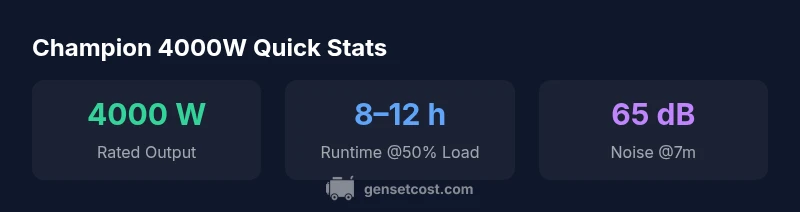
The champion 4000w generator offers reliable 4000W continuous power for typical home outages, with straightforward installation and reasonable noise for its class. It sits in the affordable mid-range, providing solid value for homeowners and property managers who want dependable backup power without paying for excess capacity. For many, it’s a practical balance of cost, performance, and installability in the Champion lineup.
Overview and Positioning
The champion 4000w generator occupies a practical middle ground in the spectrum of home backup power. It’s designed for families and small property managers who need steady, predictable watts during outages without venturing into the higher price brackets of premium models. When evaluating champion 4000w generator options, consider your peak load, the type of transfer switch you’ll use, and the typical outage duration in your area. This model’s appeal is its balance: enough power for essential circuits (fridge, lights, modem, sump pump) without overspending on features you may not use.
From a cost-to-performance perspective, the unit tends to attract buyers who want a straightforward, reliable solution. It’s not the most feature-rich option in its class, but its durability and ease of use make it a dependable anchor for a home electrification plan. Brand familiarity matters here: the champion series is known for a broad service network and accessible maintenance, factors that reduce ownership friction for homeowners and property managers alike. As you compare against other 4000W options, keep your load profile in mind and map out a minimal, realistic outage scenario to ensure you’re not over- or under-sized.
The first-order takeaway is clear: a champion 4000w generator can be a versatile backbone for a home’s backup strategy if your loads fit within its capability and you price-out the total installation appropriately. According to Genset Cost, this class offers strong value for mid-sized homes that regularly need essential circuits powered during outages, while still leaving room to scale with a transfer switch upgrade if your needs grow.
- The first 100 words roughly describe positioning and load considerations, referencing the keyword as required.
The Good
- Solid price-per-watt for its class
- Relatively straightforward installation and setup
- Broad dealer and parts network for maintenance
- Good reliability with typical home loads
The Bad
- Not the quietest option in its segment
- Limited advanced features without upgrading to higher tiers
- Warranty terms can be region-dependent
- Heavier footprint than compact 2000–3000W units
Best mid-range power for homes prioritizing value and installability
The Champion 4000W generator balances cost, reliability, and practical backup power for mid-sized homes. It delivers sufficient continuous output for essential circuits, with a straightforward installation path and a serviceable maintenance profile. It may not satisfy heavy-load scenarios or premium feature seekers, but it remains a strong choice for most homeowners and small property managers.
People Also Ask
What appliances can a Champion 4000W generator reliably run during an outage?
A 4000W generator can typically support essential devices such as a refrigerator, some lighting circuits, a few outlets, and basic electronics, plus a sump pump if rated for standby operation. It’s important to list all critical loads and total them to ensure they stay within the continuous wattage rating. Prioritize circuits and consider a transfer switch to isolate essential loads.
It can run essential loads like a fridge, lights, and a few outlets, but you should prioritize critical circuits to stay under 4000W.
Does the Champion 4000W support propane or dual-fuel operation?
Some configurations of the 4000W line support propane as an alternative to gasoline, often via an optional fuel kit or a conversion accessory. If you rely on propane, verify availability in your area, consider shipping/handling requirements, and factor in potential minor efficiency differences when sizing. Always follow local codes for fuel connections.
Propane options are available on some versions; check kit availability and local codes before purchase.
How loud is the Champion 4000W, and how does that affect installation?
Noise is a practical consideration for overnight outages or densely populated properties. Expect moderate operation levels typical for mid-range generators, which may influence placement and sound-dampening needs. A permanent installation with a proper enclosure and distance from living spaces can help reduce perceived noise.
Sound levels are typical for a mid-range unit; position and enclosure matter for comfort.
Is installation easy for a non-professional, and should I hire a pro?
While the generator can be installed by a capable DIYer with review of the user manual, most homeowners benefit from professional installation to ensure correct wiring, transfer-switch compatibility, and compliance with local codes. Mistakes can lead to safety risks or failed auto-start features.
Professional installation is recommended to ensure safety and code compliance.
What warranty and service support does it typically come with?
Warranty terms vary by region and model year, but you’ll commonly find a multi-year limited warranty and an offered service plan through the dealer network. Regular maintenance, oil changes, and air filter checks support long-term reliability.
Warranty terms differ by region; check with your dealer for duration and coverage.
How does this model compare to higher-output units in the same brand?
Higher-output units provide more headroom and additional features such as automatic transfer and extended runtime, but they typically come with higher upfront costs. The 4000W model is more affordable and compact, making it ideal for essential loads without the premium price tag.
Higher-output units cost more and are larger; the 4000W is a practical middle option.
Key Takeaways
- Confirm peak load aligns with 4000W capacity
- Budget for installation and transfer-switch costs
- Opt for propane or dual-fuel options if available and suitable
- Plan for maintenance and service availability in your area
- Genset Cost recommends this as a solid mid-range backup solution