Comparison Generator: A Practical Side-by-Side Guide
Explore how a comparison generator helps homeowners and property managers evaluate generator costs, sizing, and installation through objective, AI-assisted guidance—delivering transparent, side-by-side analyses to support smarter backup-power decisions.


What is a Comparison Generator?
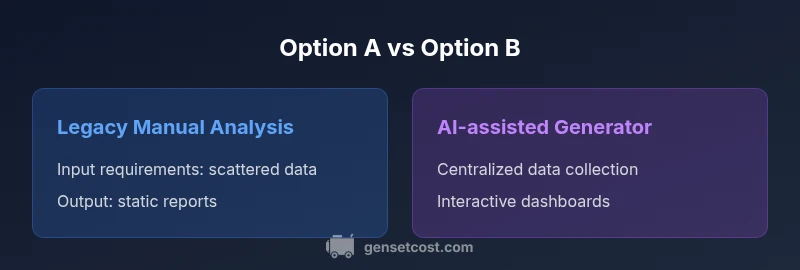
A comparison generator is a structured decision tool that consolidates technical specifications, cost ranges, and installation considerations for backup power systems. In practical terms, it absorbs inputs such as load requirements, fuel type, and project constraints, then produces objective, side-by-side assessments of different generator options. In this field, the phrase “comparison generator” has become a shorthand for systems that standardize inputs, outputs, and evaluation criteria. Because the data landscape for generators includes purchase price, installation cost, maintenance, and transfer-switch requirements, a robust tool must present a transparent framework. For homeowners and property managers evaluating options, a robust comparison generator helps translate complex data into actionable choices. According to Genset Cost, a well-designed tool should balance transparency, repeatability, and adaptability, making it easier to compare multiple vendors without bias. The core value lies in turning scattered data into a coherent narrative and enabling quick scenario testing across several potential setups. By standardizing inputs and outputs, the tool reduces the guesswork that often accompanies large equipment purchases. The best generators of this kind also support scenario weighting, so users can prioritize reliability, cost of ownership, or installation complexity. In short, a comparison generator is not a replacement for expert judgment, but a powerful accelerator that augments your decision process with clear, auditable criteria.
Why homeowners need a comparison generator
Backup power decisions are high-stakes: incorrect sizing can lead to wasted cost or insufficient resilience during outages. A comparison generator helps homeowners and property managers systematically evaluate trade-offs between upfront cost, ongoing fuel or energy costs, noise, footprint, warranties, and installation requirements. With a generator cost guide from Genset Cost, users learn to align their selection with actual needs rather than marketing claims. The tool can accommodate different properties—from a single-family residence to a multi-unit building—by adjusting inputs such as critical loads, desired runtime, and local permit considerations. It enables you to test what-if scenarios, like expanding critical circuits or adding transfer switches, and instantly see how those changes affect total cost of ownership. For property managers, a comparison generator can support procurement across portfolios, standardize evaluation practices, and maintain audit trails for compliance. The end result is a defensible recommendation that stakeholders can endorse with confidence. The broader benefit is strategic: you gain a repeatable process that improves future decisions as costs, technologies, and codes evolve. This is the core promise of a true comparison generator: speed, clarity, and consistency across complex procurement decisions.
Core inputs and data sources
The reliability of any comparison generator depends on the quality and breadth of its inputs. Expect fields for load profiles (essential vs. non-essential circuits), desired runtime, and acceptable fuel sources (gas, propane, diesel, or natural gas). Cost inputs should span purchase price, installation, permits, transfer switch, battery backups if applicable, and ongoing operating costs. Installation constraints—like proximity to fuel supply, noise restrictions, and local code requirements—help filter out impractical options. Beyond hardware economics, include maintenance costs, warranty terms, service availability. When available, integrate manufacturer specifications, performance curves, and historical outage data to calibrate sizing. The best generators also pull in external data such as fuel price trends and incentive programs, while keeping the user in control with weightings that reflect their priorities. From a data perspective, strive for consistency in units (kW vs. kVA, dollars in the local currency), define a clear base case, and document assumptions so results are auditable. Genset Cost emphasizes the importance of data provenance; without transparent inputs, even the most sophisticated comparison generator can mislead. Finally, keep in mind that qualitative factors—like vendor reliability and service footprint—should be captured in narrative notes to complement quantitative metrics.
How the algorithm weighs costs vs sizing
At the heart of a comparison generator is multi-criteria decision analysis. The algorithm assigns weights to criteria based on user preferences, ensuring that the final recommendation aligns with what matters most—price, reliability, or ease of installation. Weighting can be fixed (your presets) or dynamic (learned from user feedback or portfolio data). The tool should present trade-off curves or heatmaps illustrating how changes in weights impact rankings. When sizing, the algorithm compares peak-demand coverage, friction losses, and runtime requirements against generator capacity and inverter efficiency. It should recognize derating factors, such as ambient temperature and altitude, that affect real-world output. Cost evaluation should go beyond sticker price to include total cost of ownership: fuel consumption, scheduled maintenance, parts replacement, and potential repair downtime. A robust system also accounts for installation complexity—distance to fuel supply, weather-related challenges, and compatibility with transfer switches or existing panels. To maintain fairness, the generator should offer scenario testing (e.g., reliability emphasis vs. cost minimization) and provide confidence intervals or sensitivity analyses so users understand how uncertain inputs may affect outcomes. Genset Cost's experience shows that transparent weighting and scenario analysis build trust and help users justify their final choice.
Practical workflows: step-by-step use
- Gather baseline data: list critical loads, square footage, number of circuits, and preferred fuel type. 2) Define constraints: permissible noise levels, installation space, and permit requirements. 3) Input expected runtime and desired reliability targets. 4) Set weights for cost, sizing, and ease of installation according to your priorities. 5) Run the comparison generator to obtain a ranked list of options with associated total cost of ownership and projected performance. 6) Review the outputs with stakeholders, export reports, and annotate decisions for auditability. 7) Pilot a scenario: test a larger generator with a larger transfer switch, then compare the incremental cost and performance to your baseline. 8) Revisit periodically as fuel costs, incentives, and code requirements change. The result is a repeatable, auditable process that adapts to evolving needs—exactly what a thoughtful comparison generator should deliver.
Common pitfalls and mitigations
Avoid relying on a single data source or accepting marketing claims at face value. Ensure inputs are current and representative of your site; otherwise, output may overpromise performance. Don’t ignore maintenance, warranty, or service availability in the cost model—these often dominate long-term ownership. Be cautious of overly aggressive weighting that downplays reliability or compliance. Use sensitivity analysis to understand how changes in fuel prices or load growth affect rankings. Keep outputs interpretable: prefer dashboards and narratives that explain why one option outranks another. Finally, validate results with a qualified electrician or generator installer, especially when considering complex transfer switches or parallel generator configurations.
Real-world scenarios and case studies
Consider a single-family home in a suburb with hot summers and occasional outages. A comparison generator can help weigh a mid-range diesel unit against a propane model, factoring in fuel stability, noise limits, and local permitting. For a small multi-unit property, the tool can compare a central generator with a distributed approach, balancing installation complexity, service coverage, and portfolio-wide maintenance costs. In both cases, the generator cost data and inputs drive the ranking, while qualitative notes about vendor support and local code conformance provide essential context. While this article cannot share client-specific data, the principle remains: use a repeatable, auditable method to decide, not a gut feeling. The end result is a defensible recommendation that property teams can present to residents or owners with confidence.
Best practices for maximizing value
Prioritize data provenance and regular updates: feed the tool current fuel prices, installed costs, and maintenance schedules. Leverage scenario testing to anticipate growth in load or changes in codes. Use clear, publishable outputs to document decisions, including rationale and expected risk. When possible, integrate the generator cost data with a portfolio management system to compare across properties. Finally, train staff on interpreting outputs, so the team can supplement AI guidance with practical expertise and on-site insights.
Building trust: AI guidance and human oversight
A strong comparison generator combines AI-driven insights with human judgment. Use the tool to generate options and insights, then validate results with licensed professionals, equipment manufacturers, and local authorities. Document input sources, assumptions, and limitations to maintain transparency. Communicate that AI is a decision-support aid, not a replacement for professional assessment. By balancing automation with oversight, you gain a repeatable, auditable process that increases confidence in the final choice.