Generac GP8000E Generator Review: Costs, Specs, and Practical Guidance
A comprehensive review of the Generac GP8000E generator, covering costs, sizing, setup, maintenance, and real-world performance for homeowners and property managers evaluating home backup options.


Generac GP8000E is a portable, electric-start generator designed for home backup and job-site use. It combines high-output power with practical features like push-button start and a sturdy enclosure, making the generac gp8000e generator a strong option among portable units. According to Genset Cost analysis, total ownership depends on fuel choice, maintenance, and installation considerations.
GP8000E Positioning in the Market
The GP8000E from Generac occupies a well-understood niche among portable backup generators. It targets users who want reliable, on-demand power without the constraints of a permanently installed system. For homeowners, the GP8000E offers a balance between wattage capacity and mobility, allowing the unit to be relocated for outages, construction sites, or events. The model sits alongside other mid- to high-range portable generators, and in practice it competes with units that emphasize electric start, ease of use, and robust build. The Genset Cost team notes that buyers often compare it against units with similar peak output, while considering long-term costs such as fuel and maintenance. The GP8000E tends to appeal to households that need to power essential circuits during outages, rather than to run an entire home at once. The emphasis on durability, serviceability, and a broad dealer network can influence total cost of ownership positively when aligned with typical load profiles and local fuel costs.
Design and Build Quality
The GP8000E emphasizes rugged construction to survive outdoor environments and frequent relocations. A steel frame with protective shrouding reduces damage from debris and weather exposure, while a vented body helps keep engine temperatures within safe ranges during extended use. Users often appreciate the integrated handle design and the relatively compact footprint for a generator of its class. In testing scenarios, the enclosure and chassis generally resist rust and wear, which is helpful for homeowners who deploy their generator on driveways or in garages with limited airflow. One recurring consideration is panel access: you’ll want clear, accessible outlets and an easy-to-reach fuel cap to minimize downtime during outages. Overall, the GP8000E’s build quality tends to translate into dependable operation, provided you store and transport it properly and follow routine maintenance.
Power Output and Performance
Power output is a central talking point for the GP8000E. The generator is designed to deliver substantial running power suitable for essential circuits, portable tools, and some mid-size appliances during outages. In practice, performance depends heavily on the load and the condition of the fuel. Users who operate multiple devices simultaneously should plan for circuit-level management and consider pairing the GP8000E with a transfer switch for safer, cleaner switching from utility to generator power. While the GP8000E can handle night-time loads and power interruptions, it may not sustain high-load appliances over long periods without monitoring fuel consumption and engine temperature. For homeowners evaluating sizing, it’s important to map critical circuits and compare them against the unit’s achievable load under real-world conditions.
Fuel, Runtime, and Efficiency
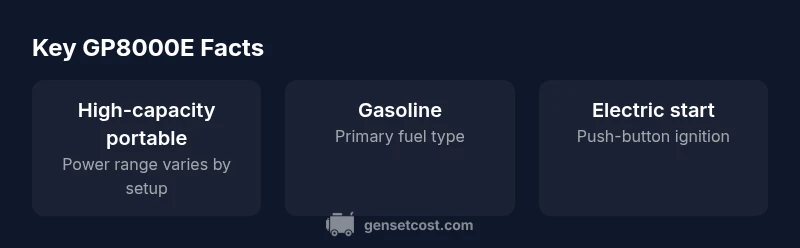
The GP8000E relies on gasoline as its primary fuel source, which aligns with most portable generators. Fuel availability and storage are practical concerns: you’ll want to store gasoline safely, rotate fuel to prevent degradation, and consider the cost implications of frequent refueling during extended outages. Run times are inherently load-dependent; light loads prolong operation, while heavier loads reduce runtime. Because this is a portable unit, you’ll typically see better efficiency when you limit simultaneous high-wattage draws. Maintenance habits, such as oil changes and air-filter replacements, also influence runtime and reliability over time. When planning outages, homeowners often compute a practical fuel plan and consider alternate strategies for keeping essential circuits powered.
Noise, Vibration, and Usability
Noise levels are a practical consideration for residential use. The GP8000E sits in the mid-to-upper range for portable generators of its class, which means it’s noticeable in quiet neighborhoods or enclosed spaces. Vibration can be felt during operation, especially if the unit is not on a solid surface, so a stable mat or base helps. Usability features—electric start, recoil backup, and accessible outlets—make daily operation easier, particularly for seniors or those with limited strength. For best results, place the generator away from living areas but within reach of a path of extension cords or a transfer switch, and use proper extension cords that are rated for outdoor use. The goal is a safe, reliable setup that minimizes noise disruption while preserving power availability during outages.
Sizing, Installation, and Transfer-Switch Considerations
Sizing a generator correctly is critical to avoid overloading circuits. The GP8000E is often evaluated for equivalent load capacity against typical household needs or job-site demands, with homeowners using load calculators to determine if a single unit suffices or if multiple units or a larger dedicated system is warranted. Installation considerations include clearances, ventilation, and electrical safety. If you plan to integrate with a home panel, a transfer switch is commonly recommended to prevent backfeeding and to provide a safer, code-compliant connection to the electrical system. In many cases, homeowners coordinate with a licensed electrician to ensure proper installation, grounding, and compliance with local regulations. The GP8000E can be a flexible element in a broader emergency power plan when sized correctly and used with appropriate safety measures.
Maintenance, Longevity, and Servicing
Routine maintenance is the key to long-term reliability. Expect periodic oil changes, spark plug inspection, air-filter cleaning or replacement, and a general inspection of hoses, wiring, and outlets. Keeping a maintenance log helps track service intervals and ensures nothing is overlooked during outage seasons. Availability of parts and local service networks for Generac units is typically strong, which supports quicker repairs and routine servicing. Homeowners who invest in preventive care—like seasonal oil changes and battery checks for electric starts—tend to enjoy smoother operation and longer engine life. In summary, regular maintenance is the backbone of a GP8000E’s longevity and dependable performance during emergencies.
Alternatives and Real-World Scenarios
For those evaluating options beyond the GP8000E, other models in Generac’s portfolio or competing brands offer similar ranges of power and features. When considering alternatives, focus on true wattage, runtime under anticipated loads, noise, weight, and cost of ownership. In real-world outage scenarios, the GP8000E often satisfies essential circuits and keeps communications, refrigeration, and some lighting operational, which is a common priority for homeowners and property managers. Scenarios such as remote job sites or outdoor events also illuminate the need for portability and ease of use, where electric-start models with durable housings can reduce setup time and stress. The key is to align the unit’s capabilities with the expected power needs and logistical constraints of your property or site.
The Good
- Electric start for quick, reliable startup
- Robust power output suitable for essential circuits
- Durable steel frame and protective enclosure
- Strong parts availability and service network
The Bad
- Heavy and bulky, less portable than smaller units
- Fuel costs and storage considerations
- Noise level can be noticeable in quiet neighborhoods
Best for homeowners needing reliable backup with straightforward operation
The GP8000E offers strong, dependable performance in a portable form. While it’s not the lightest or quietest option, its electric start, durable build, and broad service network make it a solid choice for many outage scenarios and job-site needs. Consider load and space before purchase to ensure it fits your power needs.
People Also Ask
What is the GP8000E best used for?
The GP8000E is best used for home backup of essential circuits and for job-site power needs. It provides significant run capability for critical devices and can be moved as needed. For whole-house simultaneous heavy loads, sizing and alternative strategies should be considered.
Great for essential outages and job sites; you’ll want to map critical loads before switching on everything at once.
Is the GP8000E dual-fuel or gasoline-only?
The GP8000E is typically gasoline-powered. Some Generac models offer dual-fuel options, but verify the exact configuration for this model before purchase.
This model uses gasoline; if you need propane, check the specific variant.
How loud is the GP8000E in residential settings?
Noise levels are noticeable compared with small portable units. Use proper distance, barriers, or enclosures to minimize disturbance in quiet neighborhoods.
It’s louder than small units, so plan placement to reduce noise impact.
What sizing considerations should I make with a transfer switch?
A transfer switch is commonly recommended to safely connect the GP8000E to your home circuits. Work with a licensed electrician to determine the appropriate amperage and configuration for your panel.
Have an electrician size and install the transfer switch for safe operation.
What maintenance does the GP8000E require?
Regular maintenance includes oil changes, air-filter checks, spark plug inspection, and outlet/testing checks. Maintain a service log and follow the manufacturer’s interval recommendations.
Keep up with routine oil changes and air-filter checks for reliability.
Who should consider the GP8000E over smaller units?
Homeowners with frequent outages or higher power needs may prefer the GP8000E for its balance of power, portability, and ease of use. If you rarely experience outages, a smaller unit may suffice and be more cost-efficient.
If you have frequent outages and higher power needs, this unit tends to be a better fit.
Key Takeaways
- Evaluate loads carefully to size correctly
- Expect a heavier unit that benefits from proper storage
- Plan for ongoing fuel, maintenance, and potential service costs
- Pair with a transfer switch for safer, faster outage switching