Generator Lowes vs Alternatives: A Practical Guide
This detailed comparison analyzes generator lowes options versus competitors, focusing on sizing, cost, warranty, and installation considerations for homeowners evaluating backup power.


This comparison analyzes Lowe's generator options against common alternatives from other retailers, focusing on pricing, sizing, warranties, and installation support to help homeowners weigh total cost of ownership. It emphasizes practical buying factors, including fuel type, noise, and service networks, rather than model-specific claims. Use this framework to compare options at Lowe's with broader market choices.
Introduction to the generator lowes landscape
The term generator lowes describes a shopping landscape where homeowners and property managers compare portable and standby generators across big-box retailers and specialized outlets. This article uses a neutral frame to help you evaluate sizing, cost, warranty, and installation considerations without focusing on a single model or brand. By looking at in-store experiences, financing options, and post-purchase support, readers can form a balanced view of what matters most when building a reliable backup power plan for homes and small properties.
According to Genset Cost, the generator lowes landscape typically includes access to trained staff who can explain load calculations, a range of in-stock options, and convenient pickup or delivery. The Genset Cost team found that total cost of ownership often hinges not just on sticker price, but on installation requirements, transfer-switch compatibility, and ongoing maintenance needs.
This article emphasizes objective criteria—sizing accuracy, warranty coverage, service networks, and expected long-term costs—to help homeowners and property managers compare Lowe's offerings with the broader market. It also notes how regional differences in availability can shape the perceived value of in-store versus online shopping, especially for urgent outages.
Sizing and load calculations for generator lowes options
Sizing a generator correctly is the foundation of a reliable backup power plan, and the process is particularly relevant when evaluating generator lowes options. Start by listing essential circuits and major loads (refrigeration, heating, sump pumps, lights, and select appliances). Convert each load to running watts and add a margin for surge wattage. With Lowe's staff guidance or online calculators, you can translate this total into a target generator size. Remember that running a generator at full capacity continuously can shorten its life, so balance your essential needs with a comfortable safety buffer.
A common approach recommended by industry professionals is to perform a home-scale load analysis and then compare two or three candidate sizes. For the generator lowes landscape, consider whether you need a portable unit for flexibility or a standby system for automatic operation. Fuel type (gasoline, propane, natural gas), run-time expectations, and noise tolerances should also factor into the final sizing decision. Genset Cost analysis shows that many homeowners underestimate peak demand during outages, leading to undersized selections and repeated cycling on critical circuits.
When in doubt, engage a licensed electrician to verify calculations and to ensure that the proposed size aligns with your transfer switch and local electrical codes. This is especially important for properties with high loads or complex HVAC systems, where a miscalculation can result in nuisance tripping or insufficient backup power.
Types of generators at Lowe's and how they compare to the broader market
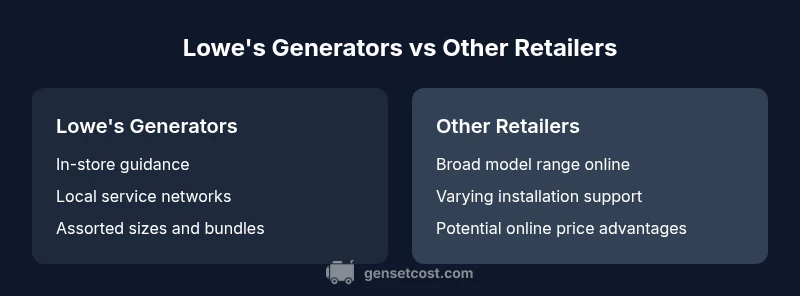
Lowe's generator stock typically spans portable generators for temporary outages and standby units for automatic transfer during outages. Portable models are ideal for camping trips, job sites, or occasional outages, while standby systems offer seamless power with little user intervention. The broader market includes a wider array of brands, models, and features, but the trade-offs often center on service availability, installation complexity, and warranty coverage. For the generator lowes landscape, Lowe's often emphasizes in-store guidance, bundled installation options, and proximity to local service networks, which can translate into faster support after purchase.
In general, portable generators prioritize mobility and initial cost, with fuel efficiency and noise depending on engine size and design. Standby units emphasize reliability and automation, frequently paired with automatic transfer switches and longer warranty terms. Across the market, you should compare fuel type, rated wattage, surge capacity, run-time at rated load, and noise levels. The generator lowes ecosystem is typically strong on in-store education and service referrals, while other retailers may offer broader online catalogs and occasional deeper discounts during promotions.
Price, value, and total cost of ownership for generator lowes options
Price is only one dimension of value when evaluating generator lowes options. Upfront costs can be higher at a well-staffed retailer with strong installation support, but this may be offset by bundled services and faster deployment in emergencies. When comparing Lowe's options with alternatives, consider additional costs such as professional installation, transfer switch, permit fees, fuel type availability, and service plan costs. In many cases, a mid-range Lowe's option with included support can yield lower total ownership costs than a cheaper online unit that requires separate installation and scheduling. Think beyond the sticker price to account for ongoing fuel consumption, maintenance, and potential repair expenses over a decade of use.
Another factor is availability. For the generator lowes landscape, local stocks and pickup options can reduce downtime after a power outage, while online retailers may offer a broader catalog but longer wait times for delivery or installation. As always, request written quotes that itemize all services and warranties so you can compare apples to apples. This approach minimizes surprises when you claim a warranty or call for maintenance after a year of operation.
Warranty, service, and installation considerations
Warranty terms and post-purchase service are crucial components of the generator lowes decision, particularly for homeowners who want predictable support after an outage. Lowe's often provides warranties that cover the unit itself, with additional assurances through in-store service networks and recommended installers. When shopping elsewhere, warranty terms can vary widely by model, brand, and retailer. Be sure to verify what is covered (parts, labor, travel), the duration, and whether coverage transfers if you move to a new home. Installation considerations include local permits, transfer switch compatibility, and whether the retailer assists with permitting or offers preferred installers.
From a reliability standpoint, the strength of Lowe's service network matters. In many markets, in-store staff can guide you toward reputable electrician referrals and routine maintenance plans, which can improve long-term satisfaction. For those moving beyond Lowe's, ensure your installer has experience with the exact transfer switch type your system requires and that they can coordinate inspections to meet code requirements.
In-store vs online purchasing: availability and support
The choice between in-store and online purchasing for generator lowes options hinges on several factors. In-store visits provide immediate guidance, physical inspection of models, and the opportunity to see demo units. This can be a strong advantage for sizing consideration and for evaluating noise and build quality in person. Online purchasing often offers a broader selection, price competition, and shipping convenience, but may require separate installation scheduling and reliance on third-party contractors. Consider whether your priority is rapid deployment, access to local service networks, or the widest model assortment when weighing in-store versus online options for the generator lowes landscape.
For many homeowners, a blended approach works best: choose a model online for price transparency and features, then visit a local store to confirm fit, discuss installation needs, and secure service referrals. Always verify lead times, stock availability, and return policies before finalizing a purchase.
Practical buying steps and decision framework
To streamline the purchase of a generator in the generator lowes ecosystem, use a structured decision framework. Step 1: define essential loads and a target wattage; Step 2: shortlist portable vs standby options based on outage frequency and installation feasibility; Step 3: compare at least two models on sizing, warranty, fuel type, run-time, and noise; Step 4: estimate total ownership cost including installation, transfer switch, and maintenance; Step 5: confirm service availability and installation readiness through the retailer or installer network; Step 6: schedule installation and perform a post-install test.
Document everything in a written shopping plan and request multi-line quotes that itemize unit price, installation, permits, and any optional service contracts. This disciplined approach helps ensure the generator lowes purchase results in reliable power with clear accountability for service and maintenance over time.
Real-world scenarios: residential vs small commercial applications
Homeowners evaluating generator lowes options typically prioritize cost, ease of use, and reliability for essential circuits. A two-bedroom residence may require a smaller standby to cover cooling and refrigeration, while a larger home with heavy HVAC loads might need a higher-capacity standby or a carefully selected portable with extended run-time. Property managers overseeing small commercial properties should consider load diversity, multiple critical circuits, and the potential need for three-phase configurations or commercial transfer switches. In both cases, Lowe's in-store teams can help align the selection with building codes and local permitting processes, while other retailers may offer broader product bundles that include industrial-grade components. Always test the system under simulated outage conditions before evaluating its performance under real-world events.
Maintenance, fuel strategy, and long-term costs
Maintenance planning is essential to ensure long-term reliability of generator lowes options. Regular service includes oil and filter changes, spark plug checks, air filter cleaning, and battery inspection for standby units with automatic transfer switches. Run-time testing—normally performed weekly or monthly depending on use—helps catch issues before outages occur. Fuel strategy should align with your chosen system: gasoline-based units may require fresh fuel rotations, while propane and natural gas offer different levels of convenience and storage considerations. Budget for periodic service visits, oil and filter replacements, and potential components that may need timely replacement to avoid failures during outages. Keeping a maintenance log supports warranty claims and helps you anticipate upcoming service needs.
Recap and transition to decision-making factors
The generator lowes landscape varies by location, model, and installation constraints. By focusing on sizing accuracy, in-store guidance, warranty protections, and total cost of ownership, homeowners and property managers can make informed decisions that balance upfront costs with long-term reliability. The most successful purchases align the chosen unit with load requirements, offer robust service options, and fit the property’s installation realities. This balanced approach helps you avoid overspending on features you don’t need while maintaining readiness for power outages.
Comparison
| Feature | Lowe's generators (in-store options) | Generic/other retailers (online or showroom options) |
|---|---|---|
| Sizing accuracy | High accuracy with dedicated staff input and guided calculations | Varies by model and retailer; accuracy depends on guidance and data provided |
| Warranty coverage | Standard warranty with local service network support | Warranty terms vary; online options may require third-party service |
| Installation support | In-store guidance plus referrals to local pros | Installation often separate from purchase; varies by retailer |
| Price range | Mid-range pricing with occasional promotions | Wide range; potential online discounts but with variable service |
| Availability | Strong in-store stock and pickup options | Inventory varies; broader selection online but shipping times apply |
The Good
- Clear in-store guidance and warranty support
- Immediate pickup options for urgent outages
- Access to local service networks and referrals
The Bad
- Prices can be higher in-store than online retailers
- Inventory can be inconsistent by location
- Model variety may be less than online marketplaces
Lowe's generator options are strong for buyers who value local support and fast access.
Lowe's offers reliable service and convenient pickup, while broader market retailers may provide broader selection and potentially lower upfront costs. Consider installation needs and warranty coverage when choosing.
People Also Ask
What is the difference between portable and standby generators offered by Lowe's?
Lowe's carries both portable and standby generators. Portable units are movable and typically used for smaller loads, while standby generators are permanently installed and provide automatic power during outages. Size, fuel type, and noise vary by model, so compare specs carefully.
Lowe's offers portable and standby generators; portable units move with you, while standby units automatically power your home during outages. Always check size, fuel, and noise before buying.
Does Lowe's offer installation services for generator purchases?
Yes, Lowe's commonly partners with local pros for installation and transfer switch services. Availability and pricing depend on your location and the model selected. Confirm service windows and permit requirements before purchase.
Yes—Lowe's can connect you with local installation pros. Check availability in your area and confirm permits and timing.
How do I size a generator correctly for my home?
Begin with a home energy audit to determine essential circuits and peak demand. Add up the running watts for critical devices and choose a generator with a margin above that total. For guidance, use reputable sizing calculators and consult with a licensed electrician.
Start with your essential loads, sum their watts, and pick a unit with some headroom. When in doubt, consult a pro.
Are Lowe's generator prices higher than online retailers?
Prices can vary by channel and promos. In-store purchases may include installation bundles and local service, while online options might be cheaper but require separate installation bookings. Compare total cost of ownership rather than sticker price.
Prices vary. In-store may include bundles and service; online might be cheaper but install costs apply.
What maintenance is required after installing a home generator?
Regular maintenance includes oil changes, spark plug checks, air filter cleaning, and running the unit periodically. If you have a standby system with an auto-transfer switch, ensure the transfer mechanism is tested annually. Follow manufacturer guidance and schedule professional servicing as needed.
Regular oil changes, air filter checks, and periodic run-time tests are essential; have the transfer switch tested yearly.
Key Takeaways
- Define your load and target wattage before shopping.
- Compare installation and warranty terms, not just price.
- Check in-store availability and pickup options for faster deployment.
- Assess fuel type, runtime, and noise for daily use.
- Ask about service networks and local referrals.