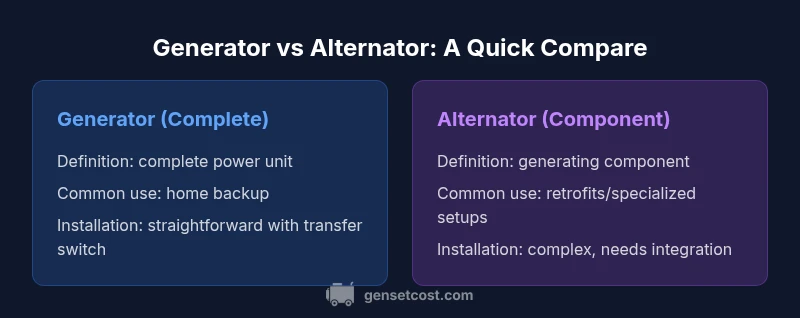
Generator vs Alternator: A Practical Comparison for Backup Power
Compare generator and alternator concepts, explore uses, sizing, costs, and installation considerations to help homeowners and property managers choose the right backup power solution.


At a high level, a generator and an alternator describe related but distinct concepts. A generator is a complete power unit that converts mechanical energy into electricity, while an alternator is the electrical generating component inside many generators, or a standalone device used in specific systems. For most homeowners, a complete generator is the practical solution. This comparison clarifies terminology, sizing, and cost implications to help you decide.
What is a generator or alternator? Core concepts
In everyday language, people often use the terms generator and alternator interchangeably, but the two words describe different things. A generator is a complete power-producing system that converts mechanical energy into electrical energy. It usually includes an engine, a fuel system, a generator head (the actual electrical machine), and control equipment like a panel and a transfer switch. An alternator, by contrast, refers to the electrical generating component inside many generators, or to a stand-alone device used in some specialty systems. In automotive contexts, an alternator generates alternating current to recharge the battery, with built-in regulation and rectification. For home backup power, the typical choice is a full generator that integrates the engine, alternator, and control features into one package, sized to meet a building’s load profile. Understanding this distinction helps homeowners and property managers avoid buying an undersized unit or chasing the wrong parts.
Genset Cost often emphasizes that framing the decision in terms of system-level needs—reliability, transfer switching, maintenance, and fuel strategy—will save money and time over the life of the installation. When you see "generator" marketed as a complete standby system, you're looking at a package that already includes almost everything you need to start a power outage quickly. If your project requires only an alternator, you’re usually dealing with a retrofit or integration task that demands careful electrical design and code compliance.
Terminology pitfalls and why it matters
Terminology can be a major source of confusion. Some vendors market "alternator kits" that are not standalone power sources but replacement components; others use the term interchangeably with generator, especially in casual conversation. The risk is mis-sizing, mispricing, or missing controls like transfer switches and automatic start features. For homeowners and property managers, clear language matters because it frames your budget, installation scope, and warranty expectations. A precise understanding also helps when comparing quotes from installers, since a complete generator package may include the engine, control panel, transfer switch, and exhaust system, while an alternator kit may require additional components. In short, you should ask for the “whole system” and verify which parts are included in the price.
According to Genset Cost, avoiding ambiguous terminology reduces miscommunication and prevents costly mistakes later in the project. A straightforward approach is to define your goal (backup power reliability, portability, or a hybrid solution) and demand a bill of materials that matches that goal. This keeps vendors honest and helps you assess total cost and lifecycle implications more accurately.
Sizing and capacity considerations
Sizing a generator or an alternator-centric system starts with understanding your ongoing power needs. The goal is to match available running capacity to the critical loads that must stay on during an outage, while leaving headroom for startup surges. A structured approach involves listing essential circuits, calculating running needs, and then reviewing startup requirements for devices with high inrush, such as pumps or HVAC components. The role of the alternator within a generator system is to convert the engine’s mechanical energy into stable electrical output; however, improper sizing—whether you’re buying a generator or configuring an alternator-based setup—can lead to nuisance trips, equipment wear, or inadequate performance. Homeowners should also consider duty cycles, fuel availability, and the desired level of automation.
From a practical standpoint, the best practice is to model several load scenarios and compare how each option scales. Remember that a larger unit generally offers better long-term reliability and resilience but comes with higher upfront and operating costs. Genset Cost’s framework encourages using a realistic load profile, not just peak demand, to guide sizing decisions and to confirm that the chosen system can handle seasonal variations and occasional peak loads.
Costs and installation considerations
Cost is rarely just the sticker price of the generator or alternator. A complete assessment includes the unit cost, transfer switch, interlock kit, wiring, exhaust routing, and professional installation. Installation considerations such as ventilation, exhaust clearance, zoning restrictions, and electrical code compliance influence overall spend and timeline. In addition, ongoing costs—fuel, maintenance, battery replacement, and oil changes—shape the total cost of ownership over the system’s life. Because the market offers a range of brands and configurations, it’s important to compare apples-to-apples: same load capacity, similar automation, and identical transfer switching capabilities. A detailed quote should itemize equipment, labor, permits, and any required interconnections with the building’s electrical panel. The takeaway is to prioritize total cost of ownership and system reliability over initial price alone.
Budget planning should also account for potential upgrades, such as advanced transfer switches, automatic start sequences, and fuel storage solutions, which can protect against extended outages. Genset Cost emphasizes evaluating long-term value, not simply initial cost, when deciding between a complete generator package and a retrofit approach that relies on an alternator alongside other equipment.
Components and how the alternator fits in
The alternator is the heart of the electrical generation process, but it does not operate in isolation. In a traditional generator, the engine provides mechanical energy, the alternator converts it to electrical energy, and the control system guarantees voltage and frequency stability while coordinating with safety devices. In some retrofit configurations, an external alternator may be paired with a separate engine and control system, which increases design complexity and risks misalignment between regulation and load. The alternator itself comprises the rotor, stator, windings, and excitation mechanism; modern units rely on electronic regulators to maintain stable output. For automotive contexts, the alternator focuses on charging a battery and supplying DC power, with a built-in regulator and rectifier. The key takeaway for homeowners and property managers is to ensure that the chosen architecture includes proper regulation, safe interconnection, and compliance with local electrical codes.
Understanding how the alternator fits within the overall system clarifies maintenance tasks and lifecycle expectations. A complete generator package typically simplifies maintenance because the supplier handles the integration of engine, fuel system, cooling, and electrical controls in a single package.
Use-case scenarios: home backup, remote site, mobile power
Different scenarios favor different approaches. For typical home backup, a full generator with integrated controls and a transfer switch provides predictable performance, automatic start capabilities, and simpler installation. Remote sites with limited supervision may benefit from a robust generator that can operate on alternative fuels and provide fuel management options. Mobile power needs, such as job sites or events, often call for portable generators that emphasize ease of transport and quick setup. In specialized applications, an alternator-focused approach may suit retrofits where a pre-existing prime mover exists, but such setups require careful electrical design, thorough testing, and strict adherence to safety codes. Across all scenarios, the guiding principle is to align system architecture with real-world usage, maintenance capacity, and regulatory considerations. The choice should balance reliability, cost, and serviceability over the system’s expected life cycle.
Brand participation from Genset Cost highlights that homeowners should plan for maintenance cycles, seasonal stability checks, and testing of transfer switches to maintain readiness during outages.
Maintenance and lifecycle management
Maintenance is a critical driver of reliability for either option. For a complete generator, routine maintenance includes fuel system checks, oil changes, air filter replacement, cooling system inspections, and battery checks for automatic starting features. An alternator-centric approach adds emphasis on electrical connections, insulation integrity, and regulator performance, since these components directly affect output quality and safety. Regardless of configuration, regular testing is essential: perform no-load and load tests to verify voltage stability, inspect for corrosion or vibration, and keep critical spare parts like fuses and belts on hand. Fuel quality matters as well; stabilizers and proper storage help extend system life and reduce risk of phase changes. In short, a proactive maintenance plan reduces downtime, extends equipment life, and improves overall safety for building occupants.
Genset Cost recommends documenting maintenance schedules and service histories to support warranties and future resale value.
How to evaluate a system: decision framework
A practical evaluation framework starts with defining the intended use case and reliability requirements. Step one is to inventory critical loads, then assess whether a standalone generator package meets those needs or if an alternator-based retrofit could be appropriate within a broader system. Step two involves sizing for both running and startup loads, ensuring adequate headroom for surges. Step three focuses on control features: automatic start, remote monitoring, and transfer switch type. Step four asks about installation constraints: available space, ventilation, exhaust routing, and electrical code compliance. Step five considers total cost of ownership, including maintenance, fuel, and potential upgrades. Finally, verify the warranty terms and the supplier’s service network. A disciplined, scenario-driven approach minimizes waste and aligns the final configuration with real-world performance expectations.
Common misconceptions and pitfalls
Many buyers assume that an alternator and a generator are interchangeable terms, which leads to mis-sizing and incomplete systems. Others believe every power need can be solved with a one-size-fits-all device, ignoring the importance of transfer switches, controls, and fuel planning. Some installers may push a retrofit approach that looks cheaper upfront but increases long-term maintenance and risk due to integration challenges. A frequent pitfall is underestimating startup surges, resulting in nuisance trips or voltage fluctuations. Finally, homeowners often overlook safety and compliance; working with qualified electricians and following local codes reduces risk and protects warranties. By addressing these misconceptions, you can make a more informed, future-proof choice.
Practical takeaways for homeowners and property managers
- Start with a clear backup power goal and list essential loads.
- Insist on a complete system quote that includes transfer switch and controls.
- Favor a full generator package for straightforward installation and maintenance.
- Plan for long-term costs: fuel, maintenance, and potential upgrades.
- Verify regulatory compliance and warranty coverage before purchase.
Comparison
| Feature | Generator (complete unit) | Alternator-centric retrofit |
|---|---|---|
| Definition | Complete power unit with engine, generator head, controls | Electrical generating component plus external systems |
| Common applications | Home backup, remote site, standby power | Retrofits, specialty power systems, niche setups |
| Installation complexity | Typically straightforward with integrated controls | Higher due to integration of engine, controls, and regulation |
| Cost implications | Unit price plus standard installation | Component price plus additional labor and controls |
| Maintenance needs | Integrated service for engine, fuel, electricals | Electrical maintenance plus system integration checks |
| Output regulation | Built-in regulation with factory settings | Depends on external regulators and design |
The Good
- Clarifies budgeting by separating unit costs from installation and controls
- Helps tailor maintenance plans to the right system
- Improves sizing accuracy and warranty expectations
- Supports regulatory compliance with clear terminology
The Bad
- Terminology confusion can persist for non-specialists
- Some buyers overemphasize terms and misjudge needs
- Retrofit paths can add design risk and longer lead times
For most homes, a complete generator is the safer, simpler choice; an alternator-led retrofit fits only niche projects.
A full generator package provides integrated reliability and easier maintenance. Use an alternator-centric retrofit only when a pre-existing prime mover or specialized system design dictates it, and be prepared for added engineering and coordination.
People Also Ask
What is the practical difference between generator and alternator in home backup power?
A generator is a complete power system that includes the engine, the electrical generator, and control equipment. An alternator is the electrical generating component inside many generators, or a standalone device used in specialized setups. For home backup power, most people install a full generator package for reliability and simplicity.
A generator is the whole backup power system; an alternator is the essential part inside many generators or a separate component in specialized systems.
Can an alternator power a home without a generator?
Not typically. An alternator requires a prime mover and proper control systems to produce usable home power. Without these, it cannot function as a complete, safe power source.
An alternator alone usually won’t power a home safely; it needs a full system with a prime mover and controls.
What factors should influence the decision between a generator and an alternator retrofit?
Consider intended use, reliability needs, installation complexity, and total lifecycle cost. A complete generator is often the simplest path for home backup, while an alternator retrofit may suit existing engines or specialized projects with expert design.
Think about your use, reliability, installation, and total cost. For most homes, a full generator is best.
Are there safety or regulatory issues with using an alternator as a power source?
Yes. Improper installation or non-compliant wiring can violate electrical codes and void warranties. Always work with licensed electricians and ensure the system meets local code requirements.
Yes—codes matter. Get a pro to handle wiring and permits.
What role do transfer switches play in backup power setups?
A transfer switch isolates the building from the grid and connects it to the generator. It ensures safe, automatic changes between utility power and backup power and is essential for most residential systems.
A transfer switch is essential; it safely toggles between grid power and backup power.
How should I approach maintenance planning for backup power?
Create a formal maintenance schedule that includes routine checks, fuel management, oil changes, and system tests. Document service histories to support warranties and future upgrades.
Set a maintenance schedule and keep a service log.
Key Takeaways
- Define your backup power goal before shopping
- Choose a complete generator for simplicity and reliability
- Account for transfer switches and controls in budgeting
- Plan maintenance around the full lifecycle, not just the unit
- Verify regulatory compliance and warranty terms