Generator vs Battery: Choosing the Right Backup Power
An analytical comparison of generator vs battery backup options for home power, covering sizing, costs, installation, and long-term reliability to help homeowners decide.


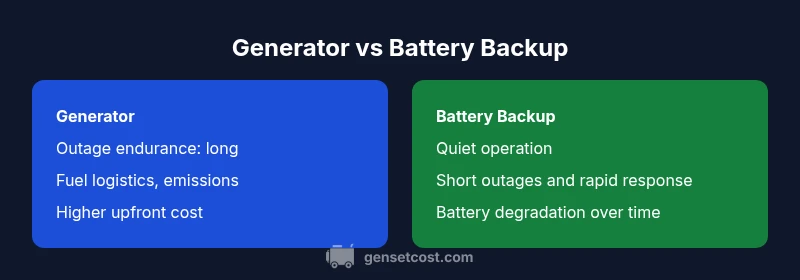
Which backup solution makes the most sense for your home depends on outage length, loads, and budget. In general, a generator provides sustained power for longer outages and heavy loads, while a battery backup excels in quiet operation for short outages and rapid response. According to Genset Cost, the best choice hinges on your typical use case, installation constraints, and planned maintenance. A hybrid approach can offer balance between resilience, cost, and convenience.
The Core Difference: Generator vs Battery for Home Backup
At its core, a generator converts fuel into electricity on demand, delivering instant power to your home through a transfer switch. A battery backup stores energy, typically charged from the grid, solar, or a dedicated charger, and releases it as needed through an inverter. When evaluating generator vs battery for home backup, consider outage duration, peak loads, and how quickly you need power to come back online. Batteries are excellent for silent operation and instant rescue during short outages, whereas generators shine in longer outages or when heavy appliances demand substantial surge capacity. For most households, the decision isn’t binary; many homeowners pursue a hybrid approach that blends the strengths of both.
The Core Difference: Generator vs Battery for Home Backup (continued)
Looking at reliability, a generator relies on fuel availability, maintenance, and proper venting, while a battery relies on charge state, temperature, and inverter health. In practice, you’ll often see people use a generator for essential circuits during multi-day outages and a battery backing up critical loads like routers, sump pumps, and fridges during shorter outages. The choice should align with how you experience outages in your area and how comfortable you are with ongoing maintenance and fuel logistics.
The Core Difference: Generator vs Battery for Home Backup (continued)
From a mental model perspective, imagine resilience as a portfolio: batteries hedge against short disruptions with quick response, and generators provide endurance for extended events. In grid-tied homes with solar, batteries become part of a broader energy system that reduces grid dependence, while generators stand as a primary line of defense when solar isn’t enough or during extended outages.
Comparison
| Feature | Generator | Battery Backup |
|---|---|---|
| Outage duration suitability | Best for extended outages with fuel stockpiles | Best for short, predictable outages and daily cycling |
| Upfront cost | Typically higher (generator + transfer switch, exhaust routing) | Typically lower upfront (inverter + battery + charger) |
| Operating cost | Fuel, oil, maintenance; periodic servicing | |
| Maintenance frequency | Regular engine service, fuel system checks, oil changes | Battery health tests and inverter servicing |
| Noise level | Audible runtime with enclosure requirements | Near-silent operation depending on setup |
| Emissions | Direct fossil-fuel emissions during operation | No direct emissions when charged from clean sources |
| Space requirements | Outdoor location with venting; exhaust routing needed | cabinet or closet with ventilation; indoor options possible |
| Installation complexity | High; transfer switch, fuel supply, ventilation | Medium; electrical integration with charging source |
| Resilience to weather | Depends on fuel stability and engine protection | Battery performance affected by temperature unless climate-controlled |
The Good
- Provides long-term resilience for frequent, multi-day outages
- Supports high-load scenarios with reliable fuel supply
- Well-established infrastructure and service networks
- Hybrid configurations offer flexibility and future-proofing
The Bad
- Higher upfront cost and ongoing fuel/maintenance needs
- Fuel logistics, venting, and noise restrictions require planning
- Battery systems can degrade in extreme temperatures without climate control
- Perceived complexity of integrating with solar or demand management
Hybrid solutions often offer the best balance for most homes
If outages are common and loads are large, a generator plus battery can cover long events and provide rapid restarts. For shorter outages and quieter operation, batteries shine, especially when paired with solar. The optimal path usually blends both technologies to maximize resilience while controlling costs.
People Also Ask
What is the main difference between a generator and a battery backup?
The main difference is how they supply power. A generator runs on fuel and can sustain long outages, while a battery backup stores energy and delivers quick power for short outages. Your choice depends on outage duration, loads, and installation constraints.
Generators run on fuel for longer outages, batteries provide quick power for short disruptions. Your choice hinges on outage length and loads.
Can I power an entire house with a battery backup?
Whole-house battery backups are possible but uncommon for existing homes without a properly sized system and a large inverter. Most homeowners power essential circuits during outages and reserve full-house capability for combined grid charging and solar storage.
Yes, but it usually requires a large, carefully sized system with an appropriate inverter and smart load management.
Do I need a transfer switch for both options?
Yes. A transfer switch safely isolates the backup system from the grid and ensures seamless transfer of power to chosen circuits. The setup differs: generators need a mechanical or automatic transfer switch; batteries typically require an inverter/charger with a transfer mechanism for critical loads.
Yes, a transfer switch is essential for safe, clean switching between grid and backup power.
Are battery backups compatible with solar panels?
Many battery backups are designed to be charged by solar, the grid, or a dedicated charger. When paired with solar, they can reduce grid dependence and provide daytime charging for nighttime outages. Always verify inverter specs and charge control limits.
Yes, most batteries can be charged from solar, which helps with daytime charging and outage resilience.
What maintenance do generator vs battery require?
Generators require regular engine maintenance, fuel stabilization, and periodic testing. Batteries require thermal management and periodic inverter checks, with battery health monitoring over time. Both need professional service at recommended intervals.
Gens need tune-ups and fuel care; batteries need health checks and temperature management.
What is the typical lifespan of these systems?
Lifespan varies by model, usage, and maintenance. Generators often last many thousands of hours with proper service; batteries have a finite cycle life and may require replacement every several years depending on chemistry and temperature.
Generators last long with maintenance; batteries need replacement after several years, depending on use and climate.
Key Takeaways
- Assess outage length and critical loads before choosing
- Consider a hybrid system to balance cost and resilience
- Plan for transfer switches and proper installation
- Factor climate and temperature into battery longevity
- Include maintenance and scheduling in your long-term plan