Generator Specs: A Practical Guide to Sizing and Installing Home Backup Generators
Learn how to read generator specs—rated output, surge, voltage, phase, fuel, runtimes, and efficiency. This guide helps homeowners size correctly, compare options, estimate costs, and plan installation for reliable home backup power.


According to Genset Cost, generator specs are the technical details that define a unit’s capability and suitability, including rated output (kW/kVA), surge capacity, voltage, phase, runtime, fuel type, engine type, and efficiency. These specs help homeowners and property managers size, compare and install reliable backup power systems, while estimating costs and ensuring code compliance.
What generator specs cover
Generator specs encompass the core dimensions of a backup unit: rated output expressed in kilowatts (kW) and kilovolt-amperes (kVA), surge capacity for startup guidance, voltage and phase (single-phase vs three-phase), runtime under nominal load, and the fuel type. Additional elements include engine design, efficiency, noise levels, and relevant certifications. Professionals and homeowners use these details to determine whether a model can handle essential circuits, such as lighting, refrigeration, and HVAC, during a grid outage. Understanding generator specs also clarifies installation needs, transfer-switch compatibility, and long-term operating costs. In short, specs translate a box of features into real-world performance.
Actionable takeaway: Always start with the essentials—power output, surge, fuel, and runtimes—then layer on compatibility with your home’s electrical system.
Reading the core spec categories
To compare generators effectively, break specs into categories: (1) Power fundamentals (kW/kVA, surge), (2) Electrical characteristics (voltage, phase, Hertz, efficiency), (3) Fuel system (type, availability, emissions), (4) Mechanical and environmental (engine type, cooling, noise, altitude derating), and (5) Certifications and warranties. Mapping each category to your needs yields a side-by-side view that reveals true differences rather than marketing gloss. For homeowners, a defined checklist makes it easier to spot gaps between a unit’s stated capabilities and your actual load profile.
Tip: Create a quick reference template that lists your critical loads and their wattage to compare against each candidate model.
Reading power output: kW vs kVA and efficiency
Power ratings come in two related but distinct forms: kW (real power) and kVA (apparent power). The relationship depends on the system’s power factor (PF), commonly 0.8 for residential gensets. A generator rated at 12 kW likely presents about 15 kVA when PF is 0.8. This distinction matters because you may be tempted to match kW numbers without considering surge, efficiency, or how your circuits will draw current. Efficiency (fuel use per hour) also affects running costs and runtime. When assessing specs, convert where needed and confirm that the unit’s continuous rating aligns with your essential load.
Practical note: If you expect to run high-draw appliances, ensure the surge rating can cover startup spikes without tripping.
Surge capacity and startup loads
Surge capacity is the extra power a generator can deliver momentarily to start motors and other high-inrush devices. A mismatch between surge and startup requirements can lead to nuisance tripping or reduced performance. When sizing, aim for a surge margin that accommodates your worst-case starter loads—typically 1.25x to 2x the running load for brief periods. If several large loads start simultaneously, your surge needs grow accordingly. Do not overlook this facet, because real-world performance hinges on it.
Checklist: List each device’s startup wattage, then verify the combined surge with your shortlisted models. If uncertain, opt for a generator with a higher surge rating to avoid surprises during outages.
Voltage, phase, and distribution considerations
Most homes in North America rely on 120/240 V single- or three-prong circuits, but some setups require three-phase service for commercial buildings or specialized labs. Generator specs should indicate compatible voltages and available phases. If you have a 240 V transfer switch, ensure the genset can sustain the necessary phase configuration. Also consider the distribution of critical circuits—perhaps dedicated transfer switches for HVAC or well pumps—to optimize load balancing and minimize energy waste. Finally, verify that the generator’s output harmonizes with local electrical codes and utility interconnection standards.
Guidance: Consult an electrician to determine whether a single-generator, multi-circuit approach is best for your property and to tailor wire sizing and protection accordingly.
Fuel types, runtimes, and fuel consumption
Fuel type greatly shapes a generator’s cost and practicality. Gasoline systems are common and flexible but may offer shorter runtimes compared with propane or natural gas, which can be more stable and readily available in some regions. Each fuel type has a characteristic energy content and consumption rate; runtimes vary with load, tank size, and efficiency. When evaluating specs, compare both the running time at your expected load and the fuel availability in your area. If you’re in a high-demand climate, you might prioritize a larger tank and refill strategy to maximize outage coverage.
Tip: If you rely on natural gas, confirm line pressure and regulator requirements with your installer to ensure stable output under heavy load.
Sizing approach: load calculation and demand factors
A practical sizing workflow starts with a comprehensive load calculation. List every device you intend to back up, note each device’s wattage, and apply demand factors for non-essential loads (e.g., outdoor lighting). Add a safety margin and then select a generator whose running rating comfortably exceeds this adjusted total. Many homeowners overlook the need for a dedicated subpanel or transfer switch, which can complicate installation and raise operational risk. The goal is a generator that can reliably handle your essential loads without excessive fuel use or underutilization.
Process tip: Use a two-step method—(1) determine your critical load in kilowatts, (2) select a unit with 1.25x to 1.5x that running rating to cover startup surges and evolving needs.
Standby vs portable: how specs differ
Standby generators are designed for automatic operation with a transfer switch and a fixed installation, often delivering higher, continuous-rated power and better efficiency for long outages. Portable generators are cheaper upfront and easier to move but require manual setup, proper ventilation, and robust safety practices. Specs differ: standby units emphasize continuous duty, network interconnection, and automatic switching, while portable units highlight portability, simple fuel options, and lower upfront cost. Before buying, decide whether you need full-time home backup or occasional temporary power.
Decision factor: If you expect frequent outages or you have critical systems, prioritize a standby model with a solid transfer-switch setup.
Installation, clearance, and compliance implications
Installation complexity drives total cost and system reliability. You’ll need safe clearance from combustibles, venting for exhaust, and proper placement away from doors or windows. Codes often require a transfer switch, weatherproof enclosure, and appropriately sized wiring with protective devices. Permit requirements vary by jurisdiction, so coordinate with a licensed electrician and your local building department. A well-planned installation reduces safety risks and ensures that the generator operates within its design envelope during events like heat waves or winter storms.
Tip: Document all components, keep receipts, and schedule routine professional maintenance to sustain performance and comply with warranty requirements.
Common myths about generator specs
Myth 1: Bigger is always better. Reality: Oversizing wastes fuel, increases upfront costs, and adds unnecessary maintenance burden. Myth 2: You only need peak power. Reality: You must consider continuous running needs, surge, and partial loads, not just maximum output. Myth 3: Any generator will do if it’s labeled ‘standby.’ Reality: Compatibility with your transfer switch and wiring, along with local codes, is essential. Myth 4: All fuels perform the same. Reality: Fuel type influences cost, availability, emissions, and runtime. Challenging myths with data helps ensure the right choice for reliability and total cost of ownership.
Choosing the right generator: a step-by-step example
Step 1: List critical loads (refrigerator, furnace fan, well pump, lights, router). Step 2: Estimate total running watts and startup surge. Step 3: Apply a 1.25x–1.5x margin for startup and future needs. Step 4: Compare models that meet this running rating with adequate surge. Step 5: Verify fuel type availability, noise limits, and installation costs. Step 6: Plan for professional installation, transfer switch compatibility, and warranty terms. This approach yields a recommended range rather than a single model, helping you choose a generator spec that aligns with your home’s load profile and maintenance expectations.
Common generator spec values for home backup systems
| Category | Typical Range | Notes |
|---|---|---|
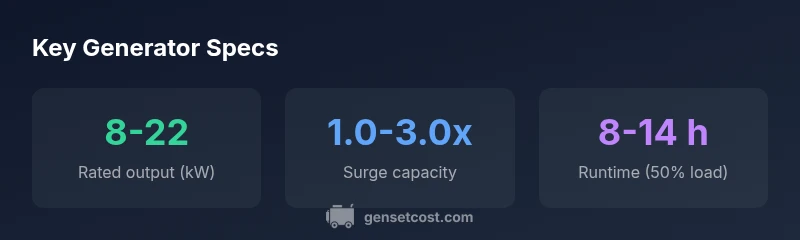
| Rated output (kW/kVA) | 8-22 kW / 10-28 kVA | Residential standby range |
| Surge capacity | 1.0-3.0x | Startup spikes for motors and compressors |
| Voltage | 120/240 V or 240 V 1-phase | Common in North America |
| Phase | 1 or 3 | System configuration |
People Also Ask
What are the core components of generator specs?
Core components include rated output (kW/kVA), surge capacity, voltage, phase, fuel type, and runtime. Additional specs cover engine design, efficiency, noise, and certifications.
Core specs include power, surge, voltage, fuel, and runtime. Check the rest for installation planning.
How do I convert between kW and kVA?
kW measures real power; kVA is apparent power. Use a power factor, typically 0.8 for residential generators, to convert: kW = kVA × PF.
Use kW and kVA with a PF of about 0.8 to convert.
What does surge capacity mean for startup loads?
Surge capacity is the extra power a generator can deliver momentarily to start motors and other high-inrush devices. It should be 1.25x–2x the running load for brief periods.
Surge capacity is the extra burst power on startup; plan for it.
Do all generators run the same fuel types?
No. Generators come in gasoline, propane, and natural gas options. Fuel choice affects availability, cost, emissions, and runtime.
Fuel type affects availability and runtime; pick what fits your system.
Are standby generators required to be installed by a pro?
Standby systems often require permits, transfer switches, and electrical connections that meet safety codes; professional installation is strongly recommended.
Most standby systems should be installed by a licensed pro.
Can I upgrade an existing generator’s specs?
Upgrading specs typically involves replacing major components or the entire unit. Consider compatibility with transfer switches, wiring, and loads; consult an electrician.
Upgrading is usually non-trivial; check compatibility and codes.
“Accurate generator specs are the foundation of a reliable backup system. Without them, sizing and installation drift into costly misalignment.”
Key Takeaways
- Start with core specs: power output, surge, voltage, and fuel.
- Remember kW vs kVA and use PF 0.8 for conversions.
- Plan for surge and startup loads to avoid nuisance trips.
- Choose fuel type based on availability, cost, and emissions.
- Ensure installation, transfer switch, and codes are aligned with your loads.