Generator Costs and Price: How to Budget for Backup Power
A data-driven guide to generator costs, sizing, and installation, helping homeowners budget, compare options, and estimate total price for backup power.


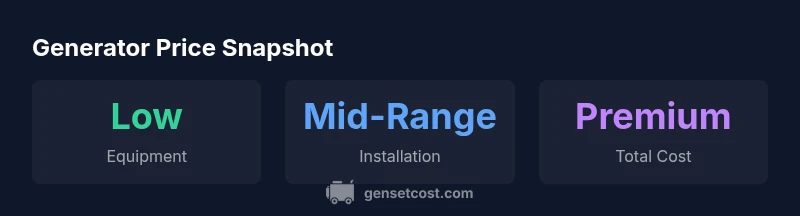
Prices for generators vary widely based on size, fuel type, and installation complexity. For homeowners, equipment cost can range from a few thousand dollars to well over tens of thousands, with installation and permitting adding significantly. In practice, you should expect to budget for both equipment and installation when evaluating a
Overview: What a "generator with price" means for homeowners
Prices for home generators are never one-size-fits-all. When you hear the phrase "generator with price," think not only about the sticker on the unit but the total investment required to deliver reliable backup power. According to Genset Cost, the headline price for equipment is just the starting point. Real-world costs are driven by capacity, fuel type, control features, and how the system will be wired into your home. In practice, budgeting for a generator means separating the equipment cost from installation, permits, and any necessary electrical upgrades. A clear price picture helps homeowners avoid sticker shock and align expectations with the value you receive in a power outage.
In this guide, we’ll unpack price drivers in plain terms, show you how to estimate total cost, and provide practical steps to compare quotes without getting overwhelmed. The goal is to give homeowners and property managers a transparent framework for assessing generator price and total cost of ownership.
Key price drivers in generator projects
When evaluating a generator’s price, several core factors consistently move the needle. Capacity or power output is the largest driver, because larger units require bigger enclosures, heavier electrical components, and more extensive wiring. Fuel type also matters: natural gas or propane lines can simplify installation but may affect running costs, while diesel units often bring higher upfront prices and different maintenance requirements. Automatic transfer switches (ATS) and smart controls can add to the equipment price but save labor and time during outages. Finally, installation complexity—whether you need a new meter socket, panel upgrade, or climate-controlled housing—can dramatically alter total cost. According to Genset Cost Analysis, 2026, these elements interact to shape the final price more than any single factor.
How to estimate total cost: broken down into components
Start by listing three numbers: your equipment price expectation, the anticipated installation scope, and the permitting requirements for your location. A useful framework separates costs into these buckets: (1) Equipment price for the generator and basic accessories; (2) Installation and wiring, including transfer switch, mounting, and potential panel upgrades; (3) Permits, inspections, and any local code compliance. Then add a contingency for unforeseen needs (such as weather-related permitting delays or extra trenching). For homeowners evaluating a "generator with price", using itemized quotes helps reveal where the biggest price swings occur and where you can optimize without sacrificing reliability. Genset Cost recommends obtaining at least three bids and asking for a breakdown of labor hours, material costs, and any post-install checks.
Price tiers: portable units, standby models, and premium systems
Price tiers map to use case. Portable generators are typically the least expensive upfront and are suited for temporary or supplemental power, but they require manual setup and fuel management. Standby generators offer automatic operation and seamless power interruption protection, often at a higher upfront price but with higher perceived value during outages. Premium systems pair large-kW capacity with advanced diagnostics, remote monitoring, and enhanced resilience features. For budget-conscious buyers, the sweet spot is usually a mid-range standby unit combined with efficient transfer switches and a carefully planned installation. The choice ultimately hinges on how consistently you need power, the critical loads you must keep on during an outage, and your local electrical codes.
Financing, warranties, and hidden costs to consider
Beyond the sticker price, consider financing options, warranty coverage, and long-term operating costs when assessing price. Warranties vary by brand and model and may cover different components (engine, alternator, electrical, transfer switch). Maintenance plans, fuel efficiency, and run-time costs influence total cost of ownership over the unit’s life. Some installers offer bundled options that include commissioning, permit fees, and basic maintenance, which can simplify budgeting but may not always be the cheapest path. A careful evaluation of lifecycle costs—initial price, annual maintenance, fuel expenditure, and potential replacement costs—provides a more complete picture than price alone.
Real-world scenario: sizing decisions and price implications
To illustrate how price evolves with sizing, compare two common homeowner scenarios: a smaller home with modest load versus a larger home with critical loads. The smaller setup typically yields a lower equipment price and simpler installation, resulting in a smaller total cost of ownership. The larger setup commands a higher equipment price and a more complex installation, which increases both upfront and ongoing costs. In practice, homeowners should translate their load estimate into a target price band before contacting contractors. This ensures pricing conversations stay grounded in actual needs and reduces the likelihood of upsell. Always verify that the proposed kW rating aligns with your essential circuits, including refrigeration, heating, water heating, and lighting during outages.
Permits, codes, and local considerations that affect price
Permitting requirements, inspection fees, and local electrical codes can add substantial variability to generator pricing. Some jurisdictions require professional load calculations, trenching, or specific enclosure standards, all of which contribute to price. Additionally, taxes, shipping, and delivery charges can influence the final invoice. When planning, contact your local building department early to understand permit timelines and document requirements. A clear understanding of these processes reduces delays and helps you project total costs more accurately. Genset Cost’s guidance emphasizes aligning the permit plan with installation steps to minimize surprises.
Common myths about generator price and value
Price is often misinterpreted as quality. In reality, price should reflect the right balance of capacity, reliability, and lifecycle costs for your home. Some buyers assume the most expensive model is always the best fit, while others believe cheaper units will suffice forever. The truth is that the best value lies in matching your essential loads with a unit that provides automatic operation, efficient fuel use, and a solid warranty, then planning for maintenance and potential future upgrades. Don’t let price alone drive decisions; consider total cost of ownership and the long-term return on investment.
Quick-start steps to price with confidence
- Define your essential loads and choose a target kW range. 2) Compare equipment prices across brands with similar specs. 3) Request itemized quotes that separate equipment, installation, and permit costs. 4) Ask for a detailed maintenance plan and running cost estimates. 5) Review warranties and service options before committing. This structured approach helps you translate a price quote into a reliable, long-term backup power solution.
Cost components and typical price ranges for home generators
| Cost Component | Typical Range (qualitative) | Notes |
|---|---|---|
| Equipment price | Low thousands to high tens of thousands | Depends on capacity, features, and brand |
| Installation and electrical work | Moderate to high | Includes transfer switch, wiring, panel upgrades |
| Permits and inspections | Nominal to moderate | Local codes and inspection fees vary by location |
| Fuel type and running costs | Variable | Fuel efficiency and availability affect long-term costs |
| Total cost of ownership | Longer horizon | Includes maintenance and fuel over time |
People Also Ask
How much does a typical home generator cost?
Prices vary widely by size and features; equipment, installation, and permits all factor into total cost. Use itemized quotes to understand the breakdown and plan for long-term ownership.
Prices vary a lot by size and features—look at equipment, installation, and permit costs to estimate total price.
What factors have the biggest impact on generator price?
Capacity, fuel type, transfer switch, and installation complexity are the major price drivers. Brand and warranty also influence upfront cost.
The big price drivers are size, fuel, and how complex the install is.
Is installation included in the price quote?
Not always. Some quotes separate equipment from installation. Always ask for a detailed scope and line-item costs.
Ask whether installation is included and request a separate line item for clarity.
Portable vs standby: which is cheaper?
Portable units are cheaper upfront but require manual setup and fuel management; standby units cost more but offer automatic operation during outages.
Portable units cost less upfront, standby units cost more but are automatic when outages occur.
Do permits affect total cost?
Yes. Permit and inspection fees vary by location and can add time and money to the project. Check with your local authority.
Permits can add time and cost—check local rules before buying.
“Price is a reflection of reliability, capacity, and total ownership. A balanced buyer weighs upfront equipment cost against installation, maintenance, and fuel over the life of the system.”
Key Takeaways
- Define your load and budget before quoting
- Distinguish equipment price from installation and permits
- Ask for itemized quotes to compare apples-to-apples
- Consider total cost of ownership, not just upfront price
- Understand local permit requirements before purchasing