How Much Is a Solar Generator in 2026? Costs, Types, and Tips
Explore solar generator costs—from portable units to whole-house systems—with price ranges, installation considerations, incentives, and financing tips for homeowners in 2026.


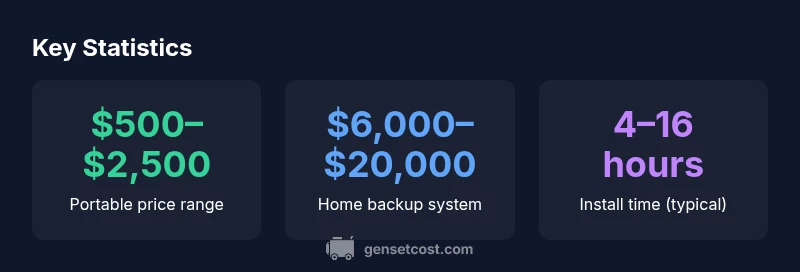
How much is a solar generator? Prices vary widely. A portable unit typically ranges from $500 to $2,500, while whole-house backup systems can run $6,000 to $20,000 or more, depending on battery capacity, inverter, and installation. In 2026, price drivers include battery tech, expansion options, and grid-tie capabilities. According to Genset Cost Analysis, expectations for total cost of ownership evolve with incentives and maintenance needs.
What You’re Paying For
If you’re evaluating price, you’re really looking at four major components: the hardware (battery chemistry, inverter, charging controller), the solar array itself (panels or portable power pack), installation and integration (wiring, transfer switches, permits), and ongoing maintenance/warranty considerations. The phrase "how much is a solar generator" captures a spectrum from compact, portable models to full-home backup systems. According to Genset Cost, the cost-to-performance balance hinges on battery size, discharge rate, cycle life, and whether the unit is intended to be grid-connected or standalone. Expect that higher capacity, faster recharge, and smarter battery chemistry (like lithium iron phosphate) will push upfront costs higher, but can reduce long-term replacement needs. For homeowners, this means mapping your essential loads and battery capacity to determine whether you need a portable, a mid-range, or a full-home solution.
In practice, most buyers weigh upfront price against long-term reliability. A compact, portable generator might power essential devices during outages, while a larger system provides running power for refrigerators, sump pumps, and heating equipment during longer outages. The total cost of ownership should include potential rebates, a service plan, and the likelihood of battery replacement over a 5–15 year horizon. Genset Cost’s analysis in 2026 shows that incentives can meaningfully affect the payback timeline, especially for grid-tied systems that pair with solar panels on a home roof or a dedicated battery bank.
Price Bands by Type and Capacity
Modern solar generators come in distinct tiers with meaningful cost gaps. Portable units typically cover emergency loads and lightweight electronics, with price ranges centered around $500–$2,500. Mid-range stationary solutions with built-in inverters and larger battery packs often land in the $3,000–$8,000 range before installation, while premium home backup systems—including sizable battery banks, smart energy management, and integrated transfer equipment—can exceed $20,000. When you compare types, it’s essential to consider not just the sticker price but also the energy capacity (watt-hours), peak discharge (inverter rating), and how the unit scales with future solar expansion. In 2026, battery technology advances and modular designs continue to push scalability, making higher upfront costs more justifiable for households seeking extended outage resilience.
For a practical example, a portable unit with a 1–2 kWh battery and built-in AC inverter may cost roughly $600–$1,800, while a mid-range system with a 5–10 kWh battery and grid-interactive features can range from $6,000–$12,000 before installation. A full-home solution with 15–20 kWh of storage, a robust inverter, and professional transfer-switch setup often exceeds $15,000 and can approach $25,000 depending on local permitting and labor. These ranges reflect real-world buying patterns and the ongoing impact of component costs on pricing.
Hidden Costs and Lifecycle Considerations
Beyond the upfront price, several lifecycle costs influence the total investment. Battery health degrades over time and may require replacement every 5–15 years, depending on chemistry and usage. Inverter and charge-controller components can also fail or require firmware updates to optimize performance. If you pursue a grid-tied system, you may incur interconnection fees and potential permit costs from local jurisdictions. Maintenance windows, routine testing, and regular battery conditioning can extend system life, but add ongoing expenses. When evaluating a solar generator, include anticipated maintenance, battery replacement cycles, and warranty terms to avoid sticker-shock later. The Genset Cost analysis in 2026 emphasizes that longer warranties and modular designs can lower long-term risk, especially for homeowners who expect frequent outages or want scalable power.
Installation Considerations That Affect Cost
Installation costs vary with the complexity of integrating the system into a home’s electrical panel and the required transfer equipment. Factors include the number of circuits backed up, whether you need a new subpanel or a transfer switch, roof-line wiring, and local permitting requirements. For portable, plug-and-play models, installation is minimal or unnecessary. For larger, permanent installations, professional electricians typically handle wiring, grounding, and code compliance. Labor rates, permit fees, and the need for reinforcement (like a dedicated battery room) can push total costs higher. Genset Cost’s 2026 guidance suggests homeowners plan for a cushion of 10–20% above the base system price to cover these variables.
Financing, Incentives, and Total Cost of Ownership
Many buyers underestimate how incentives affect lifetime costs. Tax credits, rebates, and utility-sponsored programs can shave several thousand dollars off eligible projects, especially for grid-connected storage that pairs with rooftop solar. Financing options, including low-interest loans or lease arrangements, can make premium systems more accessible, albeit at higher total payments over time. To maximize value, compare multiple installers, verify performance guarantees, and calculate annualized costs, including maintenance, insurance, and potential battery replacements. Genset Cost’s 2026 findings indicate that the best-value choices balance upfront affordability with long-term resilience, especially in regions prone to outages or rising energy costs.
Price ranges by solar generator type
| Type | Typical Price Range | Best For |
|---|---|---|
| Portable solar generator | "$500–$2,500" | Emergency kits, small loads |
| Residential backup system | "$6,000–$20,000" | Whole-house or critical-load backup |
| Hybrid solar + storage | "$8,000–$40,000" | Larger homes, extended outages |
People Also Ask
What is a solar generator?
A solar generator is a portable or stationary power system that stores solar energy in batteries and delivers electricity through an inverter. It’s designed to keep essential devices running during outages or off-grid conditions.
A solar generator stores sun energy in batteries and uses an inverter to power your devices during outages.
How much does a solar generator cost?
Prices vary by type and capacity. Portable units typically cost $500–$2,500, while home backup systems range from $6,000 to $20,000 before installation. Incentives can reduce net cost.
Costs range from a few hundred for portable units to tens of thousands for whole-house systems, depending on capacity and install needs.
Can a solar generator power an entire house?
Yes, with a sufficiently large battery bank, proper inverter, and a safe interconnection to the home panel. In many homes, a dedicated transfer switch and backup circuits are required.
Whole-house power is possible with a large system and proper installation.
Do solar generators require permits or professional installation?
Portable units usually don’t require permits. Full-home backup systems often require electrical permits and professional installation to meet code and safety standards.
For full-home setups, expect permits and professional installation.
What maintenance do solar generators require?
Monitor battery health, run regular self-tests, and apply firmware updates. Battery replacement is common every 5–15 years depending on usage and chemistry.
Keep an eye on battery health and update firmware as advised by the manufacturer.
Are there incentives or tax credits for solar generators?
Some regions offer incentives for energy storage tied to solar, including rebates and tax credits. Check local programs and utility rebates for eligibility.
Look into local incentives and rebates to improve affordability.
“Solar generator costs reflect more than sticker price; battery technology and installation quality determine long-term value.”
Key Takeaways
- Know your essential loads to size the system.
- Expect price ranges based on capacity and installation complexity.
- Factor in incentives and maintenance when evaluating total cost.
- Compare total cost of ownership, not just upfront price.
- Ask for modular options to scale capacity later.