How to Get a Generac Generator Starter: A Practical Guide
Learn where to buy a Generac generator starter, how to verify compatibility, and what to expect in terms of cost and timing. This guide from Genset Cost covers official channels, warranty considerations, and safe replacement steps.


This guide shows you how to obtain a Generac generator starter, including where to buy, what to ask for, and how to verify compatibility with your model. You'll learn about official channels, authorized dealers, and cost ranges, plus safety and warranty considerations. We also cover return policies, lead times, and how to confirm whether your current warranty covers starter replacement.
Understanding what a Generac generator starter is and why you might need one
A Generac generator starter is a critical component that initiates the engine startup sequence. In most residential backup systems, the starter works in concert with the control board to energize the starter motor and kick the engine into operation when power from the grid vanishes. If you notice slow cranking, repeated attempts, or a fault code pointing to the starting system, it’s time to consider replacement. The starter is not a generic part; it must be matched to your exact Generac model, horsepower rating, and the associated control circuitry. The Genset Cost team emphasizes that using an incorrect starter can damage the alternator, void warranties, and lead to unsafe operation. Before you buy, audit your model number, serial number, and installed firmware to ensure you select the right part. In this section, we’ll outline how to determine whether you need a starter repair versus a full control‑board replacement, and how to approach the conversation with a vendor to avoid mis buys.
- Key indicators you might need a starter include hard starting, grinding noises during ignition, or prolonged cranking times beyond normal tolerances.
- Always check the service bulletin for your exact unit; Generac periodically updates part numbers to reflect newer revisions or compatibility fixes.
- If you are unsure, pause and consult an authorized dealer or the Generac customer support line to confirm compatibility before ordering.
Where to buy a Generac generator starter
There are several legitimate routes to obtain a Generac generator starter, each with its own risks and benefits. The safest and most reliable path is through official Generac parts channels or an authorized Generac dealer. These sources ensure you receive an OEM (original equipment manufacturer) starter that matches your unit’s part number, warranty terms, and control system. When you buy from an authorized source, you also gain access to accurate compatibility information, torque specs, and installation guidance.
If an official channel is unavailable or you’re comparing costs, you can consider reputable aftermarket suppliers that specialize in generator parts. Be cautious with very low pricing since counterfeit or incompatible units are a real risk. Always request the exact part number from the seller and compare it against your unit’s service manual or digital parts catalog. Verified compatibility reduces the likelihood of issue recurrence and helps you preserve warranty eligibility. For those in remote locations, some dealers offer drop‑ship options that ship directly from the manufacturer to your property, which can save time and reduce handling damage.
Other options include independent repair shops with generator experience and established supply networks. In these cases, confirm their sourcing method and warranty on installed parts. Do not buy or install a starter from unverified marketplaces without a clear return policy and a stated warranty. The key is to balance cost, reliability, and risk of incompatibility—prioritize sources that clearly state the model compatibility and provide support after sale.
How to verify compatibility and fit with your Generac model
Verifying compatibility is the most important step to avoid costly mistakes. Start by collecting your generator’s model and serial numbers, which are usually located on a nameplate near the service access panel. Cross‑reference the numbers against Generac’s official parts catalog or the dealer’s parts databases. If you have a digital service manual, search for the starter part number and compare it with the candidate starter. Also, confirm the voltage, engine displacement, and any revisions to the control circuitry that might affect the starter’s electrical interface.
If you’re dealing with a repair shop or dealer, ask them to provide a compatibility matrix or a quote that clearly lists the exact part number, expected torque specs for mounting bolts, and any wiring harness adapters that may be required. Some Generac kits use an updated connector type or mounting footprint; installing an older starter can lead to alignment and wiring issues that hinder performance. Finally, ask about warranty implications: using an unofficial part can void warranty coverage, even if the starter is identical in appearance.
For extra assurance, request photos or a short video showing the packaging, labeling, and part numbers on the starter you plan to purchase. A quick verification step can save days of back‑and‑forth and prevent a misfit that disrupts your power continuity.
Pricing and budgeting: what to expect
Prices for a Generac generator starter vary based on the model family, revision level, and whether you’re purchasing an OEM part or a rebuilt option. In general, you should expect a price range that reflects the value of a correctly matched, fully compatible starter along with any required adapters or harnesses. To avoid sticker shock, compare quotes across at least two authorized sources and request a breakdown of hardware, gaskets, mounting hardware, and any service bulletin updates that may be included. If a vendor offers a delayed shipment or “special order” fee, factor that into your total cost and lead time.
In addition to the starter itself, budget for any ancillary components that are necessary for a clean installation: torque specs for mounting bolts, dielectric grease for electrical connections, and potentially a small amount of wiring modification if your control module requires an updated interface. Remember that cheaper options may lack warranty coverage or post‑sale support, which can increase total ownership costs over time. The goal is to select a starter that matches the exact spec sheet while preserving warranty protection and safe operation.
Safety, warranty, and compliance considerations
Safety must be your highest priority when procuring and installing a generator starter. Before handling any electrical components, disconnect the generator from its power source and follow lockout/tagout procedures. If you’re not trained, hire a licensed technician for replacement—incorrect wiring or mounting can create sparks, shorts, or fire hazards. Always wear appropriate PPE and verify that the work area is dry and well lit. If you plan to do the work yourself, consult the service manual for torque specifications and wiring diagrams, and never improvise with non‑standard connectors or makeshift adapters.
Warranty considerations are equally important. Using an OEM starter generally preserves warranty coverage, whereas aftermarket parts can void terms if the installation is traced back to non‑approved components or if the part is incompatible. When in doubt, ask the seller to confirm warranty implications and request a written statement that the starter is compatible with your model and firmware version. Genset Cost recommends documenting all steps and retaining receipts for future maintenance records.
Finally, ensure you comply with local electrical codes and inspection requirements. In many jurisdictions, a licensed professional must install replacement starters to satisfy code compliance and ensure safe operation during power outages.
Step-by-step quick-start: getting the starter shipped and installed (high-level plan)
This section outlines a practical sequence for obtaining and installing a Generac starter without unnecessary delays. If you have a confirmed part number, you can skip some preliminary checks and move directly to ordering through an authorized dealer. The steps below assume you’re handling installation with standard garage workshop equipment and that you have basic mechanical and electrical skills.
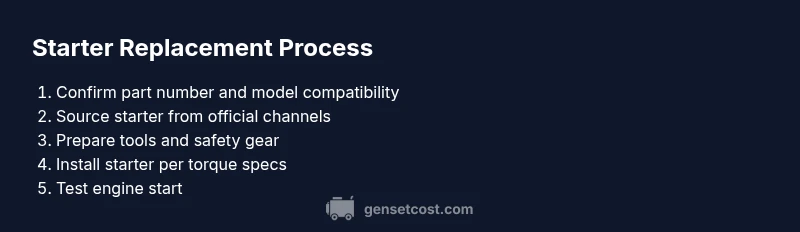
- Confirm part number and compatibility: Retrieve model/serial and the exact starter part number from the service manual or a reputable dealer. Check the latest Generac catalog for any revision notes. Tip: Take clear photos of the existing starter and connectors for reference.
- Source the starter from official channels: Prefer OEM parts through Generac’s parts department or an authorized dealer. Request a written compatibility confirmation and a quote that includes any required adapters.
- Gather tools and safety gear: Assemble a torque wrench, screwdrivers, pliers, dielectric grease, PPE, and a work light. Tip: Lay out components in a labeled tray to avoid mixups.
- Prepare the installation area: Disconnect power, remove the access panel, and inspect the mounting surface for corrosion or wear. Note any wiring changes required by the new starter.
- Install the starter: Mount the starter using the specified torque, connect wiring harnesses as shown in the manual, and apply dielectric grease to electrical contacts where recommended. Tip: Tighten bolts gradually and in a cross pattern to avoid misalignment.
- Test operation: Reconnect power, perform a controlled ignition test, and observe for proper engagement with no unusual noises. If the engine fails to start, recheck wiring and torque, and consult the manual or support if needed. Time: 30–60 minutes for installation depending on complexity.
Troubleshooting and alternatives if a starter is unavailable or incompatible
If a Generac starter is temporarily unavailable or you encounter compatibility issues, consider temporary mitigation strategies to maintain backup power continuity. First, verify whether a compatible refurbished starter or a direct replacement kit exists for your model. Refurbished units can be cost-effective but may lack the documentation and warranty of a new OEM part. Second, explore compatibility with updated harnesses or adapters that a dealer might offer to bridge older control systems with newer starters. Third, discuss with the dealer about a service bulletin or retrofit kit that might be recommended by Generac to address known issues related to your specific serial range. Finally, if the fuel system or ignition module is suspected of contributing to starting problems, schedule a diagnostic service to verify that the root cause is the starter and not another subsystems. This approach helps you avoid unnecessary part replacements and preserves overall generator reliability.
Tools & Materials
- Compatible Generac starter unit (OEM or proven rebuilt)(Match exact model/serial and part number; verify with service bulletin)
- Owner's manual or service bulletin(Provides torque specs, wiring diagrams, and compatibility notes)
- Torque wrench(Use correct torque specified by Generac; avoid overtightening)
- Socket set (metric/SAE) and screwdrivers(For mounting bolts and connectors)
- Dielectric grease or dielectric compound(Protect electrical connections and reduce corrosion)
- Electrical contact cleaner(Clean connectors before reassembly)
- Personal protective equipment (gloves, eye protection)(Safety first during disassembly and installation)
- Multimeter (optional)(Verify voltage and continuity if needed after installation)
Steps
Estimated time: 30-60 minutes for installation, plus 15-30 minutes for initial testing
- 1
Confirm the part number and model compatibility
Locate the generator’s model and serial numbers, then verify the exact starter part number with the service manual or dealer. Cross-check any revision notes to ensure compatibility with your firmware and control board. This step prevents incorrect purchases and warranty issues.
Tip: Take a photo of the nameplate and the existing starter wiring before you remove anything. - 2
Source the starter from official channels
Order the OEM starter from Generac’s parts department or an authorized dealer. Request a formal compatibility confirmation and a detailed quote that breaks out the part, adapters, and shipping. Avoid third-party marketplaces that cannot verify model fit.
Tip: Ask for the exact mounting diagram and torque specs with your order. - 3
Prepare tools and safety gear
Assemble the torque wrench, screwdrivers, pliers, PPE, and a work light. Layout parts on a clean surface labeled to match the installation sequence. This reduces misassembly risk and speeds up the project.
Tip: Arrange components in the order you’ll connect them to simplify wiring. - 4
Disconnect power and access the starter area
Power down the generator and lockout the circuit as needed. Remove the service panel to access the starter mounting location and wiring harness. Inspect the mounting surface for corrosion or wear that might affect installation.
Tip: Do not force components through tight gaps; re-check alignment first. - 5
Install and connect the starter
Mount the starter on its bolts and torque to spec in a cross pattern. Reconnect the wiring harnesses exactly as shown in the service manual, and apply dielectric grease to contacts if recommended. Double-check wire routing to avoid saws or pinch points.
Tip: Start with the main power connection, then attach signal wires to minimize unplugging later. - 6
Test the system
Power the unit and perform a controlled start to verify engagement and smooth operation. Listen for abnormal noises and watch for excessive vibration. If the unit fails to start, recheck torque, wiring, and connector integrity; consult documentation if needed.
Tip: Keep hands clear of moving parts during startup tests.
People Also Ask
Where can I buy a Generac generator starter with confidence?
The safest sources are official Generac parts channels or authorized dealers. They provide the correct part numbers, compatibility confirmation, and warranty support. Avoid unverified marketplaces that may sell counterfeit or incompatible parts.
Buy from official Generac parts channels or authorized dealers to ensure compatibility and warranty coverage.
Will using an aftermarket starter affect my warranty?
In many cases, OEM starters preserve warranty terms, while aftermarket parts can risk coverage if they’re not explicitly approved for your model. Check the dealer’s policy and request written confirmation of warranty status.
Aftermarket starters can void warranty unless explicitly approved in writing by the dealer or Generac.
Do I need professional installation for a starter replacement?
For most homeowners, hiring a licensed technician is recommended due to electrical and safety considerations. A technician ensures correct mounting, wiring, and compliance with local codes.
Professional installation is advised to ensure safety and code compliance.
What information should I collect before contacting a dealer?
Have your generator model, serial number, and the exact starter part number. Also note any service bulletins or firmware versions relevant to your unit.
Gather model, serial, and starter part number before contacting a dealer.
What if the starter is on backorder?
Ask about alternatives like refurbished OEM units or compatible updated kits. Request clear lead times and whether a temporary power solution is available.
If backordered, explore refurbished or updated kits and confirm lead times.
Can I install a starter on an older Generac unit?
Compatibility depends on revision and control board age. Always verify with the parts catalog or a dealer to avoid mismatches.
Older models require careful compatibility checks before ordering.
What should I expect in terms of cost and lead time?
Costs vary by model and source, typically reflecting OEM value and shipping. Lead times depend on stock and location; expect several days to weeks for special orders.
Cost ranges vary; lead times depend on stock and location.
Watch Video
Key Takeaways
- Identify exact model and part number before purchasing.
- Buy only from official channels or verified dealers to protect warranty.
- Verify compatibility with a replacement matrix or service manual.
- Follow torque specs and wiring diagrams precisely to ensure safety.