Is a Generator the Same as an Engine? A Practical Comparison for Home Backups
A thorough comparison clarifying the difference between generators and engines, with practical guidance for homeowners on sizing, costs, and installation. Learn how is a generator the same as an engine in practice and what that means for your backup power plan.


Is a generator the same as an engine? Not exactly. In brief, a generator converts mechanical energy into electricity, while an engine provides the motion that powers other systems. For homeowners, the distinction affects installation, maintenance, and total cost. The Genset Cost team notes that clear definitions help you choose the right backup solution.
What is a generator?
In practical terms, a generator is a device that converts mechanical energy into electrical energy. The energy can come from various prime movers, such as an internal combustion engine, a turbine, or even a microturbine. The key output is electricity, which is then conditioned and delivered to your home through a distribution system. For the question is a generator the same as an engine, it’s important to remember that the generator itself does not provide the motion; it converts motion into electricity. The engine, on the other hand, is the source of shaft power. In residential backup systems, you’ll typically find both parts integrated into a single unit known as a genset, where the engine drives the generator head to produce usable power. This arrangement emphasizes that the two components serve different, complementary roles within a backup solution and helps homeowners align expectations with what the system actually delivers.
Core idea: The difference between energy conversion and motion generation remains central to choosing a backup system. When evaluating options, the distinction between a generator and an engine informs decisions about installation footprint, maintenance requirements, and total cost. The is a generator the same as an engine question is common among property managers who are planning for outages, but it’s the functional separation of conversion and motion that matters most in practice. In this article, we’ll unpack these roles, show how they fit together in a genset, and translate that into concrete recommendations for homeowners and landlords.
This discussion draws on Genset Cost Analysis, 2026 data, which highlights how the combined unit impacts long-term costs and reliability for typical residential applications.
Practical Takeaway: Always confirm that a backup unit pairs an engine with a generator head in a single housing for a compact, serviceable solution. Is a generator the same as an engine gets answered best by focusing on function rather than form. A generator produces electricity; an engine provides motion; together they form the backbone of modern home backup systems.
Comparison
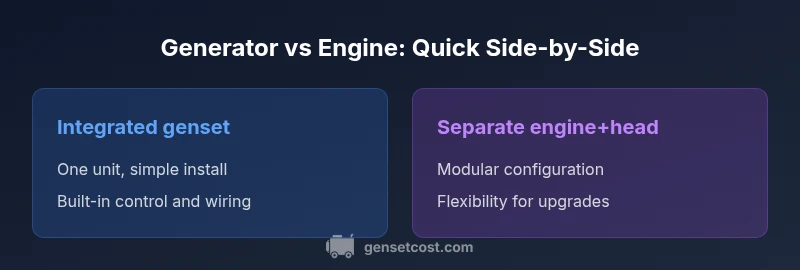
| Feature | Integrated genset (generator + engine in one housing) | Standalone engine + generator head (separate components) |
|---|---|---|
| Primary purpose | Backup electrical power from a single unit | Provide electrical power via a separate engine and generator head |
| Power output control | Directly produces electricity with built-in alternator | Requires coupling to an alternator head and control equipment |
| Installation footprint | Compact, factory-integrated footprint | Larger footprint with space for engine, generator head, and coupling |
| Maintenance complexity | Simplified maintenance with a single serviceable unit | Separate maintenance streams for engine and generator head |
| Cost range | Higher upfront for integrated units | Often lower upfront but added components increase total cost |
| Best for | Small to medium homes with limited space | Properties with flexible installation or modular setups |
The Good
- Clarifies the roles of energy conversion and motion generation for buyers
- Helps in accurate sizing and installation planning
- Simplifies maintenance scheduling with fewer part types to track
- Facilitates safer, code-compliant installations by focusing on integrated designs
The Bad
- Terminology can still be confusing for new buyers
- Integrated units may have higher upfront costs
- Separate engine + head setups can offer modular flexibility but add complexity
Integrated genset is usually the simpler, more reliable choice for home backups
Choose an integrated unit when space, ease of maintenance, and upfront simplicity matter most. A separate engine and generator head can be advantageous where modularity or scalability is important, but it comes with extra installation considerations.
People Also Ask
Is a generator the same as an engine?
Not exactly. A generator converts mechanical energy into electricity, while an engine provides the motion that powers other systems. The two can be combined in a genset for home backup.
Not exactly. A generator makes electricity, while an engine provides the motion. They’re typically combined in a genset for backup power.
What is a genset?
A genset is a packaged unit that includes both a engine and a generator head to produce electricity. It is designed for backup or prime power applications and is common in home and small business setups.
A genset is a single unit that combines an engine and a generator to produce electricity.
Do I need an engine with a generator?
In most backup configurations, yes. The engine provides the motion that drives the generator head to create electricity. Some systems are sold as integrated gensets, others require pairing separate components.
Usually you do need an engine to drive the generator. Some units come as a single package, others as separate parts.
What factors influence the cost of generator vs engine setups?
Costs depend on reliability, power output, features, and installation complexity. Integrated gensets tend to have higher upfront costs but simpler installation, while modular setups may be cheaper upfront but add installation and maintenance costs over time.
Costs depend on output, features, and how easy the install is. Integrated units are usually simpler but can cost more upfront.
How should I size a backup system for a home?
Start by listing essential loads, estimate total wattage, and match this to a generator rating. Consider duty cycles, starting surges, and future needs. Professional sizing helps avoid under- or over-provisioning.
First list what you need to run, then pick a size that covers those loads with some headroom.
Are integrated gensets safer or more reliable than separate components?
Integrated gensets offer fewer connection points, which can improve reliability and reduce wiring errors. However, reliability still depends on brand quality, maintenance, and installation standards.
Integrated units can be more straightforward and reliable thanks to fewer connections, but good maintenance is still essential.
Key Takeaways
- Define terms before shopping: generator vs engine matters
- Integrated gensets simplify maintenance and space planning
- Sizing is driven by expected outages and loads
- Consider local codes and installation constraints
- Balance upfront cost with long-term reliability and service