Difference Motor and Generator: A Thorough Comparison
Compare motors and generators for home backup and automation. Learn how they work, key differences, sizing, and practical guidance to choose the right device.


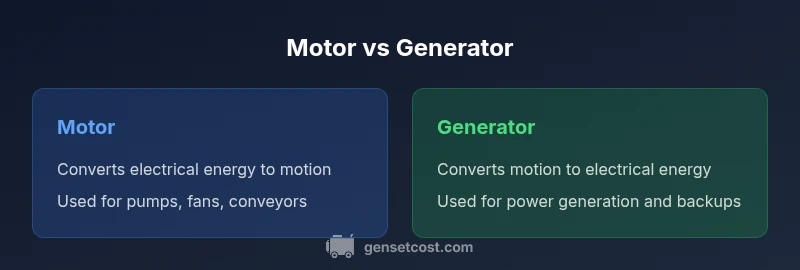
The difference motor and generator lies in energy flow: a motor converts electrical energy into motion, while a generator converts motion into electrical energy. This distinction drives their design, control needs, and best-use scenarios. According to Genset Cost, grasping this difference helps homeowners avoid mismatched equipment and plan more effective backups. In practice, motors drive pumps and fans, whereas generators provide electricity for lights, appliances, and essential systems during outages. This quick overview sets the stage for a deeper, data-informed comparison.
What is a motor and how does it differ from a generator?
A motor and a generator are both electric machines built around a shared core of electromagnetism, yet they perform opposite tasks. In simplest terms, a motor converts electrical energy into mechanical energy (motion), while a generator converts mechanical energy into electrical energy (voltage and current). For homeowners and property managers evaluating backup power, understanding the difference motor and generator is foundational for selecting equipment that meets your needs. According to Genset Cost, recognizing this distinction helps you avoid mismatched equipment, under-sizing, or over-investing in the wrong technology.
In practical terms you’ll encounter motors driving pumps, fans, conveyors, and machine tools, while generators provide the electricity that keeps lights, climate control, and essential circuits running during outages. This article uses plain language and real-world examples to unpack the physics, the design implications, and the installation considerations that stem from the energy flow direction. The goal is to give you a clear decision framework before you start shopping or sizing a system.
Core operating principles
Motors and generators rely on the same physical principles—electromagnetism and relative motion between coils and magnetic fields—but they exploit them in opposite directions. A motor typically uses electrical current in windings to create a magnetic field that interacts with permanent magnets or other windings, generating torque and turning a shaft. A generator, conversely, uses a rotating shaft to induce electrical current in windings through changing magnetic flux. The end result is electrical energy that can be fed back into a panel, stored in batteries, or passed to other loads. The key takeaway for the difference motor and generator is direction: electrical energy in equals motion out for motors; motion in equals electrical energy out for generators. These physics underpinnings shape everything from speed control to efficiency and noise. As you design a system, you’ll consider supply voltage, frequency, starting torque, and the required duty cycle, all of which hinge on whether you’re aiming to drive a mechanical load or generate electricity.
Construction and key components
Motors and generators share core components (stator, rotor, windings, bearings) but emphasize different features. A motor includes windings and rotor geometry optimized for torque production and smooth acceleration, often paired with drives like variable frequency drives (VFDs) to control speed. A generator emphasizes stable voltage regulation, excitation systems, and protective circuits to ensure clean, usable power. Common configurations include AC motors with squirrel-cage rotors and DC motors with commutator assemblies, alongside AC generators (alternators) and DC generators (dynamos). The energy conversion direction again drives the design: motors prioritize torque curves and rapid response to load changes, while generators prioritize voltage stability under varying mechanical input. In a home or small business context, the choice affects mounting, cooling, and enclosure requirements, as well as how the device interfaces with switches, panels, and transfer systems.
How energy flows in each device
Think of energy flow as a path from source to load. In a motor, electrical energy supplied by a controller or power source is converted into mechanical energy at the shaft, which then drives the connected load. In a generator, mechanical energy from an engine, turbine, or prime mover is converted into electrical energy that flows out to a distribution panel or battery charger. The two devices can even be combined in certain applications (motor-generators) to meet specialized needs, but such arrangements add complexity and require precise synchronization. For most homeowners, the distinction means deciding whether you need to move a mechanical system (a pump or compressor) or create power for electrical loads (outlets, lights, HVAC). In either case, proper protection, grounding, and interface with your building’s electrical code are essential to safe operation.
Efficiency, losses, and performance
Efficiency in motors and generators is highly dependent on design, load, speed, and control. Motors tend to be most efficient at their rated load with stable torque and minimal acceleration requirements, while generators achieve optimal performance when mechanical input is steady and electrical output is balanced. Losses come from copper resistance in windings, iron losses in the core, friction in bearings, and windage losses from cooling fans. Because the energy conversion directions differ, noise profiles and vibration patterns often diverge: motors may exhibit higher mechanical noise at high torque, while generators may produce electrical hum and cooling noise under heavy loading. For homeowners, this means that a well-mated system—one that considers starting currents, compatibility with transfer switches, and anticipated duty cycles—is more important than chasing the highest theoretical efficiency.
Control, ratings, and sizing considerations
Devices are rated in terms of voltage, current, power (kW or VA), and duty cycle. In choosing between a motor and a generator, you assess what you must accomplish and how it will be controlled. Motors often require drive electronics to adjust speed and torque (for example, soft-start and variable frequency drive systems). Generators require governors or excitation systems to maintain stable voltage under changing mechanical input. Sizing for a home or small business involves calculating peak loads, ensuring the motor’s starting torque matches the load, and ensuring the generator can handle startup surges. The same caution applies to motors: a mismatched motor can stall or fail to develop adequate torque, creating efficiency losses and potential overheating. A practical approach is to create a load profile and compare the devices against it, then factor in future expansion.
Practical use cases and homeowner scenarios
For a home, a dedicated motor might be used in appliances like sump pumps, well pumps, or HVAC blowers, where reliable motion is essential. A generator is typically chosen to back up critical circuits during outages, providing the electricity needed to power lights, refrigeration, and essential safety systems. In commercial settings, a motor-powered mechanical system can drive industrial equipment, while a generator ensures power continuity for facilities, data centers, and process lines. In both contexts, it’s important to consider startup surges, continuous running baselines, and environmental constraints (noise, heat dissipation, and space). The overarching lesson from the difference motor and generator is to tailor the choice to the primary outcome you aim to achieve and to plan for proper control interfaces and safety interlocks.
Common misconceptions and misapplications
A frequent misunderstanding is to treat motors and generators as interchangeable parts of a single energy system. They are not; they are designed for opposite energy conversions. Another misbelief is that a larger motor automatically provides more conversion efficiency; in reality, efficiency depends on load and design, not size alone. Some people assume a generator will power any load with equal ease; in practice, starting torque and voltage regulation matter for sensitive electronics. Finally, beginners often overlook the need for protective devices, proper wiring, and transfer-switch compatibility when integrating any device into a home backup system. The practical takeaway is that proper sizing, protection, and coordination with existing electrical systems are essential for safety and reliability.
Step-by-step approach to selecting between motor vs generator
Step-by-step approach to selecting between motor vs generator: Define the objective, map the load profile, assess control and integration, compare options, and plan for future needs. This method helps ensure you choose based on actual requirements rather than marketing claims. By laying out a clear decision framework, you reduce the risk of oversizing, under-sizing, or misapplying a device to a task.
Sizing and integration with home electrical systems
Sizing requires understanding both the mechanical load and the electrical demand. For motors, assess torque requirements, rope or belt drives, and the mechanical efficiency of the driven load. For generators, evaluate the continuous power requirement and the peak loads, ensuring the system can handle startup surges. Integration with home electrical systems includes wiring changes, panel upgrades, and, when necessary, a transfer switch to isolate the backup source from the grid. You should also consider cooling requirements, enclosure placement, and compliance with local codes. In all cases, partner with a licensed electrician or power systems professional to ensure safety, code compliance, and proper grounding.
Maintenance, reliability, and lifecycle costs
Both devices require regular inspection and maintenance, but the nature of the tasks differs. Motors need lubrication of bearings, verification of alignment, and periodic checks of windings and drive electronics. Generators require fuel system maintenance, ignition or excitation checks, and regular testing of output voltage under load. Reliability improves with a well-designed cooling solution and clean airflow. Lifecycle costs include initial purchase, installation, fuel for generators, electricity for motors, and ongoing maintenance. For homeowners, incorporating predictable maintenance into your budget and scheduling annual checks can prevent unexpected downtime and extend the useful life of either device. This is where the brand Genset Cost emphasizes planning for total cost of ownership rather than upfront price alone.
Summary of key differentiators and next steps
At a high level, the difference motor and generator is direction of energy flow: electrical to motion vs motion to electrical. Both types use similar components, but the control systems, protection schemes, and integration approaches vary. For homeowners, the recommended path is to define your primary objective, size conservatively for startup surges, and plan for safe, code-compliant installation. If you’re unsure, consult a qualified electrician and reference a reputable cost guide such as Genset Cost during the planning phase. The next step is to draft a requirements document and compare options against your load profile and budget.
Comparison
| Feature | Motor | Generator |
|---|---|---|
| Primary function | Convert electrical energy into mechanical energy (motion) | Convert mechanical energy into electrical energy (electricity) |
| Energy flow direction | Electrical -> Mechanical | Mechanical -> Electrical |
| Typical applications | Driving rotating loads (pumps, fans, conveyors, tools) | Power generation for loads, backup power, remote sites |
| Energy source / input | Electrical supply (grid or inverter-driven) | Prime mover (engine, turbine, or other mechanical drive) |
| Control methods | Electrical drives (VFDs, soft-start) | Excitation and governor systems for voltage regulation |
| Typical challenges | Satisfactory starting torque and drive alignment | Voltage regulation and mechanical input stability |
The Good
- Clear energy-flow concepts aid system design
- Distinct use-cases simplify selection decisions
- Standardized components and broad availability
- Applicable to both small-scale and industrial contexts
The Bad
- Can confuse newcomers due to opposite energy directions
- Sizing and protection requirements add complexity
- Installations may require additional control hardware
- Performance varies widely with load and duty cycle
Motors and generators are complementary devices; choose based on whether you need motion or power.
In most projects, define whether your primary need is mechanical force or electrical energy. Then select the device designed to optimize that outcome, while planning for proper control, protection, and integration into your electrical system. A rigorous comparison reduces risk and total ownership costs.
People Also Ask
What is the fundamental difference between a motor and a generator?
A motor uses electrical energy to produce motion, while a generator uses motion to produce electrical energy. The energy flow direction defines their primary roles.
Motors create motion from electricity; generators create electricity from motion.
Can a motor run as a generator?
Yes, a motor can operate as a generator when driven by a mechanical source, but efficiency and control depend on design and load. In practice, dedicated generator operation often requires specific configurations.
A motor can become a generator if you drive it, but it’s not ideal for most setups.
Where are motors and generators commonly used?
Motors power pumps, fans, conveyors, and HVAC components, providing motion. Generators back up homes and businesses by delivering electrical power during outages.
Motors move things; generators supply power when the grid is down.
Are motors and generators interchangeable in a system?
Not directly. They require different interfaces, protection, and control strategies. Selection should be based on the primary function you need.
They aren’t interchangeable without redesign and proper controls.
How should I size a motor or generator for home backup?
Size based on peak electrical load and startup surges, while accounting for the type of loads and whether you need motion or power. Use a load profile to guide your choice.
Size for peak loads and startup spikes, not just continuous use.
What maintenance is required for motors vs generators?
Motors require bearing lubrication and electrical checks; generators require fuel system care, ignition/excitation checks, and voltage tests under load. Regular maintenance improves reliability for both.
Bearings and alignment for motors; fuel and voltage checks for generators.
Key Takeaways
- Identify your primary objective: motion vs power.
- Map load profiles and startup surges before sizing.
- Prioritize proper interface with transfer switches and panels.
- Plan for maintenance and lifecycle costs, not just purchase price.
- Consult a professional to ensure code compliance and safety.