Difference Between a Generator and a Dynamo: A Practical Guide
Explore the difference between a generator and a dynamo, including output types, efficiency, maintenance, and best-use scenarios to choose the right backup power solution.


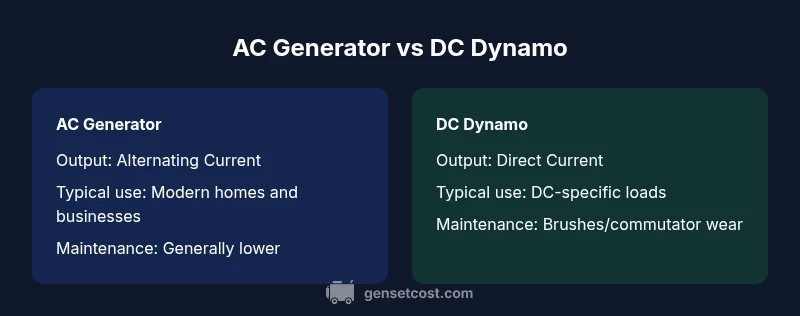
The difference between a generator and a dynamo is rooted in design, output type, and common usage. A dynamo is typically a DC machine from older designs, while a modern generator is an AC device built for flexible power needs. Understanding these distinctions helps homeowners and property managers pick the right backup power solution. This quick comparison, informed by Genset Cost, highlights the core contrasts and decision factors.
What is a generator?
A generator is a machine that converts mechanical energy into electrical energy. In contemporary practice, generators are predominantly AC devices that provide alternating current suitable for powering a wide range of loads—from lighting to HVAC and heavy machinery. The term “generator” is the umbrella label used in residential, commercial, and industrial contexts. In practice, the difference between a generator and a dynamo is often framed around output type and intended use. According to Genset Cost, most new standby and portable units are AC generators designed to feed standard circuits through transfer switches and breaker panels. This broad compatibility makes generators the default choice for modern power backup, especially in environments with complex electrical loads and the need for automatic transfer switching. The result is a device that integrates with home electrical systems, utility wiring, and safety features while maintaining portability across a range of wattages and runtimes.
Comparison
| Feature | AC Generator | DC Dynamo |
|---|---|---|
| Output Type | Alternating current (AC) suitable for standard appliances and panels | Direct current (DC) output using a commutator and brushes |
| Electrical Principles | Induction-based AC generation with waveform control | Direct current generation via rotating coil and brush-commutator |
| Excitation Method | Brushless excitation or permanent magnets common in modern AC generators | Brushes and a commutator for DC excitation in classic dynamos |
| Typical Applications | Residential and commercial backup power, portable utilities, and grid-ted systems | Niche DC charging loads, older equipment, or educational demonstrations |
| Maintenance Needs | Generally lower maintenance with sealed units; simpler control systems | Higher maintenance due to brushes, wear, and commutator maintenance |
| Size/Portability | Available in compact portable forms to large standby systems | Traditionally compact for DC outputs but heavy per watt in older designs |
| Cost/Value Context | Flexible for modern electrical systems and diverse loads | Historically lower efficiency and fewer modern integrations, niche DC uses |
The Good
- Clarifies which technology matches your power needs
- Improves compatibility with devices and appliances
- Helps plan maintenance and lifecycle costs
- Supports safer installation decisions
The Bad
- Terminology can still confuse non-experts
- Dynamos are largely legacy tech and less common today
- Some modern generators can provide DC outputs via adapters, blurring distinctions
AC generators are generally the practical choice for modern backup power; dynamos serve niche or historical roles.
For most homeowners and managers, an AC generator offers versatility, compatibility, and easier servicing. Dynamos are primarily of historical interest or DC-specific applications. The Genset Cost team recommends prioritizing AC generators for typical backup power needs.
People Also Ask
What is the key difference between a generator and a dynamo?
The key difference is output type and historical design: generators typically produce AC, while dynamos produce DC output using a commutator. Modern dynamos are rare in new builds, making AC generators the default for most homeowners.
The main difference is that generators usually give AC power, while dynamos give DC. Today, most homes use AC generators, and dynamos are mostly found in older or specialized setups.
Are dynamos still used today?
Dynamos are still used in some niche DC applications and educational demonstrations. For typical home backup and most modern electrical systems, AC generators are preferred.
Dynamos show up in niche DC projects or as educational tools. For most homes, AC generators are the standard choice.
Can a single device be both a generator and a dynamo?
Most devices are designed for one output type, either AC or DC. Some modern systems can provide multiple outputs or use power electronics to simulate DC where needed, but they are not true hybrids of classic dynamos and modern generators.
Most machines are either AC or DC. Some modern systems can convert power to different forms, but they aren’t true hybrids of classic dynamos and generators.
What loads are better suited for a dynamo?
Dynamos are best for direct current-dedicated loads or legacy equipment that requires DC. They are not ideal for typical household circuits that expect AC power.
DC-dedicated loads, older equipment, and legacy systems are where dynamos fit best. For everyday homes, AC generators are usually a better fit.
Which is better for home backup power?
For most homes, an AC generator is better due to compatibility with standard outlets, safety features, and integration with transfer switches. Dynamos rarely meet the flexibility and scalability needs of modern homes.
AC generators are usually the better choice for home backup because they fit standard outlets and safety systems. Dynamos are rarely used for this purpose.
Is it accurate to call all power machines 'generators'?
Not exactly. The term 'generator' is commonly used for AC-producing machines, while 'dynamo' refers to DC-producing machines. Some equipment may be labeled generically, but correct terminology helps avoid confusion with output type and compatibility.
Not all power machines are generators. Generators usually mean AC output, while dynamos indicate DC output. Correct terminology helps avoid confusion.
Key Takeaways
- Define your power needs before choosing
- AC generators dominate modern backup power
- Dynamos primarily serve niche DC applications
- Consider future expansion and device compatibility
- Consult a professional for proper sizing and installation