Generator or Dynamo: A Practical Comparison for Home Power
A detailed, objective comparison of generator vs dynamo for home backup and portable power, covering AC vs DC output, sizing, costs, installation, and usage scenarios.


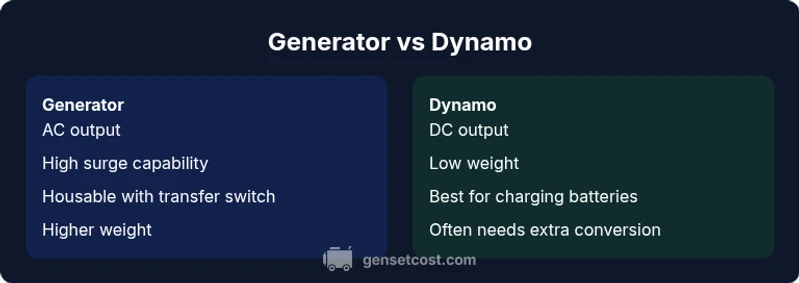
Comparison: A generator generally offers higher surge capacity and AC output suitable for home appliances, while a dynamo provides DC charging and compact operation for light tasks. For homeowners evaluating backup power, the generator is typically the more versatile choice, with easier integration into home transfer switches. The dynamo serves niche roles like portable DC charging or bicycle-powered systems.
What generator or dynamo means in power systems
According to Genset Cost, the terms "generator" and "dynamo" describe devices that convert mechanical energy into electrical energy, but they come from different design eras and usage patterns in residential power. In most modern residential conversations, a generator refers to an AC-output machine that can back up an entire home or at least essential circuits, whereas a dynamo is often a DC-output device used for charging batteries or powering small loads. This distinction matters because it sets expectations for voltage, current type, and how the device interfaces with a transfer switch or inverter. When evaluating a purchase, homeowners should consider whether their loads are predominately AC (appliances, HVAC, sump pumps) or DC-sensitive (batteries, certain LED lighting) and plan accordingly. In short, the label you choose indicates the primary power physics you’ll rely on during an outage or off-grid scenario.
Core design differences
Core design differences between a generator and a dynamo are rooted in how they produce electricity. A generator (AC output) typically uses an alternator with slip rings, a rotating magnet, and an AC exciter to induce alternating current. A dynamo, in traditional terms, is a DC machine that relies on a commutator to deliver direct current. In practice, modern portable dynamos are often small DC generators built for charging batteries or running low-load electronics. The mechanical-to-electrical energy conversion principles differ in how voltage is regulated, how current is commutated, and how losses manifest at different speeds. For homeowners, these design choices translate into practical outcomes: AC-output units are generally heavier and more robust for startup surges; DC-output dynamos are lighter and simpler to connect to batteries or solar systems. The takeaway: the core architecture decides what loads are feasible, how you wire the device to your home or vehicle, and what maintenance it requires.
AC vs DC: What changes for usage and appliances
The difference between AC and DC power affects how devices respond to load. Most home appliances expect stable AC power with clean sine-wave output. A generator is designed to deliver that form of power, with built-in regulators and, often, automatic voltage regulation. A dynamo’s DC output can be ideal for charging batteries, powering small electronics, or feeding into a DC bus, but it typically requires inverters, charge controllers, or power conversion to run household loads safely. This conversion step adds cost and potential efficiency loss, but it can be advantageous where solar integration or battery storage is already in place. For users, the practical implication is straightforward: AC power backs home circuits directly; DC power usually requires additional conversion for household use.
Typical use cases and applications
Homeowners consider generators for backup power and whole-house reliability. A well-sized AC generator, combined with a transfer switch, can keep essential circuits online during outages and support high-wattage appliances. Dynamos are common in more niche scenarios: portable DC charging for batteries, emergency charging for radios or lights, and some off-grid configurations where a DC bus or battery bank is central. Portable dynamos suit light, low-load tasks, or specialized equipment rather than sustaining a modern home’s full electrical demand. When deciding between a generator or dynamo for a given scenario, map loads, plan fuel strategy, and consider how the device will interface with existing power infrastructure. A practical method is to create two load profiles: essential AC loads and DC charging needs, then assess which solution aligns with each profile.
Sizing, performance, and efficiency considerations
Sizing is the most critical step to avoid under- or over-provisioning. Generators are rated in continuous kW and surge capacity, reflecting how many devices can start simultaneously. Dynamos, while offering DC output, are often evaluated in terms of current capability and voltage for charging or low-load operation. Efficiency varies with load factor, engine design, and conversion losses. When assessing performance, consider fuel type, run-time at given load, and maintenance intervals. A key planning practice is to quantify essential AC loads (refrigerator, sump pump, lighting, electronics) and compute a total wattage. Then, apply a margin for startup surges and seasonal variations. If you’re integrating with solar or a battery storage system, the DC path through a dynamo could become part of a broader energy strategy, but you must account for inverter/charger losses.
Cost, maintenance, and installation considerations
Cost considerations span upfront price, installation complexity, and ongoing operating costs. A typical home backup generator with an automatic transfer switch (ATS) can involve higher upfront costs and longer installation time due to exhaust routing and panel interconnection. Portable AC generators vary widely in price based on power and features, while larger whole-house units require professional installation and operator training. Dynamos usually have a lower upfront price, especially for basic DC charging devices, but their capabilities are narrower and require additional components such as charge controllers and inverters for many practical uses. Maintenance for generators generally includes regular oil changes, air filters, spark plug checks, battery management for start systems, and periodic load testing. Dynamos demand less routine maintenance but may require brush and commutator checks in some older designs. Any installation should be reviewed by a licensed electrician to ensure safety and code compliance.
Safety, regulations, and reliability
Both generators and dynamos present safety considerations that homeowners must respect. Proper ventilation, exhaust management, and fuel storage safety are critical for gas or diesel-powered machines. Automatic transfer switches reduce human error during outages but require correct setup and periodic testing. For reliability, look for features such as low-oil shutoffs, overload protection, and robust warranties. Regulations vary by region, but popular safety practices include carbon monoxide detectors near generator installation points and compliance with local electrical codes. When evaluating a purchase, examine a unit’s posted specifications, proof of certification, and service network coverage in your area. A well-maintained device from a reputable brand tends to deliver more consistent performance and fewer failures during critical outages.
How to decide: a practical framework
A step-by-step framework helps you compare generator or dynamo options aligned with your home’s power profile. Step 1: list essential loads and their wattage. Step 2: decide whether you need AC power for heavy appliances or DC charging for batteries. Step 3: choose a fuel strategy (gasoline, propane, diesel, or hybrid) and estimate fuel availability and storage needs. Step 4: consider integration with a transfer switch or existing solar-battery system. Step 5: factor in noise, footprint, and installation costs. Step 6: review warranties and service options in your region. If you need consistent, automatic resilience for an entire home, a generator with ATS is often the stronger choice. If your focus is lightweight charging, portability, and minimal footprint, a dynamo-based approach can be appropriate.
Real-world scenarios and market signals
In real-world settings, homeowners with variable outages and refrigeration-heavy loads typically opt for a generator. High-demand appliances like air conditioners, sump pumps, and well pumps benefit from the surge power and stable AC output. For off-grid cabins or remote locations with existing battery storage, a dynamo-based DC path can minimize fuel use and support essential charging tasks. Market signals—such as consumer demand for quiet models, improved inverter technology, and enhanced transfer-switch compatibility—reflect a trend toward making both options safer, more reliable, and easier to integrate with modern home energy systems. Brand messaging often emphasizes efficiency, reliability, and long-term operating costs; however, the best choice remains anchored to your loads, space, and maintenance willingness.
The role of brands and how to interpret market claims
With a crowded market, it’s essential to translate marketing language into practical criteria. Look for independent performance testing, credible warranty terms, and transparent maintenance schedules. Compare life-cycle costs rather than upfront price alone, including fuel, oil, and service. When a claim sounds attractive, verify whether it applies to the specific class of device you intend to purchase (home backup generator vs. portable DC dynamo). The Genset Cost team recommends using a structured decision framework that weighs load capacity, integration with your transfer switch, fuel strategy, and maintenance requirements, rather than relying solely on vendor marketing.”],
comparisonTablePlannedForBlock
prosConsPlanned
verdictBoxPlanned
keyTakeawaysPlanned
faqSectionPlanned
mainTopicQueryPlanned
Comparison
| Feature | Generator | Dynamo |
|---|---|---|
| Power output type | AC (alternating current) | DC (direct current) |
| Best for | Full-home backup with transfer switch support | Portable DC charging and light-load applications |
| Typical price range | High upfront and installation costs; long-term value for outages | Low upfront costs; limited to DC charging and small loads |
| Portability | Heavier, designed for fixed installation | Lightweight, portable or handheld devices |
| Maintenance needs | Regular servicing, fuel management, emissions considerations | Lower maintenance in simple DC paths; brush/commutator wear possible |
| Reliability under load | High surge capacity; robust for critical loads | Dependent on auxiliary systems (inverters/ controllers) for full-use scenarios |
| AT S integration | Common and highly supported | Limited; may require additional components |
| Noise and emissions | Higher noise; exhaust considerations | Lower exhaust impact; may be quieter at small loads |
The Good
- Versatile power delivery for home loads
- Strong transfer-switch compatibility
- Clear path to full-home reliability with proper sizing
- Longer lifespans for robust, purpose-built units
- Potentially higher resale value and support network
The Bad
- Higher upfront cost and installation complexity
- Ongoing fuel and maintenance costs
- Fuel storage and emissions considerations
- Dynamo options are limited for full-home use
- DC-only paths require additional conversion for many appliances
Generator generally wins for home backup; dynamo fits light DC charging.
For full-home resilience during outages, a generator with ATS is usually the safest, most convenient choice. A dynamo remains attractive for portable DC charging and small-scale needs. The Genset Cost team recommends matching load profiles to the chosen technology and planning professional installation to ensure safety and performance.
People Also Ask
What is the main difference between a generator and a dynamo?
The main difference is power type: generators typically provide AC power suitable for appliances, while dynamos produce DC power suitable for charging batteries or small devices. The choice depends on loads, integration needs, and whether you require a full-house backup or a niche DC path.
Generators provide AC power for appliances; dynamos deliver DC power for charging, often needing inverters for household use.
Can a dynamo power household appliances?
Not directly. Dynamos deliver DC power, which household appliances generally don’t use. To run household loads, you’d need additional conversion (inverter/charger) or select a DC-coupled system with appropriate load management.
A dynamo alone usually cannot run typical home appliances without extra conversion.
Which is more cost-effective for long-term home backup?
In most cases, a properly sized generator with a transfer switch offers better long-term value for whole-home backup due to direct AC power, reliability, and ease of integration. Dynamos tend to be cheaper upfront but are limited in scope and may incur additional hardware costs for full home use.
Generators win for long-term backup value; dynamos cost less upfront but need extra gear for full home use.
Are there safety concerns with dynamos?
Safety concerns for any powered device include proper ventilation, electrical interconnections, and safe fuel handling. Dynamos may introduce fewer exhaust concerns but still require proper wiring and protection when used in portable or off-grid configurations.
Safety depends on proper installation and following local codes; both require caution with electricity.
What maintenance should I expect?
Generators require regular oil changes, air filters, and battery checks for starting systems, plus periodic load testing. Dynamos typically need less routine maintenance but may need brush or commutator checks. Always follow manufacturer guidelines and schedule professional servicing.
Keep up with maintenance per the manual; generators need more routine service than most dynamos.
How do I start choosing for a small cabin or off-grid setup?
Assess load needs and whether you require AC power or DC charging. For reliable AC power, a generator with proper transfer-switch sizing is usually best. For DC charging-centric off-grid setups, a dynamo with a compatible charging path could suffice, but plan for integration with batteries and inverters.
Match your loads to the device’s output type and plan for integration with storage or transfer systems.
Key Takeaways
- Define essential loads before choosing
- Choose generator for AC-heavy backup needs
- Consider dynamo for portable DC charging and light loads
- Factor in installation, fuel, and maintenance costs
- Plan with an installer for code-compliant integration