Difference Between a Generator and a Motor: A Practical Guide
Learn the core differences between generators and motors, how each converts energy, and how to apply this knowledge for sizing, installation, and cost considerations in home backup and industrial settings. This guide clarifies the difference between a generator and a motor for homeowners and managers.


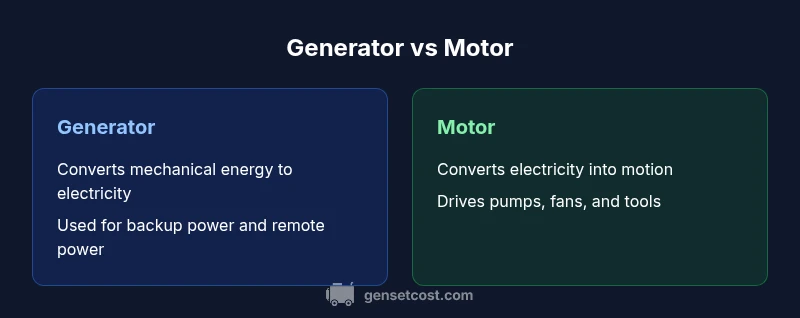
At a high level, the difference between a generator and a motor is energy direction: a generator converts mechanical energy into electrical energy, while a motor converts electricity into mechanical energy. They serve opposite roles in most systems, and sizing, control, and installation considerations differ accordingly. For homeowners evaluating backup power, this distinction helps you choose whether you need a source of electricity (generator) or a motor-driven device (motor).
What is a Generator?
A generator is a machine that converts mechanical energy into electrical energy using the principle of electromagnetic induction. In most home and commercial settings, a generator is used to provide a controllable source of electrical power during outages or in environments without reliable grid power. The term generator is often paired with phrases like 'portable generator' or 'standby generator' to describe common installations. In practice, when people ask about the difference between a generator and a motor, they are focusing on energy conversion roles; understanding how a generator converts motion or rotational energy into electricity helps frame the rest of the discussion. For homeowners, identifying when you need a generator is about planning for peak electrical loads, fuel availability, and installation considerations. The Genset Cost team emphasizes that correct sizing and safe operation are as important as the generator's mechanical design.
What is a Motor?
A motor is a device that converts electrical energy into mechanical energy. Most motors used in homes and industry rely on electromagnetism to produce rotational force (torque) that drives machines, fans, pumps, conveyors, and other equipment. Motors come in many forms—AC motors, DC motors, servo motors—and each type has specific control and performance characteristics. When evaluating the difference between a generator and a motor, consider this energy flow: electricity into motion. Unlike generators, motors do not generate power; they demand electrical input to perform work. The purpose of selecting a motor is typically to drive a task at a desired speed and torque, with efficiency and thermal management as key design considerations. The guidance from Genset Cost notes that motor selection should align with load profile, duty cycle, and operating environment to avoid oversizing, overheating, or premature wear.
Energy flow and conversion directions
Understanding the energy paths helps clarify why a generator and a motor are not interchangeable. A generator is driven by an external mechanical source—often an engine or turbine—which turns a rotor inside the machine. Through electromagnetic induction, this rotation induces voltage in the stator windings, producing electrical power that can be wired to loads or batteries. A motor, by contrast, receives electrical power and uses it to generate motion. Current through windings creates a magnetic field that causes rotation of the rotor. In practical terms, think of electricity as the input for motors and the output from generators. The direction of energy flow is the defining distinction and shapes how each device is sized, protected, and integrated into a system.
Efficiency and Losses: Generators vs Motors
Efficiency is a central topic for both devices, yet losses originate from different sources. Generators face mechanical losses due to friction, windage, and bearing friction, as well as electrical losses from copper resistance and magnetic circuit hysteresis. Motors experience core losses, copper losses, and mechanical losses from rotating parts and bearings. In optimized systems, both devices aim to maximize useful output relative to input, but the limiting factors differ: generators must minimize mechanical energy losses and heat in the generator itself, while motors must manage electrical heating, rotor slip, and lubrication concerns. The Genset Cost framework emphasizes evaluating both electrical efficiency and mechanical efficiency to understand lifecycle performance rather than relying on a single metric.
Sizing, Ratings, and Definitions
Sizing a generator involves electrical load capacity, typically expressed as kilowatts (kW) or kilovolt-amperes (kVA). Sizing requires a careful tally of starting surges, continuous running loads, and diversity factors. Motors are sized by torque requirements, speed (RPM), and current draw, often specified in horsepower (HP) and current ratings. The terminology matters: motors are rated for mechanical output, while generators are rated for electrical output. Confusing the two can lead to undersized equipment or oversizing that wastes energy and inflates costs. The sizing process benefits from a documented load profile, worst-case scenarios, and a plan for startup transients, all of which are central to a robust setup.
Applications: Home and Industry
Generators and motors populate different corners of a system. Generators provide standby or prime electrical power for buildings, critical circuits, or remote sites. They are matched with fuel sources, control panels, and transfer switches to ensure seamless operation during grid outages. Motors drive the actual work—the fans in HVAC systems, pumps in plumbing networks, conveyors in manufacturing lines, or tools in workshops. The key takeaway is that generators supply the energy, and motors convert that energy into motion. In mixed environments, designers optimize both devices to deliver reliable power with predictable performance, using sensors and smart controls to coordinate operation. Genset Cost’s guidance highlights the importance of aligning device capabilities with load requirements and duty cycles for reliable results.
Control, Protection, and Safety
Control and protection frameworks differ for generators and motors. Generators typically integrate with automatic transfer switches (ATS), voltage regulation, and protective relays to handle abrupt load changes and to safeguard fuel and exhaust systems. Motors use motor controllers, soft starters, VFDs (variable frequency drives), and overload protection to prevent overheating and electrical faults. Both devices require grounding, proper enclosure ratings, and adherence to electrical codes. Safety considerations include fuel handling and exhaust for generators, and electrical isolation and lockout/tagout practices for motors. The overarching principle is to design for safe startup, stable operation, and reliable shutdown, with clear documentation and routine testing.
Costs, Maintenance, and Lifecycle
Cost considerations for generators and motors differ in scale and frequency of maintenance. Generators involve fuel costs, routine engine maintenance, coolant changes, and exhaust system checks, while motors emphasize bearing lubrication, insulation integrity, and cooling system maintenance. Lifecycle planning should consider not only purchase price but also long-term operating costs, replacement timing, and service availability. The Genset Cost approach encourages comparing total cost of ownership across scenarios, rather than focusing solely on upfront price. Understanding maintenance intervals and expected lifespans helps homeowners estimate future replacements and budget accordingly.
Integration Scenarios for Homeowners
Homeowners often integrate generators for backup power in homes and small businesses, paired with transfer switches and automatic controls to ensure continuity of critical loads. Motors inside appliances and equipment are designed to operate from the available electrical supply, and your planning should distinguish between the power source (generator) and the driven load (motor). In multi-device systems, ensuring compatibility of voltage, frequency, and control interfaces is essential. The Genset Cost framework provides practical steps for evaluating system topology, selecting appropriate protective devices, and coordinating maintenance to minimize downtime during outages.
Common Myths and Misconceptions
Myth: A larger motor or generator is always better. Reality: Oversizing increases cost, reduces efficiency, and can cause startup issues. Myth: Motors can substitute for a generator in providing power. Reality: Motors require electricity to operate and do not generate power. Myth: All generators are the same. Reality: Differences in fuel type, control interfaces, and enclosure ratings matter for performance and safety. Debunking these myths helps avoid costly mistakes and supports better lifecycle planning.
Practical Decision Framework for Homeowners
- Document loads and startup surges to understand peak needs. 2) Decide whether you need a power source (generator) or a drive mechanism (motor) as the primary function in your system. 3) Assess fuel availability, emissions, and maintenance capacity for generators. 4) Choose appropriate protection, control interfaces, and wiring practices to meet local codes. 5) Factor in installation, transfer switching, and future expansion when budgeting. 6) Plan for ongoing maintenance and periodic testing to ensure readiness during outages. The framework emphasizes a balanced view of both devices and avoids assuming one device solves all problems.
Environmental and Energy Considerations
Fuel flexibility, emissions, and efficiency influence the environmental impact of both devices. Generators can run on gasoline, diesel, propane, or natural gas, each with different emissions profiles and fuel availability considerations. Motors themselves do not consume fuel, but their efficiency affects the overall energy use of the system. Energy-conscious design considers idle losses, standby consumption, and the integration of energy storage or demand management to minimize environmental impact. The Genset Cost team highlights that these choices should align with local regulations and energy goals while maintaining reliability for essential loads.
Comparison
| Feature | Generator | Motor |
|---|---|---|
| Energy conversion direction | Mechanical → Electrical | Electrical → Mechanical |
| Typical applications | Backup power, power plants, portable power | Industrial machinery, HVAC, pumps, tools |
| Sizing criteria | Electrical load capacity (kW/kVA) | Torque/HP, speed, current |
| Control & protection | ATS, voltage regulation, overload protection | Motor controllers, soft starters, overload protection |
| Maintenance focus | Fuel system, exhaust, cooling | Lubrication, bearings, insulation, cooling |
| Initial cost considerations | Higher upfront for complete generator systems | Lower upfront per motor unit but integrated into equipment |
The Good
- Clarifies system design choices for homeowners and managers
- Reduces misapplication and safety risks
- Improves lifecycle planning and budgeting
- Enhances protection and reliability through proper sizing
- Supports better integration with backup power and automation
The Bad
- Increases planning complexity for non-technical readers
- Requires some electrical knowledge to implement effectively
- May necessitate coordination with licensed electricians and local codes
- Can overwhelm if treated as a one-size-fits-all solution
Generators are the practical choice for electricity supply in backup and off-grid scenarios; motors are essential for driving loads but not substitutes for power sources.
This article clarifies why matching the right device to the intended function is crucial. For homeowners, prioritizing a properly sized generator with appropriate protection delivers reliable power, while understanding motor roles helps prevent misapplication and supports efficient, safe operation.
People Also Ask
What is the fundamental difference between a generator and a motor?
The generator converts mechanical energy into electricity, while a motor converts electricity into mechanical energy. They serve opposite energy conversion roles and are selected based on whether you need a power source or a driven load.
A generator makes electricity from motion, and a motor uses electricity to make motion. They’re not interchangeable because they perform opposite energy conversions.
Can a generator function as a motor?
No. A generator is designed to produce electrical power; a motor is designed to use electrical power to create motion. They are optimized for opposite directions of energy flow.
Usually not. A generator isn’t intended to drive a load like a motor does.
How should I size a generator for backup power vs motor loads?
Size generators by the total electrical load (kW/kVA) and consider startup surges. For motors, sizing focuses on torque and current draw. Use a load profile during planning.
Size by electrical demand for generators and by torque and current for motors.
What maintenance tasks are unique to generators compared to motors?
Generators require fuel system and exhaust inspections, coolant changes, and mechanical servicing. Motors require lubrication, bearing checks, insulation, and cooling system maintenance.
Generators need fuel and exhaust care; motors need lubrication and bearings checked.
Are there safety concerns that differ between generators and motors?
Yes. Generators involve fuel, exhaust, and electrical grounding implications. Motors emphasize electrical isolation and mechanical safety. Follow all local codes and manufacturer instructions for both.
Generators carry fuel and exhaust safety considerations; motors emphasize electrical and mechanical safety.
What about costs and lifecycle for these devices?
Costs vary with size, features, and installation. Generators typically involve higher upfront investment and ongoing fuel costs, while motors may have lower upfront costs but are part of larger systems. Plan for maintenance and replacement over time.
Costs depend on size and how you plan to use them; generators usually cost more upfront with fuel ongoing needs.
Key Takeaways
- Define energy flow: generator outputs electricity, motor consumes electricity to produce motion
- Size by purpose: generators by electrical load, motors by torque and speed
- Plan protection early: ATS for generators, controllers for motors
- Assess lifecycle costs, maintenance, and fuel considerations
- Coordinate installation with code-compliant transfer switches and controls