difference between generator and transformer: essentials
Explore the difference between generator and transformer in power systems. This in-depth guide explains functions, safety, sizing, and real-world applications for homeowners and managers.


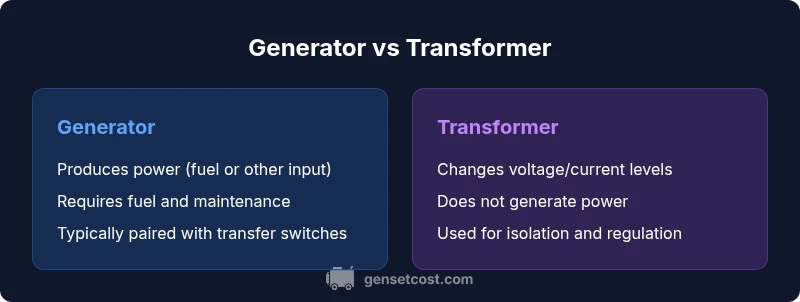
Inside the realm of power systems, understanding the difference between generator and transformer helps homeowners and managers make informed backup and power-quality decisions. A generator converts mechanical energy into electrical energy, typically using an internal combustion engine to drive an alternator. In contrast, a transformer does not generate electricity; it changes voltage and current levels as electricity passes through windings, enabling devices to operate at the appropriate voltage. The two devices occupy different roles in a power system: the generator supplies actual power when the grid is unavailable, while the transformer conditionally adjusts voltage for compatibility and safety. For a home or small building, recognizing these roles is essential to sizing, installation, and long-term operating costs. The difference between generator and transformer is not simply about power rating; it also reflects how each device responds to load, frequency, and safety requirements. In the rest of this article, we will unpack the theoretical foundations, practical applications, and decision criteria that determine when you should rely on one or the other, or both in a carefully designed energy system.
difference between generator and transformer: overview
In electrical systems, understanding the difference between generator and transformer helps homeowners and managers make informed backup and power-quality decisions. A generator converts mechanical energy into electrical energy, typically using an internal combustion engine to drive an alternator. In contrast, a transformer does not generate electricity; it changes voltage and current levels as electricity passes through windings, enabling devices to operate at the appropriate voltage. The two devices occupy different roles in a power system: the generator supplies actual power when the grid is unavailable, while the transformer conditionally adjusts voltage for compatibility and safety. For a home or small building, recognizing these roles is essential to sizing, installation, and long-term operating costs. The difference between generator and transformer is not simply about power rating; it also reflects how each device responds to load, frequency, and safety requirements. In the rest of this article, we will unpack the theoretical foundations, practical applications, and decision criteria that determine when you should rely on one or the other, or both in a carefully designed energy system.
- Key takeaway: generators create power; transformers modify voltage. Understanding this distinction matters for sizing and safety in residential systems.
Takeaway: The core goal is to match device capability to the load and voltage needs, not to confuse generation with transformation.
How a generator creates power and why it matters for backup systems
A generator converts mechanical energy into electrical energy through electromagnetic induction. The input may come from a fuel-driven engine or a turbine, driving a alternator that produces alternating current. The generated power is then fed into the electrical system, typically with automatic transfer switches to ensure seamless transition when the grid fails. The crucial point in the difference between generator and transformer is that a generator must supply real watts to the load; otherwise, equipment won’t operate. For homeowners evaluating backup options, the generator’s duty cycle, fuel availability, and run-time are central considerations. In practice, sizing a generator involves estimating critical-load requirements, circuit priorities, and peak starting currents, then choosing a unit with a comfortable margin. While a transformer can help with voltage adjustments downstream, it cannot compensate for insufficient generation during an outage. A balanced approach often uses a generator in tandem with appropriate transformers or voltage-regulation equipment to maintain safe and reliable operation.
- Consider load diversity and future expansion when assessing how big a generator should be.
- The phrase difference between generator and transformer will recur in this guide to emphasize the distinct roles.
How a transformer adjusts voltage and why it matters in distribution and load management
Transformers operate on the principle of magnetic induction to either step up or step down voltage levels without generating electrical power themselves. They are essential for voltage regulation, impedance matching, and electrical isolation in distribution networks, substations, and equipment interfaces. The core advantage is efficiency and safety: transformers minimize energy loss in transmission and ensure devices receive appropriate voltage. In the difference between generator and transformer, a transformer’s role is not to supply energy but to shape it for compatibility with appliances, motors, and control systems. For residential settings, transformers are often used in subpanels, HVAC interfaces, and specialty devices that require precise voltages. It’s important to note that transformers handle only voltage adjustment; they do not create additional wattage. When large voltage changes are needed or when multiple loads require consistent voltage, correctly rated transformers reduce heat, minimize copper loss, and support stable operation across the entire system.
- In a home power system, transformer sizing should align with downstream loads to avoid overheating and voltage drop.
- The difference between generator and transformer becomes clear: one produces energy, the other adapts it for safe use.
Key differences in function and application you should know
The most practical way to grasp the difference between generator and transformer is to map function to application. Generators are primary power sources during outages, designed to sustain essential circuits, critical loads, or entire homes depending on size. Transformers, by contrast, are passive devices that adapt voltage to fit equipment and ensure compatibility with the electrical grid. Common applications reflect this distinction: generators handle energy supply and emergency readiness; transformers handle voltage regulation, isolation, and equipment protection. In multi-equipment installations, both devices work together: a generator provides energy, and transformers or step-down devices ensure that energy arrives at safe, usable voltages for sensitive electronics. When choosing between these devices, consider your top priority—backup power or voltage matching—and how each device affects maintenance, emissions, noise, and space. The long-term costs add up from fuel, inspection, and possible maintenance contracts for generators, versus core losses and insulation checks for transformers.
- Best for backup power scenarios: generator.
- Best for voltage regulation and compatibility: transformer.
Safety, codes, and installation considerations you should follow
Safety and compliance are central to the difference between generator and transformer in residential settings. Generators require proper ventilation, fuel storage, and exhaust considerations, plus protection against carbon monoxide. Installations must meet local electrical codes, require proper transfer switches, and often involve licensed electricians and, in some jurisdictions, utility approval. Transformers, while safer in terms of emissions, still demand correct enclosure, protection from moisture, and correct grounding practices. In many homes, you’ll find transformers integrated into distribution panels or outdoor step-down equipment, with enclosures that protect access and limit accidental contact. When evaluating which device to deploy, consider access for maintenance, noise impact, and integration with existing panels. Regular inspection of electrical connections, insulation integrity, and bonding/grounding is essential to minimize the risk of shock or fire. The difference between generator and transformer is reinforced by the need for different maintenance schedules and safety measures for a mixed system.
- Always obtain permits if required by authorities.
- Plan for outdoor storage and weather protection for generators.
Sizing, compatibility, and system integration for your property
Sizing is where the difference between generator and transformer becomes most practical. A generator must meet the continuous and peak power demands of critical circuits, with enough capacity to handle startup surges from motors and compressors. Transformers must be appropriately rated for the maximum current and voltage range they will handle, with consideration for impedance and load balancing. When integrating both devices, ensure that the generator’s output can be safely connected through a transfer switch to the building’s panel, and that the downstream transformers receive the correct input voltage. In terms of compatibility, match the transformer rating to the expected load for each circuit, and ensure that circuit breakers and protective devices accommodate possible inrush currents. A well-designed system avoids voltage fluctuations, overloads, and nuisance tripping. The difference between generator and transformer in this context is about architecture: generation versus regulation and isolation. If you anticipate future load growth, plan upgrades to both the generator and any critical transformers to maintain reliability and safety.
- Use load calculations and a professional sizing method to determine appropriate ratings.
- Include a margin for future expansion when feasible.
Cost, maintenance, and lifecycle considerations you should compare
Economic considerations for the difference between generator and transformer are significant. Generators have upfront costs tied to capacity and features, ongoing fuel costs, routine maintenance, and potential replacement cycles as engine technology evolves. Transformers have lower ongoing operating costs but require periodic maintenance focused on insulation, winding integrity, and cooling efficiency. When comparing lifetime costs, consider how often you will rely on backup power, fuel price volatility, and maintenance contracts for the generator. The transformer’s lifecycle is linked to its insulation class and load profile; upgrades to the electrical system may necessitate transformer replacements with newer, more efficient designs. Homeowners should evaluate total cost of ownership, including installation, permits, and possible insurance implications for generator operation. Budgeting for both capital and operating expenditures helps ensure a robust and resilient system over the years. The difference between generator and transformer is that one adds ongoing fuel and maintenance costs, while the other adds upfront and ongoing insulation and protection considerations.
Real-world scenarios and decision trees for choosing between them
In practice, the choice is rarely about one device vs another in isolation. For a home with intermittent outages and a growing need for resilience, a generator paired with a voltage-regulating transformer or a smart panel is the common path. In other cases, a transformer alone supports sensitive equipment when feed voltage is regulated by the grid and the building’s internal distribution handles localization. Consider the property’s size, the importance of continuity of power, the type of loads, and the available space for equipment. The difference between generator and transformer becomes a decision framework: if you must supply energy during outages, you need a generator; if you must adapt voltage for safe operation, you need transformers or voltage regulators. A combined approach often provides the best balance of reliability, safety, and cost efficiency, especially when backed by a professional energy assessment and code-compliant installation plan.
- Prioritize essential loads for generators and reserve transformer capacity for critical equipment.
- Cloud-based monitoring and automatic transfer switches can enhance reliability.
Common myths and misconceptions about generator vs transformer
A frequent misconception is that a larger transformer can substitute for a larger generator during an outage. This is incorrect: transformers don’t generate power and can’t compensate for demand surges. Another myth is that all transformers are safe for outdoor use; while many are rugged, improper installation can lead to moisture ingress and insulation failure. Some homeowners assume that all standby systems require the same transformer size; in reality, transformer needs depend on the connected load and voltage requirements. Finally, many think that generators and transformers can be mixed without planning; in practice, the system must be designed with proper protection devices, load sequencing, and risk mitigation. Debunking these myths helps you avoid unsafe configurations and ensures you select the right device for the right job in the difference between generator and transformer context.
How to evaluate for your property: a practical checklist
To evaluate for your property, start with a load assessment that identifies essential circuits and peak demand. Determine whether you need continuous energy generation during outages, or if voltage regulation and isolation are your primary concerns. Verify your grid’s voltage standards and the loads that require clean, stable power. If you have critical equipment (medical devices, data centers, security systems), plan for redundancy and sufficient generator capacity. Finally, consult licensed professionals to ensure the installation complies with electrical codes and safety standards. By following these steps, you’ll be better positioned to make an informed choice between the difference between generator and transformer and how they fit into a resilient home or building power strategy.
Comparison
| Feature | Generator | Transformer |
|---|---|---|
| Primary function | Produce electrical power from mechanical energy | Change voltage/current levels without generating power |
| Power source | Needs fuel or other energy input | Does not supply energy; relies on external supply |
| Typical location | On-site units near fuel source or load center | Inside distribution equipment or at service entry |
| Key maintenance | Engine service, fuel management, exhaust care | Insulation checks, cooling, winding inspections |
| Efficiency factors | Engine efficiency and alternator design | Core losses and copper losses (depends on size) |
| Best use case | Backup power for essential circuits | Voltage regulation and isolation for loads |
The Good
- Clarifies device roles to reduce misapplication
- Supports safer, code-compliant installations
- Helps plan for maintenance and lifecycle costs
- Guides budgeting by separating energy production from regulation
- Improves resilience with properly sized systems
The Bad
- Can be confusing in mixed installations without proper design
- Transformers cannot substitute for power generation in outages
- Generators require fuel, emissions considerations, and ventilation
- Misunderstanding can lead to over or under-sizing without professional assessment
Generators and transformers serve distinct roles; use each for its intended purpose
For backup power, choose a generator; for voltage conversion, use a transformer. In many systems, both are needed to ensure reliable, safe, and code-compliant operations.
People Also Ask
What is the primary function of a generator?
A generator provides real electrical power by converting mechanical energy into electricity. It is sized to meet load requirements and can support essential circuits during outages. Maintenance and fueling are ongoing considerations.
A generator makes electricity from fuel to keep your important devices running during an outage.
Can a transformer generate electricity?
No. A transformer does not generate power; it changes voltage and current levels for compatibility and safety. It relies on an external source of electricity to do its job.
Transformers don’t produce power; they adjust voltage using the energy you already have.
Do I need both a generator and a transformer for a home backup system?
Often yes. A generator provides the energy, while transformers or voltage regulators ensure the energy is at the correct voltage for sensitive loads. The combination improves safety and reliability.
Most homes use a generator for power and a transformer or regulator to keep voltages safe and stable.
What safety considerations are different for generators vs transformers?
Generators require ventilation, fuel storage, and exhaust management. Transformers require proper enclosure, grounding, and protection from moisture. Each has unique codes and inspection needs.
Generators need air and fuel handling safety; transformers need proper enclosures and grounding.
How should I evaluate loads to decide between them?
Start with a load assessment and prioritize critical circuits. If you need continuous generation, a generator is essential; if voltage stability is the goal, consider transformers or regulators for the affected loads.
Look at what you must power and what voltage those devices need to run safely.
Are there systems that combine generation and transformation in a single unit?
There are systems that integrate energy generation with dynamic voltage control, often through modern energy-management solutions. However, the core functions remain separate: generation vs transformation.
Some systems combine features, but they still rely on the basic roles of generation and voltage adjustment.
Key Takeaways
- Define your objective: power vs voltage transformation
- A generator produces power; a transformer adjusts voltage
- Don't substitute a transformer for a generator in backup plans
- Sizing, safety, and codes differ between devices
- Plan for maintenance and lifecycle costs
- Consider integration with existing panels and loads