Silent Generator Price Guide for Home Backup Power (2026)
Discover silent generator price factors, typical ranges, and installation costs for home backup systems. Learn how capacity, sound ratings, and setup influence total ownership cost.


Typical silent generator price ranges from about $1,000 to $12,000 depending on capacity, sound rating, and installation. Compact units sit on the lower end, while full‑home standby systems with transfer switches push toward the upper end. This guide from Genset Cost analyzes the drivers and long-term value to help homeowners budget confidently.
Understanding silent generator price drivers
Prices for silent generators hinge on several core factors. The most influential are capacity (measured in kW), the level of sound attenuation (dB rating), and how the unit is enclosed to minimize noise. More doors, insulation, and baffling inside the enclosure can substantially cut operating noise but add manufacturing cost. Fuel type also matters: natural gas and propane units tend to have different price dynamics than diesel, largely due to fuel delivery infrastructure and fuel costs over time. Finally, the warranty, service network, and included transfer switch influence the sticker price. In practice, buyers should think about not just the initial sticker price but the total cost of ownership over 5–15 years, including maintenance and fuel.
Throughout 2026, the Genset Cost Team has observed that quiet operation, ease of installation, and a robust service network are consistently cited as value drivers by homeowners and property managers. When evaluating price, compare units that advertise similar decibel ratings and transfer-switch compatibility to isolate the impact of enclosure design and brand premium.
Key takeaways: lower decibel ratings and simpler installation generally reduce upfront costs, but the clean, enclosed design that keeps sound levels down often commands a premium that can pay off in comfort and property value over time.
Price ranges by capacity and configuration
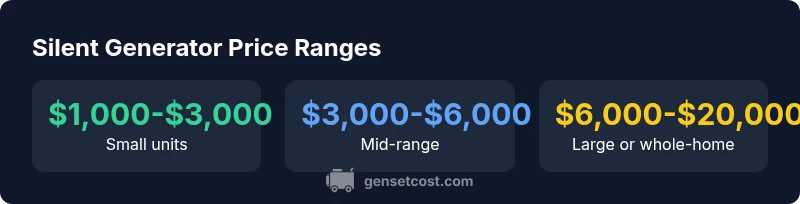
Price bands for silent generators reflect both capacity and installation complexity. For compact residential backups without complex transfer capabilities, you’ll typically see lower-end price points. For mid-range homes with automatic transfer switches and standard natural gas or propane connections, price ranges increase accordingly. High-end, full-home standby configurations with integrated transfer switches, fuel-optimized enclosures, and enhanced warranties sit at the top end of the spectrum. The ranges below illustrate typical installed price bands and are intended to help budgeting rather than guarantee exact quotes:
- 5–8 kW, 50–55 dB: $1,000–$3,000 (basic enclosure, no major modifications)
- 8–12 kW, 52–58 dB: $2,500–$6,000 (transfer switch included, standard installation)
- 14–20 kW, 55–65 dB: $4,000–$12,000 (larger unit, more complex gas line or propane setup)
- 20–26 kW, 58–70 dB: $7,000–$20,000 (full-home coverage, advanced wiring, high-end enclosure)
Note: these are installed price ranges; actual quotes vary by local labor rates, permits, and configuration. The goal is to balance noise performance with capacity while avoiding under- or over-sizing the system.
When comparing bids, ensure each quote includes the same base features: automatic transfer switch, standard enclosure, and commissioning. If one bid excludes a transfer switch or includes premium enclosure work, adjust the price comparison accordingly to avoid hidden costs.
Practical tip: ask installers for the decibel rating at full load and verify that the enclosure meets local noise ordinances. A unit labeled as “silent” can still exceed acceptable noise levels if poorly installed or poorly insulated.
Installation and hidden costs that affect final price
Beyond the base price of the generator itself, installation costs and ancillary fees can dramatically shift the total. A significant portion of the final price comes from electrical work, transfer switches, and utility connections. Expect to budget for:
- Automatic transfer switch (ATS): essential for seamless power transfer; costs scale with load and complexity.
- Electrical wiring and conduit runs: longer runs, indoor versus outdoor routing, and code-compliant installations add labor and materials.
- Gas line work or fuel system updates: upgrading a natural gas line or propane provision can require permits and inspections.
- Permits and inspections: regional code requirements can require inspections that add time and fees.
- Site preparation: trenching, concrete pads, and mounting brackets for outdoor enclosures increase the bottom line.
- System integration: some homes require additional controls or smart monitoring hardware, which adds both parts and install time.
The total installed price can be 1.5–3 times the generator’s base price in complex installs. Genset Cost’s approach emphasizes transparent quotes that itemize each element, so buyers can see how much each component adds to the total. Planning ahead with a clear scope helps prevent budget creep.
Regulatory reality: some jurisdictions require permits and inspections before activation, while others restrict venting or exhaust routing. Check local codes early in the process to avoid delays and extra costs.
Value beyond price: noise, reliability, and long-term ownership
Price is only one facet of value. A silent generator that costs more upfront may deliver substantial long-term savings by reducing downtime, extending equipment life, and minimizing neighborhood disturbance. Reliability reduces the risk of unexpected outages and service calls, which can be costly in peak storm seasons. In practice:
- Noise matters for living comfort and neighbor relations; even small decibels can influence daily enjoyment and property value.
- A robust warranty and access to an authorized service network lower long-term maintenance expenses and downtime.
- Operating efficiency affects fuel costs; newer models often boast better fuel economy at part-load and full-load conditions.
- Resale value can reflect the premium for quiet operation and guaranteed service support.
From a homeowner’s perspective, consider the total cost of ownership (TCO) rather than the upfront price alone. A slightly higher upfront investment in a quieter, more efficient model can translate into lower maintenance costs and better living conditions over 10–15 years. This aligns with Genset Cost’s framework for evaluating long-term value in generator purchases.
Actionable insight: when you quote, request a 5‑year maintenance plan and a clear breakdown of fuel costs over time to compare total expected costs across models.
Practical buying strategy for homeowners
To navigate silent generator pricing with confidence, follow a structured buying strategy:
- Load analysis: accurately determine your essential and nonessential loads to identify an appropriate kW range. This ensures you aren’t overbuilding or underperforming.
- Compare decibel ratings: prioritize units with the lowest practical dB rating for your site and check real-world noise at full load.
- Inspect enclosure quality: review insulation, weather sealing, and venting to ensure the unit remains quiet under various temperatures.
- Verify transfer-switch configuration: confirm whether the bid includes an ATS and whether it supports future expansion.
- Evaluate service and warranty: choose a vendor with a broad service network and a warranty that covers critical components beyond the first year.
- Include installation costs in the budget: obtain itemized quotes that separate hardware, installation, permits, and site prep.
- Plan for maintenance: set a budget for annual service, parts replacement, and fuel stability, especially if you’re in a high-demand or remote location.
By treating price as one input in a broader cost-of-ownership calculation, homeowners can select a silent generator that meets reliability, noise, and affordability goals. Genset Cost recommends obtaining multiple bids, reading the fine print on warranties, and validating performance claims with independent tests before purchasing.
Final check: confirm that the installed system can handle your critical loads during peak outages and that the anticipated maintenance window fits your schedule. A little upfront due diligence pays dividends in peace of mind and long-term savings.
Quick, brand-agnostic comparison of price and performance
This section compares price-to-performance considerations without tying to specific models. When evaluating silent generators, consider:
- Enclosure and insulation quality: the most effective quiet operation often comes from well-sealed, insulated housings rather than larger size alone.
- Transfer switch requirements: automatic switches eliminate manual steps during outages but add upfront cost.
- Fuel type and availability: natural gas tends to offer stable long-term fuel costs, while propane may be easier to install in some locations but with variable fuel pricing.
- Service coverage and support: a broad, responsive service network reduces downtime and can lower long-term ownership costs.
- Brand warranty and reliability: while premium brands may demand higher upfront prices, the added reliability and support can justify the premium in regions prone to outages.
In summary, the cheapest unit may not be the best value if it lacks a reliable service network or adequate noise control. A balanced choice that aligns with your load, site, and maintenance expectations will yield the best long-term outcome for home backup power. Genset Cost encourages buyers to compare total cost of ownership and to verify that any quoted price includes all essential components (ATS, enclosure, and start-up commissioning).
Typical installed price ranges by capacity and noise level
| Capacity (kW) | Silent Rating (dB) | Estimated Price Range | Typical Use |
|---|---|---|---|
| 5-8 | 50-55 dB | "$1,000-$3,000" | Small home backup |
| 8-12 | 52-58 dB | "$2,500-$6,000" | Mid-size homes |
| 14-20 | 55-65 dB | "$4,000-$12,000" | Whole-home coverage |
| 20-26 | 58-70 dB | "$7,000-$20,000" | Large homes/critical loads |
People Also Ask
What affects silent generator price?
Capacity (kW), decibel rating, enclosure quality, fuel type, and installation complexity are the main drivers. Higher reliability features and a broader service network also push price up. Compare units with similar specs to isolate true cost differences.
Factors like capacity, noise level, and installation complexity determine price. Compare like-for-like specs to spot real differences.
Do silent generators qualify for tax incentives?
Some regions offer incentives for home backup systems, especially if they improve resilience or energy efficiency. Availability varies by jurisdiction and program details. Check local government websites or consult your installer for guidance.
Some places offer incentives—check local programs and ask your installer for help with eligibility.
Is it cheaper to rent or buy a silent generator?
Renting can be cost-effective for short-term needs or emergency planning, but buying typically becomes cheaper over several outages or years of use. Calculate annualized costs based on expected outages and maintenance
Renting is good for short-term needs; buying pays off with long-term use. Do the math based on your outage frequency.
What maintenance costs should I budget annually?
Expect costs for annual professional service, filter changes, battery checks, and fuel system inspection. Maintenance helps prevent outages and prolongs life, often reducing bigger repair costs later.
Set aside a yearly maintenance budget for service, filters, and battery checks.
How long does installation typically take?
Most standard installs take a few days to a week, depending on permits, gas line work, and electrical routing. Complex sites or stricter codes can extend timelines.
Installation usually spans a few days to a week, depending on permits and wiring.
Can I mix fuel types or upgrade later?
Some systems support dual-fuel configurations and future upgrades, but adding capability after installation can be costly. Plan for current needs and potential future expansion.
Upgrade options exist, but plan early to avoid expensive retrofits.
“Quiet operation is a key component of long-term value. A higher upfront price for a well-insulated, properly installed unit often pays off in reduced downtime and better resale value.”
Key Takeaways
- Evaluate total cost of ownership, not just upfront price
- Prioritize decibel rating and enclosure quality for true silence
- Include transfer switch and installation in your budget
- Check local permitting and service-network availability
- Ask for itemized quotes to compare apples-to-apples