Comparing Generator 3500 Watt Options: A Practical Guide
Analytical comparison of generator 3500 watt options, covering sizing, fuel, noise, cost, and installation to help homeowners choose the right portable backup power solution.


According to Genset Cost, a generator 3500 watt is a practical mid-range option for essential home loads, balancing surge capacity with portable convenience. The Genset Cost team notes that choosing between gasoline and inverter designs hinges on runtime, noise, and initial cost. This comparison helps homeowners assess fit for outages and daily use.
Understanding the 3500-watt generator category
A generator 3500 watt capacity sits in the mid-range for portable backup power. It provides enough surge for critical appliances without the bulk and cost of larger units. For homeowners, a 3500-watt unit can run a refrigerator, several lighting circuits, a sump pump, and a few electronics during outages, depending on startup surges and continuous load. In practice, this size is popular for single-family homes and small offices where reliability during outages matters but space and budget remain constraints. When shopping, consider both running watts (continuous load) and surge watts (start-up power) to ensure you have enough headroom for compressors and motors. The keyword here is balance: you want enough power to maintain essential circuits without overspending on features you won’t use. Whether you choose a generator 3500 watt or a larger system, ensure the load profile matches your priorities. The Genset Cost approach emphasizes evaluating your baseline loads first and using a sizing calculator to verify compatibility with your home’s electrical panel and transfer options. This helps you avoid underpowering critical circuits or overspending on capacity you rarely tap. As you compare models, remember that the 3500-watt class spans both traditional gasoline generators and newer inverter designs, each with distinct pros and trade-offs. In short, this is about practical power, not hype.
Sizing and load calculation for generator 3500 watt
Sizing a generator 3500 watt involves listing your essential devices and estimating running watts for each. Start with the basics: refrigerator, lighting, Wi‑Fi, and a sump pump or furnace fan if applicable. Add a few comfort loads like a small television or fans, then total those running watts. Don’t forget surge watts for compressor motors and pumps; these can exceed running watts by a significant margin for brief periods. The goal is to arrive at a comfortable margin—typically 15–25% above your anticipated continuous load—to prevent overloading circuit breakers or tripping during startup. For example, if your essential loads total around 2500 W running, you’ll want enough headroom to accommodate motor startups, ideally keeping the combined demand below the generator’s peak rating. Genset Cost’s method recommends using a reputable sizing calculator and cross-checking with your home’s transfer switch requirements to ensure safe, code-compliant operation. This approach also helps you decide whether a 3500 watt unit will meet your seasonal outage needs or if you should step up to a larger model for future growth.
Fuel choices and efficiency for 3500 watt models
Fuel choice has a meaningful impact on runtime, maintenance, and total cost of ownership for 3500 watt generators. Gasoline remains the most common fuel, offering broad availability and straightforward fueling, but it runs less efficiently at higher loads and pumps more complexity into storage. Propane and dual-fuel configurations provide flexibility during an outage or when gasoline is scarce; they also tend to burn cleaner in some climates, though fuel density and regulator requirements vary by model. Inverter-based 3500 watt units often optimize fuel use by adjusting engine speed to match the load, which can extend runtimes compared with traditional fixed-speed designs. When evaluating options, compare the estimated running hours per tank or cylinder at a given load to understand true operating costs. The Genset Cost team notes that while running costs vary by fuel type and market prices, the value equation for a 3500 watt system should consider fuel availability, storage safety, and the expected frequency of use. A balanced choice minimizes long-term costs while delivering reliable outage performance for essential circuits.
Inverter vs traditional portable 3500-watt generators
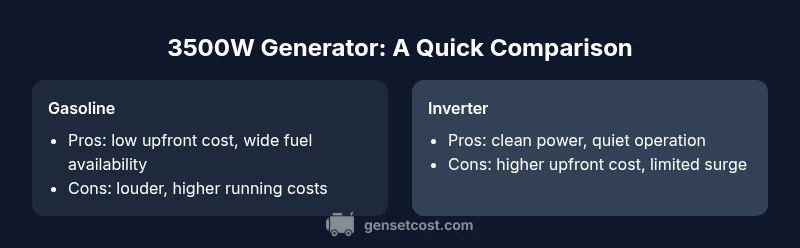
The choice between inverter and traditional portable designs within the 3500 watt class hinges on waveform quality, efficiency, and startup reliability. Inverter generators produce a clean, stable sine wave ideal for modern electronics, computers, and sensitive devices, even when operating at partial loads. They typically deliver better fuel efficiency and quieter operation, especially at lower loads, but can come at a higher upfront price and potentially lower surge capacity compared with some non-inverter counterparts. Traditional portable models prioritize raw surge power and lower initial cost, which can be advantageous for short outages where you need high startup power for a motor or compressor. Both types exist in the 3500 watt category, and your decision should reflect your critical load profile, noise tolerance, and whether you value compact form factor or maximum instantaneous surge. Genset Cost’s analysis indicates that many homeowners report a preference for inverter models when electronics are frequent, while traditional designs win on simple reliability and affordability for basic backups.
Noise, emissions, and operating considerations
Noise and emissions are common pain points with portable generators, particularly in suburban neighborhoods. A 3500-watt unit can be louder than a compact inverter, especially when idling or during surge periods for motors. If you live in tighter spaces or have noise restrictions, seek models with higher-quality mufflers, enclosed housings, or inverter technology that minimizes sound signatures. Emissions are another consideration; clean-burning fuels and well-maintained engines reduce exhaust odors and pollution, an important factor for long-term outdoor use near living spaces. Always follow local regulations about placement, ventilation, and exhaust routing to protect family members and pets. When planning installation, consider outdoor clearance requirements, proper anchoring, and how a transfer switch connects to your main panel. Genset Cost emphasizes compliance with safety standards and adherence to manufacturer maintenance schedules to ensure consistent performance and safer operation over the generator’s life cycle.
Transfer switches, power reliability, and safety
A transfer switch is a critical component when integrating a 3500 watt generator into your home power system. It ensures a safe, code-compliant handover from utility power to backup power, preventing backfeed that could endanger line workers or damage equipment. You can choose a manual transfer switch if you prefer a simple, low-cost solution, or an automatic transfer switch (ATS) if you want the system to switch automatically when outage conditions are detected. For a 3500 watt setup, ensure the switch capacity supports your running watts plus surge for any essential circuits you intend to power. Safety features to look for include automatic low-oil shutoff, proper grounding, and enclosed housings that reduce incidental contact with hot surfaces. A well-designed transfer switch also simplifies routine maintenance by isolating the generator from the grid, enabling safer servicing and prolonging equipment life. The goal is a seamless, safe, and compliant handoff to reliable backup power when the grid goes down.
Setup, maintenance, and long-term care
Routine maintenance for a 3500 watt generator is essential to preserve reliability and extend service life. Key tasks include regular oil changes with the recommended viscosity, air filter inspection, spark plug checks, and fuel system cleanup to prevent varnish buildup. Seasonal storage practices, such as stabilizing fuel and protecting the unit from moisture, help prevent corrosion and startup issues. Keep a maintenance log and follow the manufacturer’s service intervals; using a recognized service technician for complex tasks can prevent costly mistakes. Basic upkeep also involves testing the unit under load, which helps verify that the generator can sustain essential circuits during an outage. Genset Cost emphasizes documenting fuel type, run hours, and maintenance dates to track wear patterns and anticipate component replacements, such as spark plugs or filters, before problems arise. By staying proactive, you can minimize unexpected downtime and assure readiness when disaster strikes.
How to compare models: features that matter
When evaluating 3500 watt models, the most critical features include runtime per fuel tank, starting reliability (manual vs electric start), outlet configuration (AC outlets, USB ports, and RV-ready plugs), and whether the unit supports parallel operation with another generator. Look for models with automatic idling (to save fuel when loads are light), economy modes, and robust overload protection. Warranty length and coverage are important indicators of expected durability; longer warranties often correlate with more rigorous testing and better component quality. Parallel capability can be a valuable upgrade if you anticipate higher future loads or want added resilience for critical circuits. Finally, evaluate customer support, dealer network, and ease of maintenance access. A thoughtful comparison of these attributes helps homeowners select a generator 3500 watt that aligns with power needs, budget, and long-term reliability.
Real-world use cases for a 3500-watt system
A 3500-watt backup system is well-suited for several realistic scenarios. In a typical outage, you can keep essential cold storage running, charge smartphones and modems, maintain lighting, and operate fans or a small heater in moderate climates. For small households with core devices, this capacity supports a reliable power supply for several hours each day, especially when paired with an efficient inverter unit. In emergency work-from-home situations, the generator can power a laptop, monitor, internet router, and modest lighting, enabling continuity while the main power is down. If you rely on a sump pump or medical equipment, a properly sized 3500 watt generator can sustain these critical loads during seasonal outages. Remember that individual results vary with the actual loads you run and the efficiency of the equipment connected to the system. Effective load management and conservative planning help maximize uptime and minimize fuel costs.
Buying guide: price ranges and value
Price is a key factor in selecting a generator 3500 watt, but total value depends on runtime, reliability, and feature set. Gasoline non-inverter models typically come in a more budget-friendly range, while inverter-based units tend to be pricier but deliver cleaner power and better fuel economy. Budget-conscious buyers should consider basic models with essential outlets and manual start, then upgrade features as needed. For those seeking quiet operation and precision power for sensitive electronics, inverter designs with automatic start and multiple outlets may justify the higher upfront cost. In general, expect price ranges to reflect the balance between surge capacity, fuel flexibility, and technology. The best approach is to align the features with your outage profile, then compare warranties and service options from trusted retailers. Genset Cost’s framework recommends evaluating total cost of ownership over the unit’s life, including fuel, maintenance, downtime, and resale value to determine the most economical choice in the 3500-watt category.
Authority sources and buyer resources
- Occupational Safety and Health Administration (OSHA): https://www.osha.gov – Safety guidelines for portable generators, CO hazards, ventilation, and outdoor placement.
- FEMA: https://www.fema.gov – Emergency preparedness and power outage readiness guidance.
- U.S. Department of Energy (Energy.gov): https://www.energy.gov – Energy efficiency and performance considerations for backup power solutions.
- Additional consumer guidance from reputable outlets and industry reviews can help corroborate model comparisons and warranties.
Comparison
| Feature | Gas-powered 3500W portable | Inverter 3500W portable |
|---|---|---|
| Starting method | Manual recoil start | Electric push-button or remote start |
| Waveform quality | Standard sine wave | |
| Running watts | up to 3500 W | |
| Surge watts | up to 7000 W | |
| Fuel type | Gasoline | |
| Fuel efficiency | Lower at light loads | Higher efficiency due to inverter control |
| Noise level | Higher noise profile | Quieter operation |
| Price range | $400-$900 | $800-$1500 |
| Best for | Budget-backed outages and quick outages | Sensitive electronics and long runtimes |
The Good
- Clear headroom for essential loads during outages
- Lower upfront cost for basic non-inverter units
- Inverter options offer cleaner power for electronics
- Wide availability and simple maintenance
The Bad
- Non-inverter models can be louder and less efficient
- Inverter models can have higher upfront costs
- Fuel availability and storage complexity vary by fuel type
- Smaller surge margin on some inverter units
Inverter 3500W models win for electronics and quiet operation; traditional gas units win on immediate surge and simplicity
Choose an inverter 3500W if you need clean power and lower noise; choose a gas unit if you prioritize cost and straightforward maintenance, while ensuring surge capacity meets your essential loads.
People Also Ask
What can a generator 3500 watt power during an outage?
A 3500 watt generator can run essential appliances such as a refrigerator, lights, a modem, and a sump pump during outages, depending on the total running watts and startup surges of your connected devices. Prioritizing loads helps maximize uptime.
A 3500-watt generator can power essentials like a fridge, lights, and a modem during outages, depending on what else is running.
Is a 3500-watt generator suitable for a small home?
Yes, for homes with modest essential loads, a 3500-watt unit often suffices to keep core systems running during outages. It may require careful load management and a transfer switch to isolate critical circuits.
Yes, for small homes with a few essentials, a 3500-watt unit can work well with proper load management.
Gasoline vs inverter: which is better for 3500 watts?
Gasoline models usually offer lower upfront cost and higher peak power, while inverter models provide cleaner power and better fuel efficiency at part-load. Your choice depends on whether you prioritize cost or electronics-friendly operation.
Gasoline can be cheaper and surge-capable; inverters give cleaner power and run more quietly.
Do I need a transfer switch for a 3500-watt generator?
A transfer switch is strongly recommended. It prevents backfeeding, protects utility workers, and enables a safe, automatic or manual handoff to backup power for defined circuits.
Yes, a transfer switch is highly recommended for safety and reliability.
How long does a 3500-watt generator last on a full tank?
Runtime varies with fuel type, load, and efficiency. Expect longer runtimes at lighter loads, especially with inverter models that optimize fuel use. Consult the manufacturer’s run-time charts for guidance.
Runtime depends on load and fuel type; lighter loads mean longer operation.
What maintenance is required for a 3500-watt generator?
Routine maintenance includes oil changes, air filter checks, spark plug inspection, and fuel stabilization during storage. Regular load testing helps ensure reliable operation during outages.
Regular oil changes, air filter checks, and periodic load testing keep it reliable.
Are 3500-watt generators eligible for parallel operation?
Some 3500-watt models support parallel operation with a second unit. This can increase overall capacity for higher outages, but not all models offer this feature, and it may require a dedicated parallel kit.
Some can be paired with another unit for more power, check compatibility.
What is the typical price range for a generator 3500 watt?
Prices vary by technology, fuel type, and features. Expect ranges that reflect trade-offs between surge capability, noise, and smart features, with lower upfront costs for basic models and higher prices for inverter, dual-fuel, or parallel-capable units.
Prices depend on features; basic models are cheaper, inverter and parallel-capable units cost more.
Key Takeaways
- Identify essential loads before sizing
- Inverter models typically offer better power quality and efficiency
- Balance upfront cost with long-term operating expenses
- Consider transfer switches for safe, automatic operation
- Review warranty and service options before purchase