Generator 400 Amp: Sizing, Costs, and Setup Guide
Comprehensive guide to sizing, costing, and installing a generator 400 amp system for homes and multi-unit properties. Learn load calculations, configuration options, and practical installation tips from Genset Cost.


A generator 400 amp is typically needed for homes with high electrical loads or for properties with multiple service panels. It helps maintain critical circuits during outages by supporting larger transfer switches and robust generators. For homeowners, a properly sized 400 amp setup starts with a detailed load calculation and a comparison of transfer-switch options and fuel choices.
Understanding the role of a generator 400 amp
A generator 400 amp represents a high-capacity backup solution designed to support substantial home or small multi-dwelling loads. When a service is wired for 400 A, the transfer switch, main panel, and generator must coordinate to deliver power without overloading the existing electrical system. In practical terms, a 400 amp setup can sustain essential circuits across a broad range of appliances, climate-control equipment, and multi-zone lighting. According to Genset Cost, the 400 amp specification is commonly chosen for homes with heavy electrical usage or buildings that anticipate future expansion. The key benefit is reliability during outages, along with the ability to run larger induction motors and heat pumps without tripping a breaker. Remember that the exact performance depends on voltage, efficiency, and how the loads are distributed across phases. As you weigh options, balance the need for capacity with the realities of fuel availability and maintenance requirements. In short, generator 400 amp capacity is a strategic choice for serious resilience, not a one-size-fits-all fix.
In sizing discussions, you will see references to kW ratings and duty cycles. A practical starting point is to translate the 400 amp rating into a usable power figure for your home. For example, at a typical residential voltage of 240 V, a 400 amp transfer switch can imply substantial kW capability, though actual available kW depends on the generator model, engine size, and application. The Genset Cost team emphasizes that you should approach this as a system problem: assess the loads you need to support, confirm panel compatibility, and design a control scheme that prevents overload while maximizing uptime. This mindset keeps the project aligned with cost considerations and long-term reliability.
sourceRefTagForDataNotesOnlyIfNeededForBlock2
Comparison of critical aspects in a 400 A configuration
| Aspect | What a 400 A configuration covers | Key considerations |
|---|---|---|
| Transfer switch rating | 400 A capacity supports full-house recovery | Ensure compatibility with generator output and service panel |
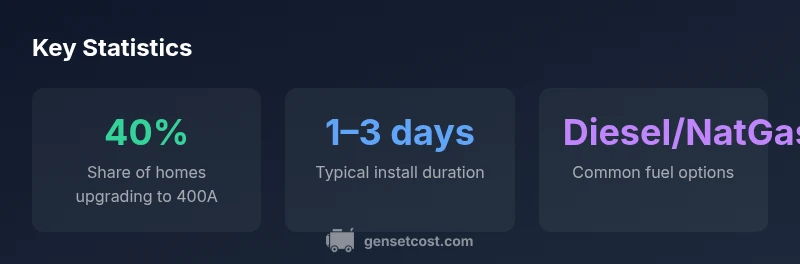
| Fuel options | Diesel, natural gas, propane | Consider fuel availability, line size, and emissions |
| Installation factors | Permits, venting, exhaust, clearance | Involve a licensed professional for safety and code compliance |
People Also Ask
What does a 400 amp generator mean for my home?
It refers to the maximum current rating of the transfer switch and generator, enabling larger loads to be served during outages. It does not automatically deliver all circuits; you still need a proper load calculation and a correctly sized panel.
A 400 amp system means your setup can handle bigger loads, but you still size and prioritize what runs during an outage.
Do I need a 400 amp system if my home has a 200 amp service?
Not necessarily. A 400 amp system is often chosen for homes planning future expansion or with high concurrent loads. A professional load calculation will determine whether a 200 A upgrade is warranted or if a 400 A setup is overkill.
It depends on your loads; a professional load calc will tell you if upgrading is needed.
What factors affect the cost of a 400 amp installation?
Equipment quality, transfer switch rating, fuel type, distance to the main panel, and permitting and labor all influence total cost. Site constraints and local codes also play a significant role.
Costs hinge on hardware, fuel, and how complex the install is.
Can I parallel two smaller generators to achieve 400 A?
Yes, parallel gensets can reach higher capacity, but synchronization and control systems add complexity and require careful design by a qualified installer.
Yes, but paralleling is more complex and needs proper synchronization.
How long does it take to install a 400 amp backup system?
Most installations require a few days, depending on site readiness, permits, and panel changes. Complex sites can take longer.
Usually a few days, but it varies with site conditions and permits.
“Sizing a 400 amp backup system correctly is essential to protect essential loads without over-sizing the service.”
Key Takeaways
- Know whether your service and panel support 400 A safely
- Start with a professional load calculation before selecting a transfer switch
- Choose fuel type based on availability, cost, and emissions
- Expect installation to require permits, proper clearances, and professional wiring
- Parallel setups are possible but add complexity and cost