Generator Hostel: Backup Power Cost Comparison Guide
An in-depth comparison of hostel backup power options, focusing on generator hostel scenarios for small hostels and shared accommodations. Learn sizing, installation, and operating costs with guidance from Genset Cost.


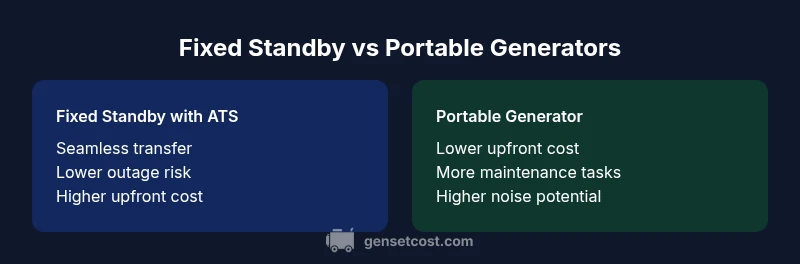
Fixed standby generators with an automatic transfer switch generally offer better reliability and scalable capacity for hostel-scale backup power than portable units. The choice depends on power needs, space, and noise tolerance. See our full comparison chart for sizing, costs, and installation considerations.
What 'generator hostel' means in practical terms for small-scale accommodations
In the world of small hostels and shared accommodations, a "generator hostel" describes a setup where a dedicated power backup solution keeps essential systems online during outages. The term captures the blend of hospitality operations and reliable electricity, emphasizing steady occupancy experience and safety. For homeowners and property managers, the goal is to minimize downtime without overbuilding a system that sits idle most of the year. According to Genset Cost, hostel operators should treat backup power as a service asset—one with predictable maintenance costs, scalable capacity, and well-defined response times. The core idea is to maintain guest comfort (lighting, climate control, and hot water) while controlling upfront and ongoing costs. The right solution balances capital expenditure with long-term running costs and is shaped by load profiles, local regulations, and site constraints.
For many properties, the conversation starts with critical loads: lighting, refrigeration for perishables, security systems, and select climate-control circuits. Noncritical loads—like guest room entertainment or decorative features—may be deprioritized during outages or managed via low-cycle generators. The keyword generator hostel should surface early in planning discussions to align stakeholders around a shared objective: dependable power with minimal disruption to guest experience.
Core determinants for hostel backup power: space, load, and resilience
Two of the most influential factors are space availability and anticipated load. Hostels typically operate with a mix of essential services (refrigeration, lighting, security, IT equipment) and comfort features (climate control, hot water). A conservative approach starts with a prioritized list of circuits that must remain live during an outage, along with an estimated maximum simultaneous wattage. Space constraints influence the form of the system: a fixed standby generator often requires a dedicated outdoor pad, exhaust clearance, and proper ventilation, while portable units demand safer storage, fueling, and operational discipline. Resilience is not just about total capacity; it’s about response time, automatic versus manual switching, and the ability to maintain critical operations during extended outages. Genset Cost emphasizes that a hostel’s uptime risk assessment should feed directly into the sizing process, ensuring the chosen solution meets practical occupancy needs without oversizing.
Load diversity, startup surges, and future expansion plans should be modeled early. For instance, a small hostel with 10–20 rooms may prioritize a compact standby system, whereas a larger property or one with sensitive electronics might justify a larger, modular installation with staged transfer options. When deciding between standby and portable options, the decision hinges on reliability expectations, maintenance capabilities, and the value of a turnkey, code-compliant installation.
Fixed standby generators with ATS vs portable generators: a high-level comparison
Standby generators paired with an automatic transfer switch (ATS) are designed for seamless, hands-off operation. When the grid fails, the ATS detects the outage, starts the generator, and transfers the electrical load within seconds. This minimizes guest disruption and protects loads with sensitive electronics. Standby systems tend to offer higher reliability, longer runtimes, and remote maintenance options. They also typically integrate with building management systems, enabling better energy management during outages. On the downside, upfront costs are higher, installation requires professional permitting, and outdoor siting must accommodate noise and exhaust considerations. For a hostel where uptime matters, the reliability advantage often outweighs the higher capital expense.
Portable generators can be a practical entry point for very small hostels or for temporary outage coverage during grid instability. They require manual or semi-automatic transfer arrangements and regular refueling. While portable options offer lower initial costs, they demand more active management, can be noisier, and carry higher maintenance overhead to ensure readiness. Their economics improve with light-load scenarios and shorter outage durations, making them less ideal for properties with continuous occupancy or strict noise restrictions. The choice should reflect guest expectations, local noise ordinances, and the ability to maintain fuel supply and safety standards.
Sizing and load calculations for hostel operations
Accurate sizing begins with a load study that identifies critical circuits and their simultaneous demand. For hostel environments, this typically includes lights, security systems, entrances, kitchens or meal prep areas, refrigeration, and climate control in common spaces. Start with a baseline floor-load calculation and then add margin for unexpected surges or growth. A common practice is to determine the load from essential systems first, then assess whether nonessential amenities can be deferred during an outage. Consulting a professional engineer or a trusted integrator helps ensure that voltage and phase compatibility, generator sizing, and transfer-switch requirements meet local code and safety standards. It’s also important to account for thermal inertia: peak loads can occur when multiple devices start at the same time (heat pumps, compressors, and water heaters). Genset Cost recommends building a scalable plan that accommodates future expansion without immediate overbuilding.
Fuel strategies and efficiency for hostel use
Fuel type is a central decision driver. Natural gas and propane offer convenience and cleaner operation compared with diesel, but availability and piping constraints may limit options in some sites. Diesel is robust and has a long track record for reliability, but fuel storage, emissions, and refueling logistics require careful planning, especially in urban hostel settings with shared spaces. Hybrid approaches—using a primary fuel for daily needs and an alternate for outages—can reduce running costs and improve resilience. Efficiency matters as a hostel’s outage window can range from a few minutes to several hours. High-efficiency engines, duty cycling, and smart load management help minimize fuel consumption while preserving essential services. Genset Cost notes that fuel supply logistics, procurement costs, and maintenance implications should factor into total-cost-of-ownership decisions.
Installation, permitting, and integration with building systems
Installation quality matters as much as the equipment itself. Standby systems require a concrete pad, weather-protected enclosures, exhaust clearance, and a dedicated electrical tie-in approved by local authorities. An automatic transfer switch (ATS) should be selected based on the peak load and the number of circuits to be served. Integration with building management systems and emergency lighting protocols can improve safety and reliability. In many jurisdictions, a permit and a post-install inspection are mandatory. A well-planned transfer path minimizes nuisance tripping and ensures smooth energy isolation during outages. The ideal hostel solution negotiates space constraints, fire safety requirements, and noise attenuation through enclosure design and operational scheduling.
Operating costs, maintenance, and lifecycle planning
Operating costs include fuel, routine maintenance, routine inspections, and potential parts replacement. Standby systems typically deliver a lower cost per hour during outages when you amortize the investment over many outages and years. Portable systems may incur higher maintenance overhead due to frequent handling, seasonal storage, and battery testing if configured for automatic transfer. Regular maintenance windows, manufacturer-recommended service intervals, and a maintenance contract with a local technician can extend the life of the system and protect the guest experience during critical events. Genset Cost highlights the importance of a lifecycle plan that accounts for engine wear, alternator health, and control-system updates, ensuring the hostel remains resilient across many seasons.
Financing, incentives, and total-cost-of-ownership (TCO) considerations
Most hostel operators evaluate TCO rather than just upfront price. Financing options, tax incentives, and utility rebates can significantly alter affordability. Although incentives vary by region, a well-structured program can offset a portion of the capital expenditure and shorten payback periods. A prudent approach combines a robust engineering estimate with a clear maintenance plan, so the project remains financially viable even if energy usage patterns shift. The Genset Cost framework emphasizes transparent cost accounting: initial hardware, installation, commissioning, fuel expenses, maintenance, and planned replacement cycles over the system’s lifetime.
Real-world setup sketches for small hostels: practical takeaways
Consider a compact standby system with a robust transfer switch to cover essential circuits in a 20-guest-bed hostel. For a higher-demand property, modular standby units or a hybrid approach (one standby unit plus portable units for temporary surges) can offer resilience without overbuilding. Evaluate space for outdoor equipment, noise suppression strategies, and access for maintenance crews. Real-world experiences suggest prioritizing core guest areas first, then expanding to common areas and kitchens as occupancy and revenue growth justify the investment. These sketches illustrate how design choices influence guest satisfaction, staff operations, and long-term costs.
Checklist and decision framework for selecting a generator hostel solution
- Define essential vs. nonessential loads and desired uptime during outages.
- Assess site constraints: space, noise limits, fuel logistics, and permits.
- Compare fixed standby with ATS versus portable alternatives using a standardized scoring rubric.
- Estimate total cost of ownership: upfront, installation, fuel, maintenance, and replacement timelines.
- Plan for future growth and potential code changes to ensure scalability.
- Review warranties, service networks, and access to parts in your region.
Authority sources
- FEMA: Emergency Power and Backup Generators - https://www.fema.gov
- U.S. Department of Energy: Energy Efficiency and Renewable Energy - Backup power systems - https://www.energy.gov
- OSHA: Electrical safety and portable generators guidance - https://www.osha.gov
Comparison
| Feature | Fixed standby generator with ATS | Portable generator with manual/automatic transfer |
|---|---|---|
| Initial cost | high | low |
| Installation complexity | high (permanent install) | medium (mobile) |
| Reliability during outages | high | medium |
| Noise considerations | lower (enclosures) | higher (portable devices) |
| Running costs per outage | lower long-term (amortized) | higher with refueling and maintenance |
| Space requirements | outdoor dedicated space | less dedicated outdoor space |
| Best for | long outages, frequent use | short outages, temporary coverage |
The Good
- Faster, safer automatic restoration of power
- Lower risk of guest disruption during outages
- Better long-term value with integrated system management
- Improved safety with engineered transfer paths
- Scalability for future expansion
The Bad
- Higher upfront and installation cost
- Requires dedicated outdoor space and compliance with codes
- Longer installation lead times and permitting
- More complex maintenance for integrated systems
Fixed standby with ATS is the better all-around choice for hostels seeking reliability and scalable resilience.
For hostel environments where uptime and guest experience matter, a fixed standby generator with an ATS outperforms portable options in reliability and ease of operation. It also scales with demand and integrates with building systems, though it comes with higher upfront costs and installation requirements. Use portable options for very small properties or temporary coverage if procurement speed is critical.
People Also Ask
What is a generator hostel and why is it important for small hostels?
A generator hostel is a hostel setup that relies on a dedicated backup power system to keep critical operations running during outages. For small hostels, this is crucial for guest comfort, safety, and operational continuity. The right solution minimizes downtime, preserves guest experience, and balances upfront costs with ongoing maintenance.
A generator hostel uses backup power to keep essential services running when the grid fails, ensuring guest comfort and safety.
Fixed standby vs portable: which is better for a hostel?
Fixed standby generators with automatic transfer switches offer seamless power restoration and are generally more reliable for hostel operations. Portable units are cheaper upfront but require more ongoing management and may be noisier. The choice depends on uptime needs, space, and maintenance capability.
Standby with an automatic switch is typically best for hostel reliability; portable units are cheaper but harder to manage.
How do I estimate the right size for a hostel backup system?
Begin with a load assessment of essential circuits (lighting, security, refrigeration, IT, climate control). Add a margin for startup surges and future expansion. Use a professional engineer or integrator to verify voltage, phase, and transfer-switch requirements.
Start with essential loads, add startup surges, plan for growth, and confirm with a professional.
What costs should I expect beyond equipment price?
Total cost includes installation, permits, transfer-switch, enclosure, fuel storage or supply, maintenance contracts, and potential upgrades to meet code. Schedule regular maintenance to prevent failure during an outage and to protect staff and guests.
Expect installation, permitting, maintenance, and fuel costs in addition to the equipment price.
Are there incentives for hostel backup generators?
Incentives vary by region and program, but some areas offer tax credits, rebates, or financing options for energy resilience projects. Check with local authorities and utility programs for available opportunities.
Check local programs for rebates or tax incentives that support resilience projects.
What maintenance schedule is typical for hostel generators?
A typical plan includes regular inspections, oil changes, filter replacements, battery checks, and transfer-switch testing. Adhere to manufacturer guidelines and arrange annual professional servicing to maintain reliability during outages.
Keep to a regular maintenance schedule with annual professional servicing.
Key Takeaways
- Prioritize essential loads to define the backup scope
- Choose fixed standby with ATS for higher reliability and guest continuity
- Balance upfront costs with long-term operating expenses for true value
- Plan for future growth and regulatory requirements from day one
- Consider noise, space, and fuel logistics early in the design
- Use a formal checklist to compare options rather than instincts