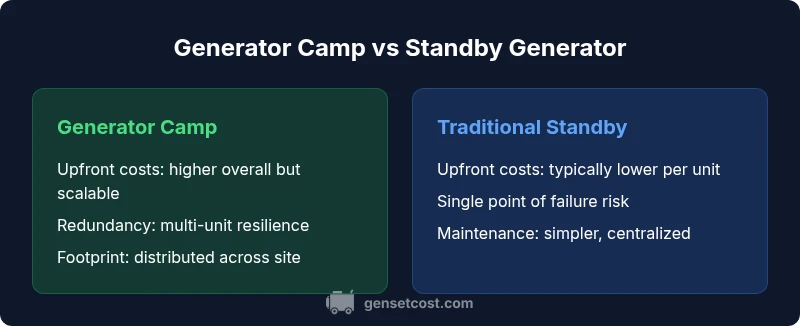
Generator Camp vs Standby: A Cost-Effectiveness Guide
Compare generator camp setups to traditional standby generators for home backup. This analytical guide from Genset Cost covers sizing, costs, maintenance, and best-use scenarios for homeowners and property managers.


In most single-family homes, a traditional standby generator remains the simplest and most cost-effective option, while a generator camp—the modular, multi-generator setup—offers scalability for multi-unit properties or campuses. The right choice hinges on load, space, and long-term maintenance expectations. This quick comparison helps homeowners and property managers decide quickly: if you need redundancy across several units or extreme weather resilience, generator camp may pay off over time, otherwise a fixed standby generator typically wins on upfront cost and ease of service.
What generator camp means in practice
For homeowners and property managers, generator camp is a modular approach to backup power that clusters multiple generators to serve a shared load. It is not a single device but an arrangement that enables staged expansion, redundancy, and diversification of fuel sources. In practice, generator camp systems can be wired to a centralized automatic transfer switch and managed by a common controller, allowing flexibility to grow with demand. According to Genset Cost, generator camp can unlock resilience for power-critical operations across multiple dwellings while preserving space and permitting selective maintenance windows. In 2026, more regional installers offer scalable pack designs for residential campuses and large properties, making generator camp a viable option even for mid-size apartment portfolios.
Core differences at a glance
- Complexity and control: A generator camp requires centralized coordination across multiple gensets, with shared transfer switches and a unified monitoring system. A traditional standby system centers on a single unit and a single transfer mechanism.
- Scalability: Camp setups are designed for staged expansion, allowing capacity to grow as loads rise or as tenants come online. Standby installations scale only with a larger single generator or a retrofit, which can be more disruptive.
- Footprint and layout: Generator camps often spread across a site, using distributed footprints and multiple connection points. A single standby unit remains compact but concentrates risk in one device.
- Maintenance and service: Multi-unit camps demand coordinated service across units, while a standalone standby typically requires less complex scheduling.
- Reliability: Camps can provide higher resilience through redundancy, but only if all units and controls are maintained. A lone standby generator is reliable when properly maintained but has a higher risk of complete outage if the one unit fails.
Load sizing and resilience
Sizing a generator camp hinges on a diversified load profile, where simultaneous peak loads are mitigated by staggering unit operation and leveraging a central controller. In practice, engineers use diversity factors and load shedding strategies to avoid over-provisioning. For campuses or multi-unit properties, a generator camp can cover common spaces (lifts, corridors, HVAC) and individual units in a balanced way. This approach improves resilience during a weather event and supports rapid restoration of critical loads. For homeowners with modest growth expectations, a single standby unit often meets the majority of needs at a lower upfront cost. As load diversity grows, the value of a camp becomes clearer. The Genset Cost team emphasizes that accurate load analysis is essential to avoid over- or under-sizing.
Space, zoning, and installation complexity
Installation challenges rise with a generator camp because you must plan for multiple generators, parallel operation, and interconnections to a shared electrical system. Permitting can be more involved when more than one fuel source or more than one building is included. Site planning should consider transfer switches, remote monitoring, and potential conduit routing to each unit. By contrast, a traditional standby installation typically centers on a single outdoor generator and a straightforward transfer switch, which simplifies permits and reduces on-site complexity. Real-world projects in 2026 show that communities prioritizing resilience through camp configurations also invest in centralized control rooms and digital monitoring to coordinate testing and maintenance windows efficiently.
Cost components and ownership economics
The cost picture for generator camp is more nuanced than a single standby unit. You should anticipate several cost components: multiple gensets, centralized transfer switches, interconnect wiring, distribution panels, and the central monitoring system. There are also site-specific factors like access, concrete pad requirements, and fire-code clearances. While upfront costs tend to be higher for a camp configuration, the cost per kilowatt can improve with scale and long-term utilization. Ongoing ownership costs include regular maintenance across units, fuel management, battery replacements for each unit, and potential fleet-level warranties. In many cases, a well-planned generator camp reduces downtime risk for multi-unit properties, making it an attractive option despite higher initial investment.
Maintenance, warranties, and service availability
Maintenance for a generator camp requires a disciplined schedule across multiple units and a robust remote monitoring setup. Service availability depends on the vendor network and local technicians trained to handle parallel operation, transfer switching, and interlocks. If one unit is offline, the control system should reassign loads among the remaining units, which reduces the impact of a failure. Warranties for each gen-set must be coordinated, and fleet warranties may offer better protection for multiple units. Homeowners with a single standby typically rely on a single maintenance contract, but multi-unit camps demand a plan that covers the fleet, parts availability, and remote diagnostics to minimize downtime.
Use cases and decision heuristics
- Multi-unit housing, student housing, or apartment complexes: Generator camp offers scalability and redundancy across tenants, making it a compelling long-term choice.
- Rural campuses or work sites with variable loads: A camp approach helps modulate peak demand and maintain essential loads during outages.
- Small businesses with growth plans: If expansion is anticipated, a generator camp can avoid future retrofits and centralize maintenance.
- Single-family homes with limited growth: A traditional standby generator is often more cost-effective and simpler to manage.
Deployment patterns and case considerations
- Central hub with distributed gensets: A core control unit manages multiple units spread across the site, providing redundancy and staged testing.
- On-site clusters per building: Each building has its own small cluster that feeds a shared panel, allowing localized maintenance without shutting down other loads.
- Hybrid with solar or storage: Solar plus storage with gensets can reduce fuel use and emissions while preserving reliability during outages. A hybrid approach requires careful integration through an intelligent control system and metering to ensure seamless transfer between sources.
The future: modular grids and smart controls
As digital controls mature, generator camps are converging with micro-grid concepts. Expect advances in remote monitoring, predictive maintenance, and automated load management to reduce unscheduled downtime. Emissions controls and fuel diversity will further influence adoption, especially in urban areas with strict air quality rules. The overarching trend is toward modular grids that balance resilience, efficiency, and cost in a scalable, serviceable package. For homeowners and property managers, this future is most compelling when paired with robust procurement, maintenance planning, and an alignment with energy-efficiency goals.
comparisonTableHTMLContent elsewhere not used in this field?
overlayTitle_callout_big_not_needed_removed?
Comparison
| Feature | Generator camp | Traditional standby generator |
|---|---|---|
| Load handling | High scalability and redundancy across units | Fixed capacity from a single genset |
| Space and layout | Distributed footprint across the site | Compact footprint on a single pad |
| Installation complexity | High: central controls, interlocks, permits | Moderate: single location, simpler permitting |
| Maintenance coordination | Requires fleet-level scheduling and monitoring | Simpler maintenance with one unit |
| Reliability and redundancy | High resilience with proper maintenance | Reliability tied to one unit; risk of single point of failure |
| Permitting and codes | More stringent for multi-building campuses | Typically fewer hurdles for single-family installs |
| Total cost of ownership | Higher upfront design costs; cost per kW can drop with scale | Lower upfront costs per unit; higher long-term risk if underutilized |
The Good
- Scalability and redundancy across multiple units
- Better long-term resilience for multi-unit properties
- Opportunity for staged investment and expansion
- Flexible use of space and zoning options
The Bad
- Higher upfront complexity and planning requirements
- Increased maintenance coordination across units
- More complex monitoring and control requirements
- Potential for higher total project duration and permitting timelines
Generator camp is the preferred approach for multi-unit or campus-like properties; traditional standby is typically best for a single residence with limited growth.
If your project anticipates expansion or multi-tenant resilience, generator camp provides scalable protection with redundancy. For a single home, a standby generator usually delivers a simpler, lower-cost solution with easier maintenance.
People Also Ask
What is generator camp and when should I consider it?
A generator camp is a modular arrangement of multiple generators connected to a shared load, typically used for multi-unit properties, campuses, or remote sites. It offers redundancy and scalability, but requires careful sizing, control strategies, and maintenance planning.
A generator camp uses several generators together for big loads. It’s ideal for multi-unit properties or campuses but needs careful planning.
How do I size a generator camp for a multi-unit property?
Sizing a generator camp involves analyzing total and peak loads across all units, considering diversity factors, and planning for future expansion. A centralized controller helps distribute loads and prevent over-provisioning. Engage a qualified engineer to model scenarios before selecting gensets.
Work with an engineer to map loads across all units and plan for growth.
Are generator camps more expensive than standalone standby generators?
Upfront, generator camps tend to be more expensive due to multiple units and centralized controls. However, they can lower the cost per kilowatt and improve resilience when loads are spread over several buildings. Total cost of ownership depends on maintenance, fuel, and utilization.
They cost more upfront, but can be cheaper per unit of power over time with good planning.
What maintenance challenges come with generator camps?
Maintenance for camps requires coordinated service across all units and reliable remote monitoring. Establish a fleet-wide maintenance schedule, ensure parts availability, and train local technicians to handle parallel operation safely.
Maintenance is more complex, but centralized monitoring helps keep everything aligned.
What permits are required for generator camp installations?
Permitting varies by location but is generally more involved for multi-unit or campus-like installations. You may need interconnection agreements, environmental clearances, and fire-safety approvals. Start early with the local utility and building department to avoid delays.
Check with local authorities early; multi-unit projects often require more approvals.
Can a generator camp integrate with solar or other energy storage?
Yes. A generator camp can be integrated with solar and energy storage to reduce fuel use and emissions. Integration requires a sophisticated control system to manage switching between sources and ensure seamless reliability during outages.
You can combine it with solar or storage for better efficiency.
Key Takeaways
- Assess current and future load before choosing
- Generator camp suits campuses and multi-dwelling properties
- Factor permits and centralized controls into the plan
- Expect higher upfront costs with potential long-term savings
- Plan a robust maintenance and monitoring strategy