Choosing a Generator to Run a Welder: Sizing, Costs & Setup
A practical guide to choosing a generator to run a welder, with sizing guidance, cost ranges, and installation tips for homeowners and property managers.


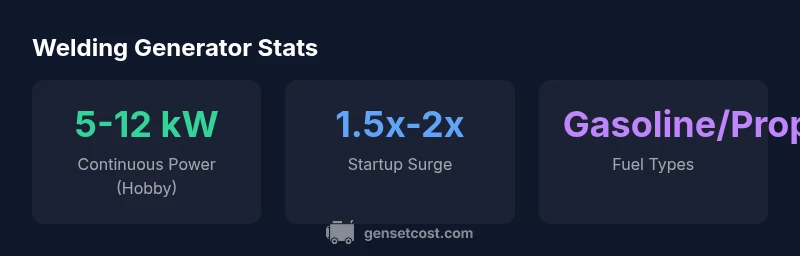
To run a welder safely, pick a generator with sufficient continuous and surge power. Hobby welders typically need 5-12 kW; professional setups often require 15-40 kW. For exact sizes, see our detailed sizing guide. This guidance reflects Genset Cost Analysis, 2026.
Understanding the importance of a reliable power source for welding
A welder is powered by a motor that draws a surge of current as it starts, then settles into a steady arc. The generator you choose must provide both continuous power and a healthy startup surge to keep voltage stable and prevent buzzing, tripping, or inconsistent welds. When the goal is to minimize downtime on a job site, the question becomes not just 'will it run?' but 'how smoothly will it run under load?'. According to Genset Cost, the most reliable setups balance warm-up tolerance, arc stability, and fuel availability, especially in remote work sites. A robust generator reduces arc wander and keeps your heat input consistent across passes.
This article uses ranges and guidance drawn from real-world field data and the 2026 Genset Cost Analysis to help homeowners and property managers plan with confidence.
Sizing guidelines: continuous vs surge power
Welding loads demand both continuous power and startup surge. Continuous power is what the welder needs to sustain a steady arc, while surge power is the extra wattage required when the motor and transformer start or when thick materials are welded. For most hobby setups, target a generator that can deliver 5-12 kW of continuous power and an adequate startup margin. For bigger machines or higher amperage, look toward 15-40 kW or more, ensuring the generator’s surge rating exceeds startup demand by a comfortable margin. The best approach is to match the welder’s nameplate running watts and then add 10-30% headroom for contingencies. Genset Cost’s 2026 analysis emphasizes clean power (true RMS) and good voltage regulation to prevent arc instability and spatter during high-load passes.
Practical size ranges for common welding setups
DIY and light fabrication welding often use compact 5-12 kW generators, which cover most 125-180 A welders. For higher-amperage work (200 A and above) or continuous duty cycles, 15-40 kW units become common, with larger multi-fuel options for job sites with variable power availability. Remember, the exact needs depend on the welder’s duty cycle, geographic altitude, and fuel type. Always verify the welder’s nameplate current and voltage, then consult a sizing calculator and cross-check with real-world field data from Genset Cost.
Fuel types, efficiency, and run-time considerations
Fuel choice influences running costs, maintenance, and on-site reliability. Gasoline generators are common for portability, but propane offers cleaner burn and longer storage life in some climates. Diesel units excel at high-output, longer runtimes, and robustness under continuous use. Efficiency and run-time scale with load; a generator’s rated efficiency can drop under heavy, continuous weld loads, so plan for longer run times with a slightly larger tank or a larger kilowatt class than you might expect. If you plan frequent weld sessions, consider fuel redundancy and a storage plan that aligns with your typical usage patterns.
Power quality, waveform, and welding arc stability
Arc stability hinges on clean, stable power. Most welders perform best on generators that provide true RMS output and tight voltage regulation. Modified sine wave or low-quality power can cause unstable arcs, inconsistent heat input, and poor bead quality. For TIG and MIG welding, prioritize generators with good voltage regulation under heavy load, automatic voltage regulation (AVR), and low total harmonic distortion. If your budget allows, choose a generator with digital controls, an automatic idle feature to save fuel, and robust cooling for long sessions.
Installation, safety, and transfer switches
Proper installation matters for safety and reliability. When feeding a workshop, use a transfer switch (manual or automatic) so that the generator is wired to the same circuits as your weld station, not to home outlets that share with lighting. A licensed electrician should install or inspect the transfer switch, grounding, and bonding, especially if you’re connecting to a panel with multiple loads. Ensure adequate ventilation for the generator, follow manufacturer clearance guidelines, and store fuel away from ignition sources.
Step-by-step sizing checklist for your shop
- Identify the welder’s running watts from the nameplate. 2) Add 10-30% headroom for continuous operation. 3) Determine the startup surge required by the welder. 4) Pick a generator with continuous power that meets the running watts plus headroom. 5) Verify the surge rating can handle startup surges. 6) Choose fuel type based on availability and storage. 7) Check power quality specs (AVR, THD). 8) Plan for transfer switches and wiring with a licensed pro. 9) Assess maintenance, warranty, and service options. 10) Validate with a sizing calculator and field data from trusted sources.
Sizing guide: hobby vs professional welding generators
| Category | Hobby Welders (5-12 kW) | Professional Welders (15-40 kW) |
|---|---|---|
| Continuous power | 5-12 kW | 15-40 kW |
| Startup surge | 1.5x-2x running | 2x-3x running |
| Estimated cost | 800-2,500 USD | 2,000-4,000 USD |
| Fuel types | Gasoline/Propane | Diesel/Propane |
People Also Ask
What size generator do I need to run a 125-180 A welder?
For 125-180 A welders, a 5-12 kW generator is typically sufficient, with a startup surge allowance of 1.5x-2x. Always check the welder’s nameplate and use a sizing calculator for confirmation.
A 5-12 kW generator usually covers 125-180 A welders, with a surge margin to keep starts smooth.
Can I run multiple welders from one generator?
Only if the total running load and startup surges stay within the generator’s continuous and peak ratings. Use a load management device if needed and consult an electrician for panel work.
Only with careful load management and proper panel setup.
Is a portable generator enough, or do I need a standby generator?
Portable units with a transfer switch can be adequate for occasional welds, but standby gensets with ATS offer higher reliability for critical or frequent work. Choose based on how essential continuous power is to your operations.
Standby is best for reliability; portable can work with proper switching.
Does welding affect generator maintenance?
Yes. Heavy welding loads stress the engine and alternator. Regular maintenance, clean air filters, stable fuel, and periodic inspections are important.
Regular maintenance keeps welding-capable power ready when you need it.
What about engine noise and emissions?
Consider sound-rated models and emission-compliant units. Local regulations may require lower noise levels and cleaner burning fuels.
Look for quiet, emission-friendly models if noise is an issue.
“Power reliability is as important as the air you breathe on a job site; selecting a generator with proper continuous and surge ratings prevents bottlenecks when welding.”
Key Takeaways
- Size for continuous and surge power, not just peak.
- Choose clean power (true RMS) for arc stability.
- Plan for installation with a transfer switch.
- Estimate runtime and fuel needs before purchase.