What Generator Size Do I Need: A Homeowner's Guide
Learn how to determine the right generator size for your home, including loads, surge, fuel options, and budgeting. A practical, step-by-step guide by Genset Cost.


If you’re asking what generator size do I need, start by listing essential loads and estimating both running and starting watts. Size for the peak of those essentials, then add a comfortable margin for surge and future additions. According to Genset Cost, accuracy comes from a careful load assessment, not guessing. This guide helps you measure, compare, and choose with confidence in 2026.
Why sizing matters
Sizing a generator correctly matters for safety, reliability, and cost. An undersized unit will repeatedly trip breakers or stall under load, while an oversized one wastes fuel and increases initial investment. For homeowners and property managers evaluating backup power, the goal is a unit that runs efficiently at or just above your peak essential load. The Genset Cost team emphasizes that practical sizing focuses on essential circuits (lighting, refrigeration, security systems, sump pumps, medical devices) rather than every appliance in the home. A properly sized generator keeps critical systems online during outages and avoids unnecessary fuel burn when demand is low. In 2026, many outages last longer, so sizing for reliability and margin is a core best practice.
How to estimate your loads
To determine the right generator size, you first need a precise load profile. Start by listing every device you want to run during an outage: furnace blower, lights, refrigerator, well pump, sump pump, modem/router, TV, and any medical equipment. For each item, record its running watt age (the continuous power draw) and its starting wattage (the brief surge when turning on). If you don’t know numbers, use manufacturer labels, user manuals, or official product pages. When you total the running watts, you’ll get a baseline; add the highest starting-wattage bulge to account for motorized equipment. Genset Cost data shows that homeowners often underestimate inverter-based devices (TVs, gaming consoles, smart-home hubs) because they draw less power but can intermittently spike load. Use a spreadsheet or a sizing calculator to keep track of running and starting watts, and don’t forget to include essential loads only if you’re aiming for a modest-size system.
Surges and continuous loads explained
Loads fall into two broad categories: continuous running loads and surge (starting) loads. Continuous loads run steadily for long periods; surge loads occur briefly as motors start. A typical air conditioner can spike by 2-3x its running wattage during startup, while other devices may peak at 1.2-1.5x. When sizing, you must cover the sum of running watts plus the largest surge you expect, but avoid overestimating by including every idle device. A practical rule is to size the generator to cover the running watts of essential devices plus the maximum anticipated surge from one or two key motors at startup. This approach prevents the unit from straining and reduces wear over time.
kW vs kVA: what’s the difference and why it matters
Generators are rated in kilowatts (kW) and kilovolt-amperes (kVA). Real power is measured in kW, while apparent power is measured in kVA. The difference matters because many generators are sized to provide a certain kVA at a given power factor (often 0.8). If you only look at kW, you may misjudge the capability for motors with high starting surges. A 20 kW generator might be rated around 25 kVA at 0.8 PF. Always check both numbers and confirm your equipment’s power factor. In practical terms, convert your total running watts into kW, then multiply by 1.25–1.6 to account for starting surges as you compare generator sizes. This helps avoid under-sizing while staying economically prudent.
Fuel types and efficiency: propane, natural gas, and diesel
Your fuel choice affects cost, availability, and continuous runtime. Diesel tends to offer higher energy density and robust cold-weather performance but may require a larger fuel tank and more maintenance. Natural gas and propane provide easier fuel storage and long-term reliability but can limit peak output depending on line pressure or tank size. In many homes, dual-fuel or tri-fuel units offer flexibility if your primary fuel is scarce. Consider local fuel costs, delivery reliability, and the ability to refuel during extended outages. Genset Cost’s analysis shows that choosing a fuel strategy aligned with your outage duration expectations leads to lower total ownership costs over the life of the unit.
Whole-house sizing vs essential loads: where to start
If you want uninterrupted full-house power, you’ll need a larger generator and a robust transfer switch setup. For most homeowners, sizing based on essential loads keeps costs reasonable while preserving critical services during outages. Start with the refrigerator, sump pump, and a few lighting circuits, then decide whether you want to add HVAC support or an extra circuit for convenience. As a rule of thumb, essential-only sizing often sits in the 5–12 kW range for many homes, but your exact needs depend on your location, climate, and home size. For property managers, consider peak occupancy patterns and whether common areas (lobbies, stairwells) require backup power too. Genset Cost’s consultations emphasize planning for the worst-case scenario and validating with a professional.
How to size using a calculator and manual methods
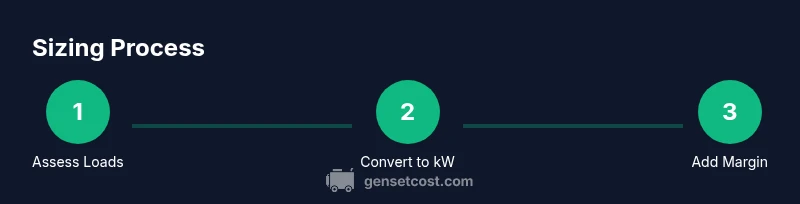
A reliable approach combines a manual wattage tally with a sizing calculator. Start by compiling a list of all devices, noting running watts and starting watts. If a device lacks data, estimate using similar models or manufacturer guidance. Input totals into a calculator, then apply a 10–20% safety margin for surge and future additions. If the result is a near tie between two sizes, choose the larger one to avoid frequent cycling and to cover unexpected surges. Always verify your final choice with a licensed electrician or generator installer to ensure compatibility with your transfer switch and service panel.
Common sizing mistakes and how to avoid them
Common mistakes include using full-house loads, ignoring surge watts, and misinterpreting kW vs kVA ratings. Another pitfall is failing to account for the HVAC compressor startup, which can dominate starting current. Don’t neglect safety margins for future improvements or battery backups. Always double-check the unit’s continuous-rated output versus peak demand and confirm that your wiring and transfer-switch configuration can support the calculated size. If in doubt, run through a professional sizing check to confirm your numbers align with code and safety standards.
Real-world examples: translating numbers into decisions
Example 1: A small 1,800 ft² home with a heat pump, fridge, well pump, lighting, and a few electronics can often be served by a 7–12 kW generator sized for essential loads plus motor surges. Example 2: A larger 3,000 ft² home with central AC, multiple sump pumps, and a home office could require a 14–20 kW unit, depending on climate and occupancy. For property managers, consider common area loads, security systems, and elevator operations if applicable. These examples illustrate the practical steps of listing running watts, adding starting watts, and selecting a margin that accommodates future needs. Genset Cost’s practical framework helps you translate these numbers into a sound purchase decision.
Tools & Materials
- Appliance wattage/wattage data for each device(Running watts and starting watts if available; otherwise estimate using similar models.)
- Wattage calculator or generator sizing calculator(Online tools can speed up calculations and help visualize margins.)
- Recent utility bill or energy usage data(Useful for estimating annual runtime and fuel needs.)
- Pen, notebook, or digital note-taking app(For recording appliance data and margins.)
- Panel and transfer-switch information(Know the available amperage, main breaker, and transfer switch compatibility.)
- Electrical safety gear(Gloves, insulated tools, and a voltage tester for hands-on checks by a pro.)
Steps
Estimated time: 60-90 minutes
- 1
Gather your data
Compile a running watts list for essential devices (refrigerator, sump pump, lights, critical electronics) and note starting watts where possible. If you’re unsure, use manufacturer data or estimates from similar models. This creates the foundation for accurate sizing.
Tip: Double-check fridge and freezer doors; they draw higher starting watts when both are open or doors are left ajar. - 2
Identify continuous vs. surge loads
Separate devices into running (continuous) loads and starting (surge) loads. The emergency sump pump may be a top surge contributor; HVAC compressors also surge heavily. Understanding this split helps you set a reasonable margin.
Tip: Put surge loads on a separate line when possible to simplify the calculation. - 3
Sum up and convert to kW
Add all running watts, then convert to kilowatts by dividing by 1000. This is your baseline run-load. Remember to factor in motor loads with high startup demands.
Tip: Use a calculator to cross-check conversions and avoid arithmetic mistakes. - 4
Add surge margin
Add the largest startup wattage you expect to the running watts. A typical safety margin is 20% to 40%, depending on your diversity of loads and future plans.
Tip: If you’re unsure about surge, choose a unit with higher peak rating rather than relying on a tight margin. - 5
Decide on kW vs kVA and power factor
Understand your generator’s kW rating and its corresponding kVA at the manufacturer’s power factor. Use running watts to estimate kW, then compare to the unit’s kW rating.
Tip: Aim for a unit with at least a 0.8 power factor to match common household loads. - 6
Choose fuel type and runtime targets
Select propane, natural gas, or diesel based on fuel availability, storage, and desired runtimes. Consider dual-fuel options for flexibility and future outages. Map your estimated annual usage to a fuel supply plan.
Tip: Factor in fuel supply chain reliability in your region (e.g., rural outages may degrade fuel access). - 7
Validate with a professional check
Have a licensed electrician or generator installer confirm the final size and panel integration. They’ll verify transfer-switch compatibility, wiring, and code compliance.
Tip: Request a written sizing confirmation with exact unit model numbers before purchase.
People Also Ask
What is the difference between running watts and starting watts?
Running watts represent the continuous load a device draws, while starting watts cover the initial surge when motors start. Accurately capturing both ensures your generator can handle motor startups without overloading.
Running watts are for the steady power you use; starting watts cover the motors' surge. Be sure to size for both to avoid overload.
Should I size for 100% of my loads or just essential circuits?
For most homes, sizing for essential circuits provides practical reliability while keeping cost down. If you want full-house power, you’ll need a much larger generator and a different transfer-switch setup.
Most people size for essential loads to keep outages manageable; full-house power needs a bigger system.
Can I power all appliances during an outage?
Powering all appliances is possible with a large, well-planned system and a suitable transfer switch, but it’s expensive and may be unnecessary for many households. A staged approach often suffices.
Full-house power is possible but costly; many homeowners stage critical loads first.
What’s the difference between kW and kVA, and why does it matter?
kW is real power; kVA is apparent power. Generators are rated in both, and the ratio depends on power factor. Match your loads to the generator’s kW rating and confirm the corresponding kVA.
Kilo-watts are the real power, while kilo-volt-amperes include reactance. Check both values when sizing.
How accurate are sizing calculators?
Calculators are helpful, but you must provide accurate appliance wattage. Use manufacturer specs when possible and verify results with a professional for final sizing.
Sizing tools help, but confirm with an expert before purchase.
Do I need a professional to verify my size?
Yes. A licensed electrician or generator installer can confirm final size, wiring, and code compliance, reducing risk and ensuring safe operation.
Yes—have a pro double-check your final size and wiring.
Watch Video
Key Takeaways
- Size for essential loads, not total household load
- Account both running and starting watts
- Use a calculator and verify with a pro
- Choose fuel type based on availability and runtime needs