Who House Generator: A Homeowner's Guide to Sizing, Costs, and Installation
A practical, educational guide for homeowners and property managers evaluating whole-house generators. Learn sizing methods, cost factors, installation steps, and maintenance with trusted guidance from Genset Cost.


In this guide you’ll learn how to determine your home’s backup power needs, compare generator options, and plan installation for a reliable whole-house solution. You’ll size by essential loads and critical circuits, understand fuel options, and estimate ongoing running costs. By the end, you can calculate a realistic budget using clear, repeatable steps.
What is a who house generator and who should consider one
The phrase "who house generator" isn’t a standard industry term, but homeowners and property managers commonly refer to a whole-house or home backup generator. A whole-house generator automatically powers a home's essential circuits during an outage, using a transfer switch that detects outages and switches from utility power to generator power within seconds. This capability is especially valuable for households that rely on medical devices, refrigeration, sump pumps, or climate control, and for properties where even short outages create significant disruption. According to Genset Cost, the decision to install such a system should weigh outage frequency, the critical loads you must support, and installation feasibility. If you live in a region with frequent storms, extended outages, or tight living spaces where portable generators don’t suffice, a home backup generator becomes a compelling option.
Who should consider it? Homeowners with long outages or high-priority loads — like refrigerated medications, perishable foods, or essential safety systems — and property managers who must keep units online for tenants. A properly sized system reduces risk, improves comfort, and preserves critical infrastructure in a power interruption. The goal is to match size and features to your actual needs without overspending on capacity you won’t use.
Quick-sizing concepts for your backup plan
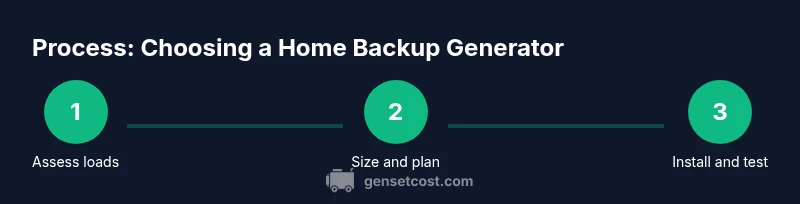
Sizing a home backup system starts with your essential loads and ends with a comfortable safety margin. List all circuits you want to be powered during an outage (lights, refrigeration, heating or cooling, water pumps, security systems, medical devices). Then separate running watts (the power a device requires while running) from starting watts (the surge needed to start motors). For motors such as AC compressors or sump pumps, the starting surge can be significantly higher than running load. The transfer switch and generator must handle both running loads and surges. The key is to balance reliability with cost by prioritizing critical circuits and avoiding oversized capacity that adds unnecessary expense and complexity. The process also includes considering future needs, such as potential upgrades or an additional exterior outlet for a future addition. A well-planned load list helps you select a generator that safely covers your essential needs while staying within a reasonable size range.
Cost factors to understand (no exact price quotes)
Costs for a home backup generator and installation vary widely based on generator size, fuel type, installation complexity, and permitting requirements. Major drivers include the cost of the generator unit, a transfer switch (automatic preferred for convenience), pipes or trenching for exhaust routing, and labor for a licensed electrician. It’s common to encounter additional expenses for site preparation, concrete pads, or weatherproof enclosures. Genset Cost analysis shows that investing time in upfront load assessment, site planning, and multi-quote comparisons reduces the risk of surprises later and helps you find a configuration that delivers real value rather than a best-guess spec. Use a structured budgeting approach that separates equipment, installation, and ongoing operating costs.
In practice, you’ll see a broad spectrum of total project costs. The range reflects differences in system size, installation constraints, and regional permitting practices. The most cost-efficient path often involves detailed planning, professional sizing, and clear quotes that cover both hardware and labor. Avoid low-bid installs that compromise safety or code compliance. Your best bet is a transparent plan with contingencies for unexpected site conditions and required upgrades to electrical panels or ventilation.
Installation considerations: location, safety, and codes
Proper installation is critical for both safety and performance. Generators must be placed in well-ventilated outdoor locations away from windows and doors, with adequate clearance for exhaust and service access. A properly installed automatic transfer switch (ATS) ensures a seamless transition between utility power and generator power, reducing the risk of back-feeding the grid. Local codes and permits are essential steps of the process; an electrical permit and sometimes a building permit may be required, depending on your jurisdiction. Adequate maintenance access, weatherproof protection, and a secure fuel supply (whether propane, natural gas, or diesel) are also important considerations. Working with a licensed electrician or a qualified generator installer is strongly recommended to ensure compliance with electrical codes and local requirements. If you’re moving from a portable generator, plan for a fixed location with proper anchoring and weatherproof housing to withstand the climate and outdoor conditions.
Choosing the right site also involves soundproofing considerations for noise, which can be a local concern. Some neighborhoods have strict noise ordinances, and generator manufacturers offer enclosures and mounting options designed to minimize disruption while maintaining safety and accessibility for service.
In all cases, a well-documented plan with site diagrams, clear electrical load lists, and a scheduled maintenance plan reduces risk and makes future upgrades smoother. The end result should be a safe, code-compliant installation that reliably powers your chosen loads during outages.
Fuel types and practical trade-offs
Most home backup generators run on propane, natural gas, or diesel, with gasoline as a temporary option for smaller units. Propane offers excellent storage stability but may require larger fuel tanks or frequent refills for high-use scenarios. Natural gas is convenient if you have an existing gas line, but supply reliability depends on local gas pressure and utility service. Diesel generators are known for fuel efficiency and long-term durability, but diesel storage and cold-weather performance can complicate maintenance. Fuel availability, storage considerations, and local climate all influence your choice. For many homes, a dual-fuel or tri-fuel option can provide redundancy, reducing the risk of outages due to fuel supply issues. When evaluating fuel types, consider long-term availability, costs, storage needs, and the ability to maintain a steady supply during seasonal outages. A practical approach is to start with your existing fuel infrastructure and select a generator compatible with that system, then confirm with a qualified installer that the chosen model aligns with local codes and safety standards.
Maintenance, warranties, and long-term planning
A well-maintained generator lasts longer and performs more reliably. Routine maintenance includes oil changes, filter replacements, battery checks, and periodic exercise cycles to keep the system ready. Warranties vary by manufacturer and model, typically covering major components for several years, with service terms that depend on proper installation and regular maintenance. Establishing a maintenance schedule with a licensed technician is critical to preserving performance and safety. In addition to routine upkeep, plan for annual inspections, testing of transfer switching, and fuel system checks. Keeping documentation of all service visits helps with warranty claims and resale value. Long-term planning also means revisiting load requirements as your home evolves, adding circuits for new appliances, or upgrading to more efficient equipment. By staying proactive, you ensure your home backup generator remains a dependable safeguard through multiple seasons and weather events.
Quick-start checklist and next steps
- List all critical loads to power during outages. - Identify potential peak loads and starting surges. - Choose a transfer switch type (automatic preferred) and a generator size that accommodates your core loads plus a safety margin. - Obtain at least three quotes from licensed installers and verify permits. - Plan for fuel logistics, ventilation, and outdoor siting that complies with local codes. - Schedule a professional installation and a test run to verify operation. - Create a maintenance calendar and keep copies of all warranties and service records. The Genset Cost team recommends consulting with a licensed professional to finalize your plan and pricing, ensuring safety, code compliance, and long-term reliability.
Authoritative sources
For further reading and verification, consider the following reputable sources:
- U.S. Department of Energy: https://www.energy.gov
- National Renewable Energy Laboratory: https://www.nrel.gov
- FEMA guidance on emergency power and preparedness: https://www.fema.gov
- Oak Ridge National Laboratory: https://www.ornl.gov
Final note on the search term and practical reality
While you may encounter variations in search terms like "who house generator" due to language or regional phrasing, the practical takeaway remains consistent: a properly sized, code-compliant home backup system can dramatically improve resilience during outages. The real value comes from precise sizing, careful site planning, and professional installation rather than chasing generic specifications. By focusing on essential loads, installation quality, and ongoing maintenance, you equip your home to withstand power interruptions with confidence.
Tools & Materials
- Measuring tape(At least 25 ft to map distances for transfer switch and generator location)
- Safety gear(Gloves, safety glasses, and hearing protection during site assessment)
- Voltage tester(Used for basic electrical verification during load listing)
- Notepad and calculator(For listing loads and running rough estimates)
- Transfer switch (automatic or manual)(Critical component; install by a licensed electrician)
- Licensed electrician or generator installer(Professional installation required by code and safety standards)
- Permitting documents(Electrical/permitting paperwork as required by local jurisdiction)
Steps
Estimated time: 2-6 weeks
- 1
Identify essential loads
Create a list of circuits and devices you want powered during an outage. Prioritize refrigerators, freezers, sump pumps, well pumps, heating and cooling controls, lighting, and essential electronics. This creates a baseline for sizing and helps you decide if you need a full-house or partial-house solution.
Tip: Document each item’s purpose and frequency of use to avoid over- or under-sizing. - 2
Estimate running and starting loads
For each item on your list, note running watts and any high starting watts for motors. Add these values to get a running-load total, and then consider surges for start-up. Use a margin to accommodate future additions and measurement inaccuracies.
Tip: Think in terms of multiple small motors vs. a single large motor; motor startups drive peak demand. - 3
Choose a generator size with a cushion
Select a generator that can comfortably handle your running-load total plus surge margins. Remember that more capacity means higher upfront cost and installation complexity, so balance needs with budget and future plans.
Tip: Avoid under-sizing; a slightly larger unit can improve reliability and reduce wear from frequent startups. - 4
Decide on automatic vs manual transfer
Automatic transfer switches offer seamless power during outages, while manual switches require intervention. Consider reliability, convenience, and whether a professional is needed for installation.
Tip: An ATS is highly recommended for homes with critical loads or medical devices. - 5
Obtain quotes and verify permits
Request detailed quotes from multiple licensed installers. Ensure each quote includes equipment, labor, site prep, exhaust routing, and permitting. Check what warranty coverage is offered and what maintenance is required.
Tip: Ask for a written scope of work and a project timeline to compare apples-to-apples. - 6
Schedule installation and test
After choosing a contractor, schedule installation, then test the system under simulated outage conditions. Confirm all safety checks, transfer switch operation, and that loads stay within rated limits.
Tip: Request a hands-on walk-through of the equipment and a written maintenance plan.
People Also Ask
What is meant by a 'who house generator'?
The term appears to be a search variation; in practice it refers to a whole-house or home backup generator that powers selected circuits during an outage. It uses a transfer switch to switch from utility power to generator power automatically or manually.
A whole-house generator powers key circuits during an outage using a transfer switch, even if you search for 'who house generator'.
How do I determine the right size for my generator?
Start by listing essential loads, determine running and starting watts, and add a safety margin to cover surges. A licensed installer can verify calculations and ensure the unit can handle peak demand.
List essential loads, estimate running and start-up power, and add a safety margin. Have a pro verify the size.
Should I hire a professional for installation?
Yes. Proper installation ensures electrical safety, code compliance, and reliable operation of the transfer switch and generator.
Yes—professional installation is essential for safety and reliability.
What maintenance is required for a home backup generator?
Regular maintenance includes oil changes, filter replacements, battery checks, and periodic exercise runs. Keep service records for warranty and resale.
Regular service keeps it reliable; changes and checks should be documented.
What fuel types are available and which is best?
Propane, natural gas, and diesel are common. The best choice depends on fuel availability, storage, and local regulations.
Propane, natural gas, or diesel work; choose based on availability and storage needs.
How long can a generator operate during extended outages?
Runtime depends on fuel supply and consumption, maintenance, and load. Work with a pro to ensure a sustainable plan that aligns with your outage risk.
Runtime depends on fuel supply and usage; a professional plan ensures sustainability.
Watch Video
Key Takeaways
- Define critical loads before sizing.
- Plan for a safety margin and surge capacity.
- Allocate budget across equipment, installation, and permits.
- Hire a licensed pro to ensure safety and code compliance.