Inverter Generator vs Non-Inverter: A Comprehensive Comparison
Compare inverter generators with traditional non-inverter units to understand power quality, noise, efficiency, and cost. A practical guide for homeowners and property managers evaluating backup generator options.


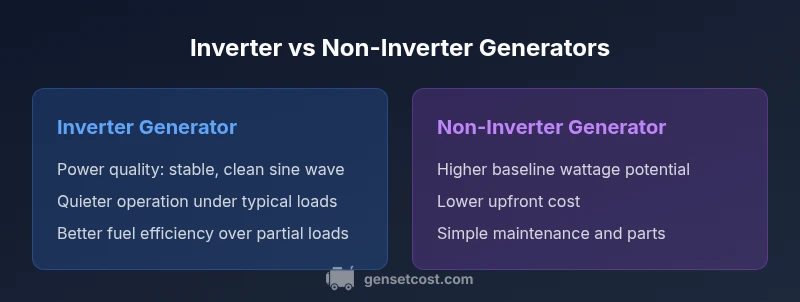
Inverter generator vs non inverter: the inverter model uses advanced electronics to convert AC power from DC, delivering a clean, stable sine wave even as engine speed changes. For most home backup needs, the inverter option offers better power quality, lower noise, and improved fuel efficiency, though it often costs more upfront. This comparison helps homeowners decide which type fits their loads and budgets.
What is the difference between inverter generator vs non-inverter?
At its core, an inverter generator houses an alternator that produces AC power, converts it to DC, and then inverts it back to a clean AC waveform. This enables tighter voltage and frequency control, which is essential for sensitive electronics. Non-inverter (conventional) generators produce AC power directly at varying voltages and frequencies depending on engine speed. The distinction matters for load stability, fuel efficiency, and noise. According to Genset Cost analysis, choosing between inverter and non-inverter paths often hinges on anticipated loads, desired power quality, and the acceptable price premium. This guide uses the term inverter generator vs non inverter to reflect the practical decision homeowners face when sizing a backup system for a home or small property.
startWithHeadingInBlock":true}
Power quality and electronics suitability
One of the defining advantages of inverter generators is power quality. The output is a clean sine wave with minimal harmonic distortion, which means most modern electronics—from computers to TVs and medical devices—operate safely without voltage spikes. This is especially important for devices with microprocessors or precision motors. Non-inverter generators, while robust for many tools and appliances, can introduce more fluctuation during startup or under heavy load. For property managers overseeing multiple units, this difference can translate into fewer nuisance outages for critical electronics during a outage scenario. The takeaway: if you run sensitive equipment, inverter technology often provides a safer, steadier power profile.
startWithHeadingInBlock":true}
Noise, RPM, and fuel efficiency considerations
Inverter generators typically run at variable engine speeds, ramping up and down in response to load rather than always running at full throttle. This translates into lower idle and peak RPMs, which generally reduces noise and improves fuel efficiency compared to traditional non-inverter units. However, real-world results depend on size, load, and how long the generator operates at peak. For homeowners and property managers, choosing a model that maintains comfortable noise levels is critical when the unit is installed near living spaces or rental units. In practical terms, the inverter option is often the better choice for long runtimes with modest loads and for settings with strict noise constraints.
startWithHeadingInBlock":true}
Cost considerations: upfront vs running costs
Pricing for inverter generators is typically higher upfront than for equivalent non-inverter models. The premium reflects the added electronics, higher voltage regulation capabilities, and better fuel economy. Over the lifetime of a backup system, inverter technology can reduce running costs due to improved efficiency and longer maintenance intervals for sensitive electronics. That said, if your loads are large and occasional, a smaller, traditional non-inverter unit may meet your needs at a lower initial outlay. When budgeting, consider both initial purchase price and projected running costs, including fuel consumption and maintenance.
startWithHeadingInBlock":true}
Sizing and load handling: what each type can support
Sizing a generator correctly is essential, regardless of inverter or non-inverter design. Inverter generators excel with rounded, moderate loads and can be paired with transfer switches and energy management strategies to optimize power use. Non-inverter units tend to deliver straightforward peak power and are easier to scale for higher total wattage, but they may not regulate voltage as tightly under fluctuating loads. Property managers should perform a load analysis that includes essential circuits (refrigeration, lighting, heating, and critical outlets) and consider future expansions. The goal is to match the unit’s sustained output with your critical needs, not just maximum surge capacity.
startWithHeadingInBlock":true}
Installation, transfer switches, and maintenance considerations
Installation complexity varies by model and your existing electrical setup. Inverter generators are often compact and feed through automatic transfer switches with smart load management, which can simplify integration and maximize efficiency. Non-inverter units may require larger power connections or multiple units for the same service level, potentially increasing upfront and installation costs. Maintenance is generally straightforward for both types, but inverter models include electronic controllers that require protective measures against voltage spikes and moisture. Include basic yearly inspections, fuel system checks, and battery or controller diagnostics as part of your maintenance calendar.
startWithHeadingInBlock":true}
Use-case scenarios: home backup, small business, and RVs
For a typical home backup with a modest electrical footprint, an inverter generator often provides adequate power with better quiet operation and smoother performance in sensitive electronics. If the goal is to run heavy air conditioning or large appliances during outages, a higher-watt non-inverter or a system with multiple units might be more practical, though often noisier and less efficient. RVs, camping, and job sites with prolonged use favor inverter models for their cleaner power and quiet operation. Property managers should tailor the choice to the most frequent use case and the expected load mix across units.
startWithHeadingInBlock":true}
Maintenance and longevity considerations across the two types
Longevity depends on build quality, operating conditions, and maintenance. Inverter generators often have robust control electronics, protective shielding, and modern cooling; these features can extend lifespan when cared for properly. Non-inverter units may be simpler mechanically but can wear more with fluctuating loads and less precise regulation. A consistent maintenance plan—including oil changes, air filters, spark plugs, and periodic load testing—helps ensure reliability for both types. For renters or multi-unit properties, a reliable maintenance contract can improve uptime and reduce unexpected service calls.
startWithHeadingInBlock":true}
Decision framework: how to choose between inverter and non-inverter
A practical framework begins with load profiling: list essential circuits and their estimated wattage. Then assess electronics sensitivity: if you have computers, medical devices, or delicate electronics, favor inverter models for their stable output. Consider noise restrictions and neighborhood expectations; inverter units are often quieter and more neighbor-friendly. Finally, balance total cost of ownership: compare upfront prices, maintenance costs, and expected runtime. If you expect frequent use with modest loads, inverter generators often win on efficiency and reliability; for high-wattage, occasional-use scenarios, non-inverter units may be a pragmatic fit.
startWithHeadingInBlock":true}
Buying tips for homeowners and property managers
When shopping, request formal load calculations and a written transfer-switch plan. Look for models with solid warranties, reputable dealer support, and readily available parts. Ask about automatic shutdown features, fuel type compatibility (gas, propane, or diesel), and ease of service. Compare two or three quotes that include installation and maintenance options, so you can evaluate total cost of ownership. Finally, check user reviews for real-world performance, particularly around noise, fuel economy, and reliability.
startWithHeadingInBlock":true}
Comparison
| Feature | Inverter Generator | Non-Inverter Generator |
|---|---|---|
| Power quality and regulation | Clean, stable sine wave with tight voltage control | More variable output with less precise regulation |
| Noise and RPM behavior | Typically quieter with variable RPM that adapts to load | Usually louder and runs at a more constant RPM |
| Fuel efficiency | Better fuel economy under partial loads | Less efficient under fluctuating loads |
| Upfront cost | Higher upfront price | Lower upfront price |
| Maintenance considerations | Electronic controllers; specialized parts | Mechanically simpler; fewer electronics |
| Best-use scenarios | Sensitive electronics, quiet operation, and modest loads | High-wattage loads, occasional use, budget-conscious setups |
The Good
- Cleaner power suitable for electronics and appliances
- Quieter operation in typical use
- Better fuel efficiency under partial loads
- Potentially longer runtime with smart load management
The Bad
- Higher upfront cost
- More complex electronic components
- Limited peak power compared to some traditional models
Inverter generators are generally the better all-around choice for home backup and small-to-moderate loads; non-inverters can be a sensible pick for high-load, budget-conscious, or rugged scenarios.
Choose inverter if you prioritize power quality, quiet operation, and efficiency. Opt for non-inverter when upfront cost matters most or when you need straightforward, high-wattage capability without the need for delicate electronics.
People Also Ask
What is the main difference between inverter generators and non-inverter generators?
The main difference lies in how power is produced and regulated. Inverter generators convert AC to DC and back to a clean AC waveform, delivering stable voltage and frequency. Non-inverter generators produce AC directly and can have more fluctuation under varying loads. This affects efficiency, noise, and suitability for sensitive electronics.
Inverter generators convert and finely regulate power for stability; non-inverters run more like traditional tools with less precise regulation.
Are inverter generators quieter than traditional non-inverter models?
Yes, inverter generators typically operate at lower RPM and use smart load management, making them quieter in most common usage scenarios. However, actual noise levels depend on size, enclosure, and installation. For neighborhoods or multi-unit properties, this can be a deciding factor.
They’re usually quieter, thanks to smarter speed control.
Can I run a refrigerator or computer on a non-inverter generator?
You can, but you may experience more voltage fluctuations under load. If your critical electronics are sensitive to power quality, an inverter generator is a safer choice. For basic appliances, a non-inverter can still perform adequately.
If you have sensitive devices, go with an inverter model.
Is the upfront cost of inverter generators worth it?
For many homeowners, the higher upfront cost is justified by better energy efficiency, lower running costs, and improved power quality for electronics. If you mainly need to power simple loads or’re on a tight budget, a non-inverter unit may be sufficient.
Think long-term value: better power quality and efficiency often pay off.
Do inverter generators require special maintenance?
Maintenance is similar in scope to traditional generators but includes ensuring the electronic controllers and sensors stay clean and dry. Regular service intervals and using proper fuel are important for longevity.
Stick to recommended maintenance and you’ll keep it reliable.
What’s the best use-case for inverter vs non-inverter?
Inverter generators are best for homes with electronics, noise restrictions, or partial-load usage. Non-inverter units work well for construction sites, larger loads, or when upfront budget is the primary constraint.
Choose based on load type and noise needs.
Key Takeaways
- Prioritize power quality for sensitive devices.
- Consider noise constraints when locating the unit.
- Factor both upfront cost and running costs in total ownership.
- Use load analysis to match generator type to needs.
- Inverter models excel with partial loads; non-inverters suit high-load, budget-focused cases.