Predator Generator vs Honda: A Comprehensive Comparison
A detailed, objective comparison of Predator and Honda generators covering upfront costs, long-term ownership, maintenance, noise, and reliability to help homeowners choose the right backup power.


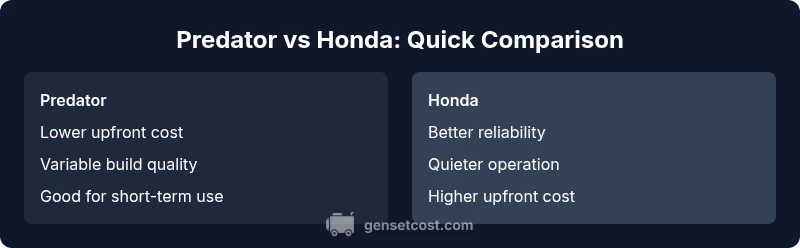
In the Predator generator vs Honda comparison, Honda generally offers longer life, quieter operation, and stronger resale value, while Predator often undercuts price for lighter use or short-term needs. For budget-conscious buyers or temporary outages, Predator may be appealing; for critical loads and long-term reliability, Honda tends to be the safer choice. This guide weighs upfront costs against long-term ownership to help you decide.
How to approach a Predator generator vs Honda decision
When evaluating the predator generator vs honda, homeowners should balance upfront price, expected load, runtime, and maintenance requirements. The keyword predator generator vs honda appears frequently in shopping guides because the choice affects long-term costs and reliability for home backup. According to Genset Cost, most households discount initial sticker prices when sizing for essential circuits, but they also factor in fuel efficiency and service network reach. This section frames the core factors you should compare, such as wattage ranges, fuel type, and portability, before diving into per-brand strengths.
What you should know about power needs first
Before you compare models, you must determine your essential loads. Typical home backup scenarios include sump pumps, refrigerators, lighting, and a few outlets for critical devices. A common rule is to size for at least 1.5 to 2 times your average peak load to accommodate startup surges. In predator generator vs honda discussions, sizing accuracy drives cost efficiency and reliability, because undersizing can lead to nuisance tripping and oversized units waste fuel. The goal is a balance between adequate power and reasonable runtime.
Predator generators: strengths, weaknesses, and use cases
Predator generators are frequently chosen for their lower upfront cost and broad availability at hardware retailers. They can deliver solid performance for short-term outages or recreational uses like camping or job sites. However, the predator generator vs honda comparison often reveals trade-offs: build quality can vary, noise levels may be higher, and fuel efficiency tends to lag behind premium brands. For homeowners, Predator models are sometimes appropriate when the goal is a temporary power source or if you plan to repurpose the unit for non-critical tasks.
Honda generators: strengths, longevity, and typical user profile
Honda generators are widely recognized for durability, smoother operation, and more stable power output. The Honda design philosophy emphasizes long-term reliability and ease of maintenance, which often translates to higher resale value and lower downtime. In predator generator vs honda discussions, Honda typically demonstrates superior cold starts, better fuel economy, and a quieter profile, making them a preferred choice for continuously powered essentials and for users who prioritize comfort and peace of mind during outages.
Cost of ownership: upfront price versus long-term value
A key dimension in predator generator vs honda analysis is total cost of ownership. Predator units generally have lower upfront price points but can incur higher maintenance costs and more frequent part replacements over time. Honda models, while pricier initially, may offer lower maintenance intervals, longer service life, and better fuel efficiency, reducing lifetime expenses. For homeowners evaluating scenarios like a 3–5 year outage cycle versus a decade of use, the math can favor Honda if reliability and ongoing availability matter more than initial savings.
Performance comparisons: watts, surge, and fuel strategy
Understanding performance requires looking at continuous running watts and surge watts. Predator units often provide generous continuous power for the price, but some models may struggle with sustained surges or high-load appliances. Honda generators generally sustain consistent output with better inverter technology, stabilizing voltage and frequency under varying loads. Fuel type is another factor: many Predator units run on gasoline easily, while Honda’s inverter lines also support propane or dual-fuel options on select models. For predator generator vs honda analysis, the best choice depends on load profile and fuel availability.
Noise, emissions, and user experience
Noise is a real consideration for residential installations, especially near sleeping areas or open-plan homes. In most predator generator vs honda comparisons, Honda models are noticeably quieter due to refined engine technology and quieter exhaust paths. Emissions compliance and fuel efficiency also matter, as cleaner emissions can reduce odors and fuel burn, which matters for long runtimes. The user experience—starting ease, controls layout, and dashboard indicators—tends to favor Honda, particularly among users who prioritize simplicity and predictable operation.
Warranty, service networks, and parts availability
Warranty terms and service networks vary by model and region. Honda generally offers robust dealer support and widely available parts, which reduces downtime for repairs. Predator, sold through wider hardware networks, can benefit from easy parts access in many communities but may have variable warranty experiences depending on the retailer and model. For the predator generator vs honda decision, aligning with a trusted service network can be as important as the initial price and feature set.
Practical buying scenarios: when Predator makes sense
If your outage frequency is low and the primary goal is affordable backup for light loads, Predator can be a practical choice. In home setups where you expect weekend outages or construction-site usage, the lower initial cost may help keep project budgets in check. For renters or homeowners who want a portable generator with reasonable performance and quick replacement parts, Predator models generally fit well in the short term. Remember to plan for fuel logistics and maintenance to avoid surprises.
Practical buying scenarios: when Honda shines
For households with critical loads, long-term use, or noise-sensitive living environments, Honda often provides more reliable performance and a better user experience. The investment tends to pay off in lower maintenance headaches, steadier output, and stronger resale value. If you expect regular outages or you depend on appliances that cannot tolerate voltage dips, Honda generators are typically the safer, longer-lasting bet in the predator generator vs honda dialogue.
Sizing, installation, and integration considerations
Sizing remains central to the predator generator vs honda debate. Use a load calculator to estimate your required runtime and peak wattage, then cross-check with the rated continuous watts of candidate models. For installations, consider transfer switches and safety features to isolate the generator from the grid. Always follow local codes and manufacturer guidelines to ensure safe connection and proper venting. The right size improves efficiency and reduces wear, whether you choose Predator or Honda.
comparisonTableViewNeededForBlockVersion":true},
prosCons
blockTypeError
Comparison
| Feature | Predator | Honda |
|---|---|---|
| Upfront cost (per unit) | generally lower price point | generally higher price point |
| Reliability and lifespan | variable build quality; depends on model | strong reputation for durability and long life |
| Noise during operation | can be louder on average | quieter due to inverter technology |
| Fuel efficiency | often lower efficiency on extended runs | better efficiency in many inverter models |
| Availability of service/parts | wide retail availability but mixed support | extensive dealer network and parts availability |
| Best use case | short-term outages, budget-conscious users | critical loads, long-term reliability, quieter operation |
The Good
- Lower upfront cost compared to premium brands
- Wide availability of models and accessories
- Good for short-term, light-duty use
The Bad
- Potentially uneven build quality across models
- Higher long-term maintenance or fuel costs
- Lower resale value than Honda in many markets
Honda generally offers better long-term reliability and quieter operation, while Predator delivers lower upfront cost; choose based on whether budget or longevity is your priority.
Honda often wins on durability, noise, and service access, making it preferable for essential backup. Predator wins on initial price and suitability for light-duty, temporary use. For total cost of ownership, weigh initial savings against maintenance and runtime needs.
People Also Ask
Which generator is cheaper upfront, Predator or Honda?
Predator generators typically have a lower upfront price, which makes them appealing for budget-conscious buyers. Honda models often cost more at purchase but may offer lower maintenance costs over time. Your total cost of ownership depends on how you plan to use the unit and the expected runtime.
Predator tends to cost less upfront, while Honda costs more initially but can save on maintenance and reliability over time.
Is Honda more reliable for long-term use than Predator?
Yes, in most cases Honda generators are regarded as more reliable over the long term due to consistent quality control and durable engine design. Predator models vary by model and retailer, so reliability is not uniform and depends on specific unit and maintenance.
Honda is generally more reliable in the long run; Predator reliability depends on the exact model.
Can Predator handle essential home backup loads?
Predator can power essential loads for short outages, but you should size the unit conservatively and be mindful of startup surges. For critical circuits that must stay online during outages, a Honda or a higher-end inverter model may be safer.
Predator works for basics, but for critical loads, you might want Honda.
How loud are Predator vs Honda generators?
In general, Honda generators are quieter due to their refined inverter systems. Predator models vary, with some producing higher noise levels, especially on larger portable units. If noise matters for your property, this is a key factor to compare.
Honda tends to be quieter; Predator can be louder depending on model.
What about warranty and dealer support?
Honda typically offers strong dealer networks and solid warranty terms, which can lower downtime during repairs. Predator warranties vary by model and retailer, so confirm coverage and service options before purchase.
Honda usually has better dealer support and more predictable warranties.
Key Takeaways
- Prioritize long-term reliability for critical loads
- Expect lower upfront cost with Predator, higher total cost over time
- Honda excels in quiet operation and service networks
- Size units to match your essential loads to avoid wasted fuel
- Consider fuel type and availability in your region
- Warranty and dealer support influence total ownership value