Inverter Generator vs Normal: A Data-Driven Home Backup Guide
Explore the inverter generator vs normal comparison to weigh power quality, noise, efficiency, and cost for home backup. Learn which option fits your load, budget, and installation needs.


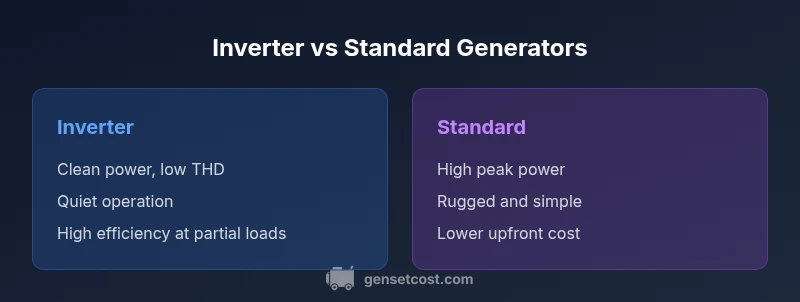
An inverter generator offers clean, stable power with low THD and quiet operation, while a standard generator delivers raw power at a lower upfront cost. Use-case and load determine the winner. For sensitive electronics and long-term use, inverter is preferred; for peak power and simple fueling, standard units may fit.
What is an inverter generator vs a standard generator?
When comparing generator technologies, the phrase inverter generator vs normal often comes up. An inverter generator combines a small engine with an electronic control system that converts AC to DC, then reconverts to a clean, steady AC output. In contrast, a traditional or standard portable generator sends power from a fixed alternator through a regulator to the output. For homeowners evaluating a backup system, the distinction matters for power quality, fuel efficiency, noise, and long-term costs. The keyword inverter generator vs normal appears here to anchor the comparison for readers who want a foundational understanding before diving into specifics. While both types can deliver essential electricity during outages, they are built for different use cases. The inverter approach emphasizes precision and flexibility, whereas the traditional model emphasizes raw output and simplicity. As you assess options, consider load profiles, electronics sensitivity, and acceptable noise levels on your property.
- Key takeaway: inverter generator vs normal is a spectrum, not a binary choice. Your decision should hinge on how clean the power must be and how quietly you need the system to run.
- Related topics: portable generators, true sine wave, voltage regulation, AVR vs inverter, peak vs continuous power.
How power quality differs: clean power, THD, and sensitive electronics
Power quality is a central differentiator between inverter and standard generators. Inverter generators typically produce a true sine wave with very low total harmonic distortion (THD), which translates to cleaner voltage and safer operation for electronics, computers, and microcontroller-driven devices. This is especially important in homes with sensitive appliances, medical devices, or modern AV equipment. Standard generators, by contrast, often deliver a robust current with higher THD under varying loads, which can lead to fluctuations that at times stress electronics or cause nuisance tripping on devices with sensitive power electronics. When sizing, prioritize a unit that maintains THD within acceptable limits for your critical devices. Beyond THD, look at how the controller smooths surges or sagging voltage, as better regulation reduces wear on electronics over time.
- Practical tip: check the product specification for THD values and whether the manufacturer specifies “true sine wave” output.
- Safety note: higher THD can affect sensitive equipment more than simply dimming lights.
Noise, fuel efficiency, and runtime
Noise and efficiency often determine homeowner satisfaction as much as raw power. Inverter generators are designed for quieter operation, especially at partial loads, because their engines adjust speed to match demand and the inverter electronics smooth the output. This translates to less noise at typical household use and improved fuel efficiency when the generator runs below its maximum rating. Standard generators generally run louder because the engine speed is tied to the load without the benefit of continuous speed regulation. Fuel efficiency is still a factor, but at higher loads or where the generator runs near its maximum capacity, the efficiency advantage of an inverter model may lessen. When planning for runtime, consider how often you’ll run at partial vs peak loads and whether you need quiet operation during evenings or in neighborhoods with strict noise ordinances.
- Quick cue: inverter units tend to be the better choice for camp outs, outdoor events, or home backups where noise matters.
- Real-world factor: if you frequently power high-draw tools, the higher peak power of a conventional generator may be advantageous.
Peak power, surge handling, and load acceptance
A major practical difference in inverter generator vs normal comparisons is how each type handles peak loads. Inverter generators typically provide lower continuous peak power, with the ability to surge for short periods when a motor starts or a tool kicks on. This is often enough for typical household loads coupled with small-to-mid-sized appliances. Standard generators may offer higher peak output, which can be important for starting air conditioners or well pumps that demand a momentary surge. However, the higher peak capability often comes with steadier maintenance across a wide load range or the risk of short-term voltage dips if the regulator is not doing its job well. When you map your essential loads, include appliances that require startup surge, like refrigerators and HVAC fans, to ensure the chosen unit can handle those spikes without overloading.
- Decision point: if your property has several instant-on loads, confirm the unit’s surge capacity and whether it is built into the rated continuous power or only as a temporary boost.
Sizing, installation, and transfer switches
Sizing accuracy is critical in both inverter and standard generators. Start with a load calculation that includes essential circuits to determine the minimum continuous power you need. Then add a buffer for startup surges from refrigerators, pumps, and HVAC components. Installation considerations include placement for ventilation, fuel access, and electrical safety. For homes, many people pair a generator with an automatic transfer switch (ATS) so the system automatically engages during a blackout. Inverter generators can be a good fit for transfer-switch setups because they are often compact and lighter, though you’ll want to verify clearance and mounting requirements. If you’re renting or using temporary power, portable transfer options may be necessary.
- Practical step: work with a licensed electrician or generator installer to ensure proper wiring, grounding, and compliance with local codes.
Maintenance, warranties, and reliability
Reliability is a major factor when choosing between inverter and standard generators. Inverter units often feature more sophisticated electronic controls and diagnostics, which can reduce long-term wear when used properly and under the right loads. They also tend to have longer maintenance intervals for some components, though eventually you’ll service spark plugs, air filters, and oil as with any portable device. Standard generators may rely on traditional regulators and simpler controllers; they can be extremely robust but might require more frequent attention at higher operating hours. Consider warranty duration and coverage, as this reflects the manufacturer’s confidence in durability. Regular maintenance, fuel quality, and proper storage all influence reliability.
- Tip: store fuel with stabilizers if the unit will sit idle for extended periods, and perform seasonal checks before the power is needed.
Real-world scenarios: home backup vs job sites
For home backup, inverter generators are often preferred due to their clean power, quiet operation, and efficiency, which protect electronics and provide dependable service during outages. They work well in neighborhoods with noise restrictions and can be sized to support a typical essential-load profile (refrigeration, lighting, router, modem, and some medical devices). In contrast, for job sites or locations where sheer power matters more than noise, standard generators can deliver robust, high-output performance. They are typically easier to scale for large tools or construction equipment and may have longer runtimes on larger fuel tanks. The optimal choice depends on where you’ll use the generator and what loads are critical.
- Use-case pairing: choose inverter for living spaces and sensitive electronics; choose standard when you need maximum headroom for continuous high loads.
How to decide: a practical framework
To decide between inverter generator vs normal, build a decision matrix around five pillars: power quality, peak surge needs, noise tolerance, long-term cost of ownership, and ease of installation. Start by listing essential and nonessential loads, then match each segment to the power quality and surge capability required. If your priorities include minimal disruption, quiet operation, and protection for electronics, inverter generators usually win. If your primary need is raw power for rugged tools and you are budget-conscious upfront, a standard generator can be the better choice. Finally, factor in ongoing costs such as maintenance, fuel efficiency, and potential transfer-switch installation costs to reach a total cost of ownership assessment.
Closing note on the inverter generator vs normal decision
This comparison highlights the fundamental trade-offs between inverter and standard generators. The choice ultimately hinges on your load profile, tolerance for noise, and how much you value fuel efficiency versus peak output. As you finalize a decision, consult product specifications, read user reviews, and consider a sizing calculator to map exact needs. The right choice reduces outage stress while protecting your appliances and your budget.
Comparison
| Feature | Inverter Generator | Standard Generator |
|---|---|---|
| Power quality (THD) and waveform | Very low THD; true sine wave ideal for electronics | Higher THD; adequate for simple loads but riskier for sensitive equipment |
| Peak vs continuous power | Lower peak output with smooth regulation | Higher peak capability with less precise regulation at times |
| Noise level | Quieter, especially at partial loads | Louder; design prioritizes raw output and ruggedness |
| Fuel efficiency | Excellent efficiency at partial loads | Variable efficiency; may be less economical at light loads |
| Weight/size | Compact and lighter for similar power ranges | Heavier, larger footprint for higher output |
| Price range | Higher upfront cost reflecting advanced electronics | Lower upfront cost but potential higher long-term fuel use |
| Best for | Homes with electronics, quiet operation, portability | Construction sites, off-grid power with high peak needs |
The Good
- Cleaner power reduces risk to sensitive electronics
- Quieter operation improves living space comfort
- Better fuel efficiency at partial loads saves running costs
- Compact size makes storage and transport easier
- Higher resale value due to modern electronics and efficiency
The Bad
- Higher upfront cost compared to many standard models
- Lower peak output can limit starting surges for large loads
- More complex maintenance may be required over time
- Availability of service and parts varies by brand
Inverter generators generally win for home backup due to power quality and quiet operation
Choose inverter if electronics safety and noise are priorities. Opt for a standard unit when peak power and upfront cost are the dominant concerns, especially for large, non-sensitive loads.
People Also Ask
What is an inverter generator and how does it differ from a standard generator?
An inverter generator uses advanced electronics to produce a clean, stable sine wave with low THD, making it safer for electronics. A standard generator provides straightforward, higher-power output but may have higher THD and more noise. The main difference lies in how power quality and efficiency are achieved.
An inverter generator uses electronics to clean and stabilize output, great for electronics; a standard generator offers raw power with simpler regulation.
Are inverter generators really quieter and more fuel-efficient?
Yes, in most cases inverter generators run closer to optimal engine speeds, delivering quieter operation and better fuel efficiency at partial loads. They scale engine speed to match demand, reducing noise and saving fuel compared to traditional units under similar workloads.
Typically, yes—they run quieter and use fuel more efficiently at partial loads.
Can inverter generators handle air conditioners or other high-start-load appliances?
Many inverter generators offer adequate surge capability for common home appliances, but some high-start-load devices may challenge smaller models. Check the surge rating and the minimum starting load to ensure compatibility with devices like air conditioners.
Check surge ratings to confirm compatibility with items like air conditioners.
How should I size an inverter vs a standard generator for a home backup?
Compute essential loads (refrigerator, lighting, modem, critical appliances) and add a safety margin. For larger homes or higher loads, a standard generator may be easier to meet peak demands, while a well-sized inverter can cover essential circuits with quieter operation.
Size based on essential loads plus a safety margin; consider peak needs and noise goals.
What about installation costs and warranties?
Installation costs vary with system complexity and local codes. Warranties for inverter units often focus on electronics and regulator components and can be longer for reputable brands. Always verify coverage terms and service networks.
Expect variability in install costs; warranties usually emphasize electronics protection.
Key Takeaways
- Assess load profiles to match power quality needs
- Prioritize low THD for electronics-heavy households
- Balance noise tolerance with peak power requirements
- Factor in installation and ongoing fuel costs
- Plan for maintenance and warranty coverage