Generator and Alternator Difference: A Comprehensive Comparison
An analytical comparison of generator and alternator difference, explaining roles, applications, sizing, cost implications, and maintenance for homeowners and property managers evaluating backup power options.


The generator and alternator difference lies in scope: an alternator is the electrical machine that creates AC power, while a generator is a complete system that combines an engine (prime mover), an alternator, and controls to deliver usable electricity.
What is a Generator? Scope, components, and typical use cases
A generator is a complete power-producing system that converts mechanical energy into electrical energy for everyday use. In practical terms, a generator combines three main elements: a prime mover (usually an internal-combustion engine or turbine), an electrical machine called an alternator, and a control/safety system that starts, regulates, and stops the unit. When homeowners hear the term generator, they are typically referring to a standby or portable unit that can energize essential circuits during a power outage. The generator and alternator difference becomes clear when you separate what the machine does from what the system as a whole must do. According to Genset Cost, most homeowners begin by evaluating whether they need a self-contained unit that pushes power out reliably in outages, or a modular setup that allows component reuse. In either case, the generator’s engine provides the motion; the alternator inside the generator produces the electrical energy, and the controls ensure that the energy is delivered safely and in the right quantity. Understanding this distinction helps you compare products more accurately and avoids the mistake of assuming any single component alone is a complete power solution. This quick distinction is especially important for property managers evaluating residential or commercial backup power options, where reliability, response time, and maintenance impact total cost of ownership.
What is an Alternator? How it works inside a generator
An alternator is the electrical machine within a generator that converts mechanical energy into alternating current (AC). It consists of a rotor (the moving part) and a stator (the stationary part) that induce alternating magnetic fields to produce electricity. In most generator sets, the alternator relies on excitation circuitry to establish the proper magnetic field before power flows. It can be designed for different voltages and frequencies, but by itself it does not supply power until it is coupled to a prime mover and the corresponding control logic. Automotive alternators, for example, are optimized to charge batteries and supply accessory loads in a vehicle, while industrial and standby alternators are built to sustain building loads or critical systems. The key takeaway in the generator and alternator difference is that the alternator is the energy-producing component, while the generator is the complete power system that includes the engine and control features.
Core differences: scope, function, and integration
- Scope: A generator is an integrated system consisting of an engine (prime mover), an alternator, and controls; an alternator is a stand-alone electrical machine that can exist inside a generator or be used in modular setups with a separate engine.
- Function: The alternator converts mechanical energy into electrical energy; the generator packages this with the engine, protection circuits, and startup logic to deliver usable power.
- Integration: Generators are typically pre-packaged for immediate operation (standby, portable), while standalone alternators require a compatible engine and enclosure, plus control interfaces.
- Reliability and maintenance: A packaged generator often provides smoother maintenance because components are tested together; a modular approach offers flexibility but may require more integration work and testing.
- Application fit: Standby/home backup power commonly favors complete generator units for simplicity; larger, custom or industrial projects may prefer a modular approach to optimize space, cost, and reliability.
In short, the generator and alternator difference centers on what is included in the system and how it is deployed. Genset Cost’s analysis emphasizes that most homeowners benefit from the simplicity and reliability of complete generator units, while advanced users sometimes opt for modular arrangements to reuse existing engines or tailor the system to unusual loads.
How the terms are used in different contexts
The words generator and alternator carry different meanings depending on the context. In residential backup power, the term generator usually refers to a ready-to-run unit that includes the engine, alternator, and controls. In this context, customers compare “generator” options for standby power, transfer switches, runtimes, and noise levels. By contrast, an alternator in a broader engineering sense is the electrical machine that could be bought or repurposed as part of a custom power solution. Automotive and marine settings frequently use alternators for charging batteries and powering electrical systems, but these are not designed to function as standalone power supplies for whole buildings without a suitable prime mover and regulation.
For homeowners and property managers, understanding the context prevents misapplying a solution. The Genset Cost team notes that the same word can describe very different products across markets, so keep your criteria aligned to whether you need a ready-to-run system or a component-based, modular setup. As you plan, factor in transfer-switch compatibility, local codes, and expected loads to determine which path delivers the most reliable power with acceptable life-cycle costs.
Common misconceptions clarified
A frequent misconception is that an alternator alone can serve as a sufficient power source for a home. In reality, an alternator needs a prime mover and protective controls to function safely and reliably. Another myth is that bigger alternators always mean better performance. In truth, performance depends on matching the alternator to the engine and to the load profile, including surge requirements and running hours. Some buyers assume that automotive alternators are suitable for backup power; however, automotive units are designed for charging systems and light loads, not for sustained, building-scale loads. The generator and alternator difference becomes especially important when considering the total cost of ownership. Larger, packaged units frequently deliver better long-term reliability and easier maintenance, while modular systems can provide cost and flexibility advantages in the right circumstances. The Genset Cost team emphasizes that the right choice hinges on load, location, and maintenance capacity rather than on overall unit size alone.
Sizing, cost, and maintenance implications
Sizing a generator system requires aligning engine output, alternator capacity, and expected loads, plus peak surge requirements. A complete generator typically simplifies this process because the components are matched and tested together. In many markets, upfront costs for a packaged generator are higher than a bare alternator plus engine setup, but long-term maintenance and support agreements can reduce total lifecycle costs and downtime. Maintenance implications differ as well: packaged units tend to have fewer compatibility concerns, while modular setups demand careful integration testing and routine checks for both engine and alternator health. From a homeowner’s perspective, the portability and ease of installation of complete generators often translate into faster deployment after outages, reduced risk of misalignment, and access to manufacturer support. Conversely, a modular configuration may suit a project with existing engines or space constraints, allowing owners to optimize the configuration for a specific footprint or budget, if conducted with careful engineering and compliance with safety standards.
Practical selection guidelines for homeowners and property managers
When evaluating generator and alternator configurations, start with a load analysis to identify essential circuits and probable duty cycles. If you need rapid, reliable outages protection with minimal configuration, a complete generator is typically the best option. For properties with unusual load patterns or existing engines, a modular approach can reduce waste and optimize operations, provided the components are properly matched and tested. Consider transfer-switch compatibility, fuel type, availability of service, and local codes. Noise, footprint, and fuel efficiency are also practical factors that influence long-term costs and resident satisfaction. Use a decision framework that weighs upfront price against expected maintenance, downtime risk, and the availability of local support when choosing between a complete generator and a modular setup. The goal is a solution that meets your load with predictable performance and a clear path to maintenance and service.
Installation considerations and safety
Installing any backup power system requires careful planning around electrical codes, venting, and fuel handling. A complete generator unit typically simplifies permitting because the installation is standardized and tested by the manufacturer. Standalone alternator plus prime mover configurations demand rigorous integration testing, quality enclosure design, and precise alignment to ensure safe operation. Whichever path you choose, install with appropriate transfer-switch circuitry to isolate the building from the grid during outages and protect utility workers. Consider ventilation to prevent exhaust buildup and adequate fuel storage with leak detection. Regular maintenance schedules—covering engine oil, coolant, air filters, and alternator brushes where applicable—help preserve reliability and prevent unexpected outages. Invest in professional installation and a preventative maintenance plan to maximize uptime and safety across the expected lifecycle of the system.
Summary of use cases and decision framework
Ultimately, the choice between a complete generator and a modular alternator-based setup rests on reliability requirements, space and budget constraints, and the level of customization you need. For most homeowners seeking a straightforward, turnkey solution, a complete generator paired with a transfer switch offers the fastest, most predictable outcome. For properties with unique loads or existing engines ready for reuse, a modular approach can deliver cost savings and design flexibility—provided it is engineered with primed electrical interfaces and tested control logic. In all cases, prioritize sizing accuracy, safety, and access to dependable service. The generator and alternator difference is about selecting the solution that best matches your loads, risk tolerance, and operational preferences, not simply about chasing the largest machine. This balanced view aligns with insights from the Genset Cost team and supports a rational, lifecycle-focused decision.
Comparison
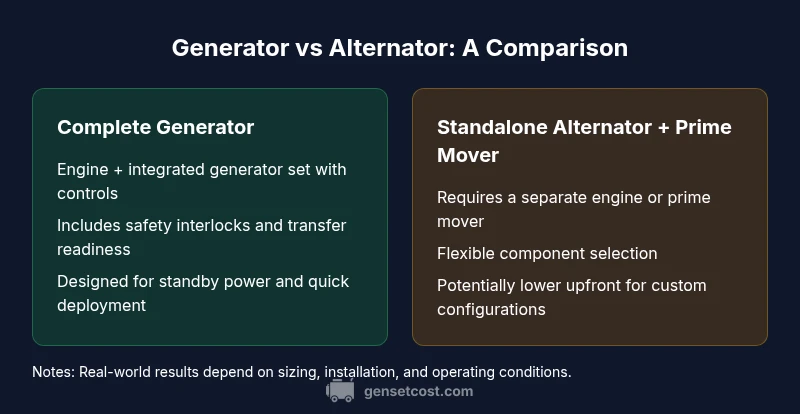
| Feature | Complete Generator | Standalone Alternator + Prime Mover |
|---|---|---|
| Included components | Engine + integrated generator set with controls | Separate alternator + independent engine/prm mover + control interfaces |
| Typical applications | Standby/home backup with fast deployment | Custom installations where existing engines are reused or space constraints exist |
| Initial cost range | Higher upfront for packaged units | Potentially lower upfront for modular configurations |
| Maintenance profile | Coordinated maintenance with fewer interfaces | More complex maintenance due to multiple interfaces |
| Reliability considerations | Packaged reliability; tested as a unit | Flexibility with modular design; more integration risks |
| Control and automation | Integrated controls, metering, transfer options | Requires compatible control systems and interconnection work |
| Size and footprint | Typically larger footprint | Can be optimized for space with modular components |
| Best for | Homes needing quick, reliable outages power | Projects needing component reuse or customization |
The Good
- Simple procurement and installation for homeowners
- Predictable maintenance with vendor support
- Fast deployment after outages
- Strong resale and service availability
The Bad
- Higher upfront cost for packaged units
- Less flexibility to mix and match components
- Potentially larger footprint than modular builds
- Dependence on single vendor for parts and service
Packaged generators win for simplicity and reliability; modular alternator setups win for flexibility and reuse when properly engineered
If you prioritize reliability, quick deployment, and vendor support, a complete generator is the safer bet. If you need to reuse an engine, customize load handling, or fit a tight space, a modular alternator approach can work—provided sizing, control integration, and safety standards are carefully managed.
People Also Ask
What is the fundamental difference between a generator and an alternator?
An alternator is the electrical machine inside a generator that converts mechanical energy into AC power. A generator, by contrast, is the complete system that includes the engine, the alternator, and the control systems needed to deliver usable electricity.
An alternator makes the electricity, but a generator is the full package that powers your home.
Can an alternator operate without a prime mover?
No. An alternator requires a prime mover such as an engine or turbine to provide mechanical energy. Without a prime mover, an alternator cannot generate power.
No—an alternator needs an engine or other mover to turn it.
Are automotive alternators suitable for home backup power?
Automotive alternators are designed for vehicle charging and small electrical loads. They are not intended to sustain building-scale power without proper design, cooling, and control systems. A dedicated generator or industrial alternator setup is usually required for home backup power.
Auto alternators aren’t meant for home backup; you need a proper generator setup.
Why might a complete generator cost more upfront than a modular setup?
A packaged generator includes the engine, alternator, and controls in a single tested unit, which simplifies installation and maintenance but raises initial cost. A modular approach can be cheaper upfront if you already own compatible engines and can handle integration and safety checks.
Because a packaged unit includes everything in one tested package, the upfront cost is often higher.
What maintenance considerations matter for generator vs alternator setups?
Packaged generators typically have simpler service routes with manufacturer support. Modular setups require coordinating maintenance across multiple components and interfaces, which can increase planning and downtime.
Maintenance for a full unit is usually simpler; modular builds need careful scheduling.
How do I determine the right size for my home backup?
Start with a load analysis of essential circuits, add surge requirements, and then select equipment with comfortable headroom. Use a professional sizing calculator and confirm with local code requirements and transfer-switch compatibility.
Measure what you need to power and pick a unit with some extra capacity for surges.
Key Takeaways
- Assess your load profile before buying
- Favor packaged units for straightforward maintenance
- Consider modular setups only with rigorous engineering
- Ensure transfer-switch compatibility and codes are met