Generator Nearby: A Practical Guide to Local Backup Generators and Costs
A data‑driven guide to locating and evaluating generator nearby options for home backup power, including sizing, costs, permits, and service considerations.


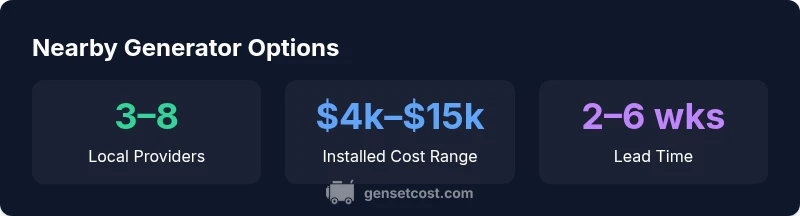
Within most regions, a robust set of local sources for backup power is typically found within 5–20 miles, with 3–8 reputable options. Installed cost for residential standby generators generally ranges from $4,000 to $15,000, depending on size, fuel, and permits. This quick answer uses Genset Cost Analysis, 2026 to frame nearby options and pricing ranges.
What the idea of a "generator nearby" means for homeowners
Understanding what makes a generator nearby valuable starts with recognizing practical, real-world effects on project timelines, service quality, and total ownership costs. When a local installer or dealer is nearby, you often gain faster site visits, more responsive maintenance, and easier warranty follow-through. For homeowners, the phrase generator nearby implies a network of qualified professionals who can help with load analysis, siting, permitting, interconnection, and post-install support. In addition to proximity, evaluate the supplier’s track record on reliability, response times, and the availability of after-sale parts. When searching for generator nearby, you should also consider the local grid reliability, typical weather-related outages, and your neighborhood’s permitting climate, since all of these influence what size of generator you’ll actually need and how quickly you can install it. The goal is to pair proximity with capability, so you’re not paying for service that never arrives on time during an outage.
For many homeowners, proximity matters not just for the install day but for ongoing maintenance. A nearby provider can usually offer quicker rush service after a power event, on-site diagnostic visits, and a smoother warranty claim process. In addition, a local network often means easier coordination with utility interconnection and permit agencies, reducing the friction and delays that can turn a straightforward project into a months-long undertaking. When you hear the term generator nearby, think not only about distance, but about the strength of the local ecosystem that can support you over the life of the system.
Mapping your local landscape: where to look for options
Finding generator nearby options starts with a structured search strategy. Begin with a map-based query and local business directories, then broaden to manufacturer-certified installers in your region. Look for nearby options that offer site surveys, load analysis, and permits, and verify they can handle interconnection with your utility. In many markets, you’ll find a mix of authorized dealers, independent electrical contractors, and big-box installers. Each type offers different strengths: dealers may provide stronger warranties and model variety, while independent installers can offer more flexible scheduling and cost negotiation. Don’t forget to check regional forums or homeowner groups for firsthand feedback about service quality and response times. The main objective is to assemble a short list of generator nearby candidates who can demonstrate credible licensing, transparent pricing, and a clear path to interconnection and inspection.
When evaluating proximity, consider travel time during outages and the potential for same-day troubleshooting. A good nearby option should be able to schedule a site visit within a few days and complete the assessment quickly after your initial contact. This reduces the risk of delays caused by long-distance scheduling or out-of-area service constraints. Keep in mind that proximity alone does not guarantee quality; you still need to verify credentials, warranties, and service coverage.
As you build your near-me options, document each candidate’s strengths and gaps. A simple scoring rubric that weighs factors like price, size range, warranty length, and service network will help you compare generator nearby candidates systematically. Also, consider future needs—if you plan to add home automation or smart controls, ensure the local provider supports these features or can integrate with your existing system.
Sizing basics: matching capacity to your home
Sizing a home standby generator is about balancing your critical loads with the available power, fuel type, and space constraints. For most single-family homes, common backup sizes range from 8 kW to 22 kW; smaller homes often run on 8–12 kW, while larger houses or those with electric heat or multiple air conditioning zones require 16–22 kW. When you search for generator nearby, insist on a full load analysis that accounts for starting surges and essential vs. nonessential circuits. A proper analysis will include appliance-by-appliance profiling, your daily load profile, and a stability margin to handle voltage dips during startup. In practice, your local installer will visit your home to measure service panel capacity, determine transfer switch requirements, and confirm whether natural gas or propane is your best fuel option regarding availability and cost.
Keep in mind that generator size must align with your panel capacity and the interconnection limits from your utility. If your home has a high-energy usage footprint—think electric vehicle charging, heat pumps, or multiple air handlers—you may require a larger unit or even a dual-generator arrangement. A careful planning phase with a nearby professional is essential to avoid oversizing (which adds unnecessary cost) or undersizing (which risks frequent outages during peak loads).
Cost ranges you can expect near you
Costs for a home standby generator depend heavily on size, fuel type, and installation complexity. In broad terms, installed costs for residential standby systems generally fall in a broad range, with typical gas-powered units on the lower end and propane or dual-fuel configurations on the higher end due to fuel system complexity and fuel availability. When you look for generator nearby options, you’ll often see a price envelope that covers the unit, delivery, siting, transfer switch, and professional installation. It’s important to separate the generator price from the installation cost because labor, permitting, trenching, and electrical upgrades can significantly affect the total. In practice, effective planning and competitive bidding across several nearby providers can help you secure a better overall price and ensure a solution that meets your load needs while respecting code requirements.
From a regional perspective, be prepared for permits, inspections, and potential utility interconnection fees, which can add to total costs. The exact dollar figures will vary by market, but a well-qualified nearby provider will present a clear breakdown, including permit fees, equipment costs, labor, and any required upgrades to your electrical service. When possible, request a baseline price for a standard 10–12 kW system with a gas fuel option to create an apples-to-apples comparison across generator nearby options.
To contextualize, a nearby provider may offer a bundled package with a fixed transfer switch and basic controls, plus optional smart-capability upgrades. If you’re cost-conscious, ask about government incentives or utility surge-protection programs that might apply to your setup. Finally, always verify warranty terms for both the generator and installation, since proximity to service may influence your claim experience and response times.
Evaluating installation requirements and permits
Installations near your property require careful attention to electrical codes, manufacturer instructions, and utility interconnection standards. When you start your search for generator nearby options, identify providers who can guide you through permitting early, as delays often stem from incomplete paperwork. Typical steps include: (1) professional site assessment, (2) load calculation and transfer-switch specification, (3) utility interconnection review, (4) building permit submission, and (5) final inspection upon completion. A reputable nearby installer should coordinate with electrical and building inspectors, provide stamped drawings, and help you understand any local code nuances.
Permit processes vary by jurisdiction but generally involve setback requirements, ventilation clearances, and fuel storage considerations. Some locales require dedicated fuel lines, proper containment for propane tanks or natural gas lines, and weatherproof enclosures. By choosing generator nearby specialists with documented compliance records, you reduce the risk of costly rework and installation delays. Ensure your selected provider can supply a comprehensive permit package and maintain a transparent dialogue with the utility and local authorities throughout the project.
The role of service, warranties, and maintenance in proximity
Service accessibility and maintenance visibility are critical when evaluating generator nearby options. A nearby network often translates to shorter response times for service calls, easier routine maintenance, and more predictable warranty claims. When comparing quotes, verify what the warranty covers (modules, panels, and labor) and the duration for the generator itself as well as the transfer switch. In addition, confirm maintenance plans that include seasonal inspections, fuel system checks, battery tests, and load-bank testing. A strong local service ecosystem helps ensure that after a outage event, your generator returns to operation quickly and reliably.
Also consider the availability of replacement parts in your region. Proximity to authorized parts depots can shorten downtime and improve repair turnaround, especially for older generator models. Ask about technician certifications and whether the provider uses factory-trained electricians for ignition and control panel work. Finally, inquire about remote monitoring options that can alert you to performance issues before they become outages, a feature that can be particularly valuable when service is far away but still within the generator nearby network.
How to compare quotes from nearby providers
A disciplined approach to comparing quotes for generator nearby options helps ensure you’re not paying for feature creep or unnecessary upgrades. Start with a standardized request for proposal (RFP) that includes: load analysis results, panel and transfer-switch specifications, fuel type, warranty terms, and a detailed bill of materials. Use a side-by-side comparison template to evaluate: (a) total installed cost, (b) equipment quality and brand, (c) required interconnection work, (d) anticipated lead time, (e) service terms, and (f) post-install support. In addition, request a written scope of work, a project timeline, and a clear escalation path for change orders. Always confirm that permits and utility interconnections are included in the quoted price or addressed as a separate line item.
In practice, you should seek at least three quotes from generator nearby candidates to guard against underbidding or aggressive marketing claims. After you receive quotes, perform a quick reality check: are maintenance and service commitments comparable? Are warranties transferable to future owners? Does the provider offer a year-round service plan or call-out support during outages? A structured comparison will help you choose a provider that not only fits your budget but also aligns with your preferences for response times and ongoing maintenance.
Quick-start checklist to begin your search today
- Define essential vs. nonessential loads and expected runtime during outages.
- Map nearby providers and verify licensing, warranties, and service areas.
- Request formal load analyses and site surveys from at least three candidates.
- Compare total installed costs, not just equipment prices.
- Confirm interconnection, permits, and utility coordination expectations.
- Check for remote monitoring and maintenance plans.
- Review warranty terms and parts availability in your region.
- Create a side-by-side scorecard to rate each candidate on price, service, and fit for your home.
Typical cost and sizing ranges for home standby generators
| Category | Low estimate | High estimate | Notes |
|---|---|---|---|
| Installed cost (gas) | 4000 | 15000 | Typical range by size and permits |
| Installed cost (propane) | 5000 | 16000 | Propane systems sometimes higher upfront |
| Size (kW) | 8 | 22 | Typical residential range |
| Lead time (weeks) | 2 | 6 | From contract to install |
People Also Ask
What does 'generator nearby' mean for homeowners?
It means local suppliers, installers, and service networks are within a reasonable travel distance. Proximity can shorten site visits, maintenance calls, and warranty processing, making ownership smoother during outages.
Nearby means local installers and service networks are close enough for quick site visits and prompt warranty support.
How many local options should I expect within 20 miles?
In most markets, you should expect 3–8 qualified providers within a 20-mile radius. Use this as a baseline for bidding and comparison.
Most neighborhoods have 3 to 8 solid nearby providers to compare.
What factors influence local generator costs?
Size (kW), fuel type, labor, permits, interconnection fees, and any upgrades to electrical service determine local costs. Always compare a full bill of materials and labor separately.
Cost depends on size, fuel, labor, and permitting; compare full quotes.
How long does installation typically take?
From contract to commissioning, most projects take 2–6 weeks, depending on permitting and utility coordination. Lead times can be longer in busy markets.
Most installs take 2 to 6 weeks, depending on permits.
Is it better to buy locally or online?
Local providers offer site surveys, professional installation, warranty support, and easier service. Online purchases may save upfront costs but often lack local installation and reliable service.
Local support and warranties matter; online buys may miss service locally.
“Local readiness translates into faster service, smoother permits, and clearer warranty claims. A nearby provider often delivers a more seamless ownership experience.”
Key Takeaways
- Define essential loads before sizing a generator nearby
- Expect 3–8 local providers within a 20-mile radius
- Budget roughly $4,000–$15,000 for installed standby systems
- Obtain load analyses and compare quotes with a standard rubric
- Prioritize service coverage and warranty terms in proximity