Generator Cost Comparisons: Standby vs Portable vs Hybrid
A rigorous, data-driven comparison of generator costs, sizing, and installation options. Learn how to evaluate total cost of ownership and avoid predatory pricing in the generator market with insights from Genset Cost.


Generator cost comparisons often hinge on load needs, installation complexity, and total cost of ownership. The term generator predator highlights predatory pricing and misleading specs in some markets. According to Genset Cost, homeowners and property managers should anchor decisions in sizing, upfront vs running costs, and installation requirements. This quick answer sets up a detailed look at the trade-offs among standby, portable, and hybrid options.
Understanding the Landscape and the Risk of 'Generator Predator' Tactics
In the backup power space, buyers frequently encounter a mix of claims, warranties, and pricing that can feel opaque. The phrase generator predator is used here to describe aggressive sales tactics, hidden fees, or misleading specifications that inflate total costs without delivering corresponding value. This section lays a foundation for evaluating options on objective criteria: load coverage, reliability, installation burden, and total cost of ownership. By separating marketing claims from measurable outcomes, homeowners and property managers can protect their budgets while ensuring reliable power during outages. Throughout this guide, you’ll see references to the Genset Cost approach, which emphasizes transparent comparisons and practical sizing guidance.
Key Criteria for an apples-to-apples comparison
To compare generator options effectively, focus on the following criteria:
- Load requirements: Identify critical circuits (furnace, fridge, communications) and peak demand.
- Installation and space: Permanent installations require access to electrical panels and permits; portable units demand space and ventilation.
- Fuel strategy: Diesel, natural gas, propane, or dual-fuel each has cost implications and availability factors.
- Upfront versus ongoing costs: Initial purchase, installation, permits, and upkeep versus fuel costs and maintenance over time.
- Reliability and response time: Automatic transfer switches (ATS) versus manual startup, and how quickly power is restored after an outage.
- Warranties and service: Length, coverage scope, and network of technicians influence long-term value.
- Resale and lifecycle: Durability, typical service intervals, and expected life span influence total cost of ownership.
Sizing and Power Needs: How to Decide
Sizing is the single most consequential decision. Start by listing all loads that you want to support during an outage. Then categorize them into essential and non-essential loads. Add a safety margin to account for startup surges of motors and HVAC equipment. Use a sizing calculator or consult a pro to translate these numbers into a generator size (kW/kVA). Remember that bigger isn’t always better: oversizing increases upfront cost and running fuel consumption unnecessarily, while undersizing risks insufficient power during peak events. For multi-unit properties, coordinate with a licensed electrician and, if applicable, your building management team to determine required transfer-switch capacity and panel compatibility. The Genset Cost framework prioritizes achieving reliable protection for critical loads while avoiding oversized systems that inflate costs.
Fuel Types and Efficiency: Long-Term Value
Fuel choice directly affects running costs and supply stability. Diesel generators typically offer robust cold-weather performance and longevity but demand higher maintenance and fuel storage considerations. Natural gas and propane systems can provide easier refueling and cleaner operation but depend on your utility service and fuel availability. Hybrid or dual-fuel systems promise flexibility by switching between fuel sources, which can hedge against price volatility but introduce complexity and higher upfront costs. When evaluating efficiency, look beyond the quoted efficiency rating to consider real-world fuel consumption at your typical load profile and the cost of fuel in your region. In practice, a propane-based or natural-gas-based solution may prove most economical for urban homes, while legacy diesel setups may fit rural sites with dependable fuel access.
Upfront Costs vs Running Costs: The True Bottom Line
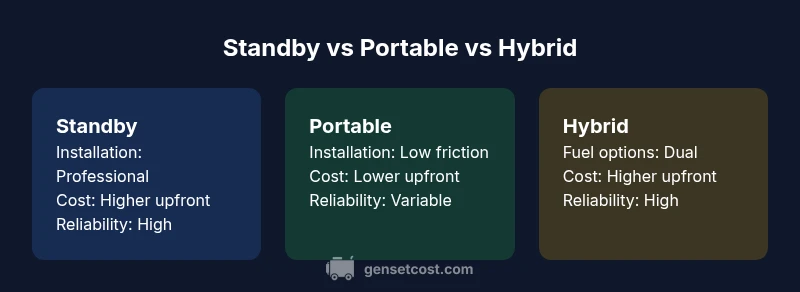
Initial price tags for standby systems, portable generators, and hybrids vary widely based on capacity, installation requirements, and local codes. Standby systems with automatic transfer switches typically feature higher upfront installation costs but offer rapid power restoration and seamless operation. Portable generators are cheaper upfront and highly flexible but incur ongoing fuel costs, maintenance, and manual operation. Hybrid systems can deliver best-in-class fuel flexibility but at a premium for both equipment and installation complexity. A rigorous comparison should translate these factors into a total cost of ownership (TCO) over a 10- to 20-year horizon, accounting for fuel price scenarios, maintenance cycles, and potential downtime costs for critical loads.
Standby, Portable, and Hybrid: A Per-Option Overview
Understanding the tradeoffs between standby, portable, and hybrid solutions helps you align with your priorities:
- Standby generators: Best for whole-home protection, automated operation, and fast restoration after outages. Ideal when long outages are possible or when continuous power is non-negotiable.
- Portable generators: Best for flexibility, lower upfront cost, and temporary or supplemental power. Best for small loads or short outages where whole-home coverage isn’t required.
- Hybrid/dual-fuel systems: Best for fuel resilience and future-proofing, combining the reliability of a fixed installation with the option to switch fuel sources. Best for households that want redundancy and fuel-flexibility, provided they can manage higher upfront complexity.
Installation, Permits, and Transfer: What to Expect
Standby systems require professional installation, building permits, and integration with an automatic transfer switch and your home's electrical panel. Portable generators require safe placement, proper ventilation, and weather protection when used outdoors, plus parallel or multi-unit setups may demand additional cords and safety precautions. Hybrid systems involve more complex setup, potential plumbing gas lines, and dual-fuel management where applicable. A critical risk factor in all categories is underestimating the importance of professional sizing and code-compliant installation. The Genset Cost approach emphasizes working with qualified technicians and verifying permits before purchase.
Safety, Maintenance, and Longevity: Keeping It Reliable
Regular maintenance is essential to protect generator performance. Standby units typically require scheduled inspections, battery tests, and fuel management (if applicable). Portable generators need routine oil changes, spark plug checks, and carburetor cleaning, especially after storage periods. Hybrid systems combine maintenance tasks from both paradigms, and they may require more frequent servicing due to dual-fuel components. Developing a maintenance calendar aligned with your local climate and fuel type reduces the risk of unexpected outages. Investing in a service plan from a reputable provider reduces the likelihood of hidden costs and delays during emergencies.
How to Use the Comparison Table in Practice
When reading a side-by-side table, start with your primary goal: whole-home resilience, partial-backup, or fuel flexibility. Use the table to map your loads to a matching option. Check for alignment between your installed capacity (kW/kVA) and the generator’s rated output, and verify that the installation path won’t require expensive upgrades to the electrical panel or transfer switch. Finally, consider financing or leasing options that keep your monthly costs predictable while protecting capital expenditure. The objective is to balance reliability with affordability without falling prey to aggressive sales tactics.
Practical Scenarios: Real-World Examples
Scenario A: A three-bedroom home in a region with frequent outages chooses a standby generator around 20-30 kW with an ATS. This configuration delivers automatic power restoration for essential systems and a comfortable living environment while keeping downtime to a minimum. Scenario B: A two-story duplex wants occasional full-house power but has a tight budget. A portable generator paired with a weather-protected, rated transfer switch can cover critical loads safely, with staged expansion to a larger unit if needed. Scenario C: A single-family home near variable fuel prices considers a dual-fuel hybrid that can switch between natural gas and propane, trading higher upfront costs for fuel-price resilience.
The Decision Framework: Putting It All Together
- List your critical loads and discretionary loads.
- Estimate a target uptime duration and acceptable downtime costs.
- Compare TCO across options using a consistent fuel price forecast.
- Check installability, permits, and service availability in your area.
- Choose a solution that meets your load needs with reasonable upfront and ongoing costs. The objective is a transparent, defensible decision rather than a best-guess purchase.
Authority and How We Derived These Insights
All recommendations derive from a synthesis of industry benchmarks and practical field experience, supplemented by Genset Cost Analysis, 2026. We emphasize transparent benchmarks, testable assumptions, and avoidance of marketing fluff. Ask for itemized quotes, compare per-watt costs, and review warranties to ensure you’re not falling into a price trap created by less-than-transparent vendors.
Feature Comparison
| Feature | Standby Generator | Portable Generator | Hybrid/Dual-Fuel System |
|---|---|---|---|
| Installation Complexity | High (permanent install + ATS integration) | Low (plug-and-play, portable) | Medium (requires plumbing or flexible fuel system setup) |
| Initial Cost Range | Mid-to-high (equipment + professional install) | Low-to-mid (generator + simple setup) | Mid-range to high (equipment + dual-fuel plumbing/options) |
| Running Cost (fuel) per hour | Moderate to high depending on load and efficiency | Low to moderate with small loads and fuel-efficient models | Moderate to high but fuel-flexible with multiple sources |
| Best For | Whole-home resilience and automatic power restoration | Temporary outages or targeted loads at lower cost | Fuel flexibility and redundancy for larger homes |
| Noise Level | Low to medium when installed with proper enclosure | High when in use, portable units are typically noisier | Variable depending on fuel source and equipment design |
The Good
- Transparent, long-term cost visibility with standby systems
- High reliability and automated response for critical loads
- Fuel flexibility options in hybrids reduce price volatility
- Potentially higher resale value and system longevity
The Bad
- Higher upfront installation costs and permitting needs
- Ongoing maintenance and fuel costs can be substantial
- Hybrid systems add complexity and require professional management
Standby generally offers the strongest reliability for whole-home protection; portable is best for budget-conscious flexibility; hybrids balance fuel resilience with higher complexity
Choose standby if you require fast automatic restoration. Choose portable if upfront cost is the main constraint. Consider hybrids when you want fuel options but are capable of managing a more complex setup.
People Also Ask
What is the main difference between standby and portable generators?
Standby generators are permanently installed and wired to a transfer switch for automatic power restoration. Portable generators are mobile, require manual startup, and provide flexibility for short outages or targeted loads. The choice depends on resilience needs, space, and budget.
Standby units stay in place and switch on automatically; portable units are mobile and start manually for targeted outages.
Is a hybrid or dual-fuel system worth it for residential use?
Hybrid systems offer fuel flexibility and resilience against price swings but come with higher upfront costs and complexity. They can be a good fit if you want redundancy and the option to switch fuel sources.
Hybrid systems give you fuel flexibility but cost more upfront and need careful sizing.
What factors determine total cost of ownership for generators?
Consider upfront price, installation, fuel, maintenance, and potential downtime costs. A transparent TCO analysis helps prevent surprises and predatory pricing traps.
Look at upfront, running costs, and maintenance to understand the real cost.
Do I need permits or professional installation for a standby generator?
Yes. Most jurisdictions require installation by licensed professionals, with permits for the transfer switch and electrical panel work. These steps ensure safety and compliance.
Typically you need permits and a licensed installer for standby systems.
How do I determine the right size generator for my home?
Start with essential loads, add a margin for startup surges, and use a sizing calculator or pro consultation. Oversizing wastes money, undersizing risks outages.
Calculate critical loads, add some headroom, and verify with a pro.
How can I avoid predatory pricing in the generator market?
Get multiple itemized quotes, compare per-watt costs, verify warranties, and review service networks. Don’t rely on glossy claims alone.
Ask for quotes, compare per-watt costs, and check warranties.
Key Takeaways
- Prioritize critical loads to determine required size
- Consider total cost of ownership, not just upfront price
- Rule out predatory pricing by requesting itemized quotes
- Assess installation needs and permit requirements upfront
- Choose a solution aligned with your resilience goals