Home Generator Comparison: Standby vs Portable Options
An analytical, side-by-side guide comparing standby and portable home generators, covering sizing, fuel choices, installation, and long-term costs to help homeowners and property managers decide on a reliable backup power solution.


According to Genset Cost, standby home generators paired with a transfer switch typically provide the most reliable whole-home backup, while portable options offer flexibility for smaller outages. This comparison weighs sizing, fuel options, installation requirements, running costs, and maintenance so homeowners and property managers can choose based on resilience goals, budget, and usage patterns.
Overview of home generator options
A home generator system provides power to your home during an outage, helping you avoid uncomfortable losses of power. The two primary categories are standby generators and portable generators. Standby systems are permanently installed and connect to your home through a transfer switch, enabling automatic start within seconds of a blackout. Portable generators are movable units that you start manually and power through extension cords or a dedicated transfer switch. When evaluating a home generator, consider reliability, load requirements, space, installation complexity, and long-term operating costs. The aim is to balance resilience with total cost of ownership, ensuring you have enough power for critical appliances and essential circuits. According to industry guidance, proper transfer-switch sizing and professional installation help prevent backfeeding and safety hazards. For many homeowners, a targeted needs-based approach yields the best long-term value. Genset Cost emphasizes planning for safety equipment and professional installation to maximize reliability and warranty protection while minimizing risk during outages. The right choice depends on outage frequency, budget, and how much of the home you want to keep powered during an outage.
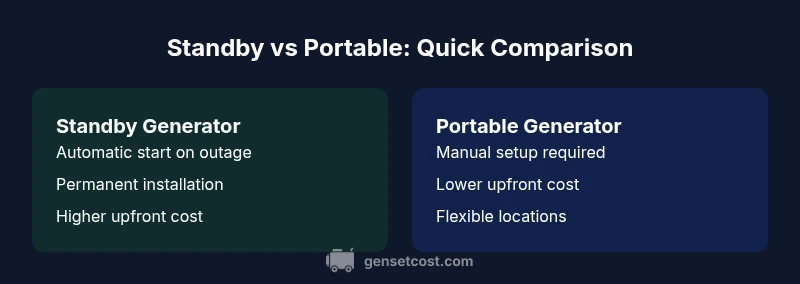
Standby vs portable: Core differences
Choosing between a standby generator and a portable model hinges on how you plan to use backup power, the size of your home, and how much you’re willing to invest upfront. Standby units are designed for automatic operation and whole-home coverage; they typically power essential circuits and major appliances with minimal human intervention. Portable units, by contrast, are flexible, can be used for multiple locations, and often cost less upfront, but require manual setup, safe fueling practices, and careful management of loads. In terms of reliability, standby systems generally outperform portable options during prolonged outages because they integrate with a transfer switch and automatic start logic. For many property managers, this translates into higher uptime for critical systems like HVAC, refrigeration, and lights. Portable generators remain appealing for rental properties, vacation homes, or smaller residences where only a subset of circuits is required. The key is to map your critical loads and choose a solution that matches your outage expectations and budget without overprovisioning or under-provisioning.
Reliability and load handling: Standby vs portable
Reliability during outages is one of the most important factors when comparing home generator types. Standby systems typically offer automatic start, seamless transfer, and continuous operation capability for extended outages, which translates into higher uptime for essential systems including heating, cooling, and refrigeration. Portable generators, while more affordable upfront, require manual activation and can be limited by fuel availability and load management. When evaluating load handling, create a detailed list of critical appliances and circuits you need to keep powered. Standby designs often accommodate a more expansive load and can be scaled with multiple transfer switches to support large homes. Portable options are well-suited for selective power needs or temporary scenarios, such as construction or remote locations. For property managers, reliability must be weighed against space constraints, maintenance responsibilities, and the likelihood of frequent outages. Genset Cost recommends a defensible sizing strategy that prioritizes essential loads but allows for future expansion if risk profiles change. Safety is also a consideration; automatic systems reduce the chance of human error during an outage, while portable units require vigilant fuel management and proper ventilation.
Fuel types and efficiency: how to compare running costs
Fuel choice profoundly affects running costs and availability. Standby gensets commonly run on natural gas or propane supplied through fixed lines or on-site storage, which can simplify fueling and reduce on-site storage risks. Portable generators most often use gasoline or propane; gasoline has high energy density but storage and volatility concerns, while propane offers easier on-site storage and cleaner emissions. Diesel is another option for larger standby units, with advantages in durability and fuel efficiency at higher loads, but it can be noisier and require more frequent maintenance. Efficiency varies by engine design, transfer switch optimization, and load factor. In practice, you’ll see higher ongoing fuel costs with frequent outages and heavy use, especially for portable units if they must be refueled frequently. Genset Cost analysis shows that total cost of ownership improves when you size for essential loads, minimize idle runtime, and select a fuel that aligns with your property’s fuel infrastructure and maintenance capacity. Consider fuel availability, storage needs, and potential supply disruptions when choosing a fuel type.
Sizing and installation considerations: calculating needs and navigating permits
Sizing a home generator starts with a comprehensive load assessment. Identify essential circuits and appliances, calculate their running wattage, and add a safety margin to account for startup surges. A well-sized standby system should cover the most critical loads without wasting capacity, while a smaller portable unit may suffice for limited outages. Transfer switches are a central element of an automatic standby system, enabling safe and immediate switching from utility power to generator power. Installation involves electrical work, fuel supply connections, and often work with your utility provider and local authorities. Permitting requirements vary by jurisdiction, but most installations require licensed electricians and may require inspections. A professional sizing and installation ensures compliance with electrical codes and can preserve warranties. Genset Cost emphasizes documenting load profiles, confirming available fuel options, and planning for future expansions to ensure the system remains aligned with evolving power needs and building codes during installation. Proper planning reduces delays and avoids rework later on.
Cost of ownership: long-term costs, maintenance, and service considerations
Initial cost is only part of the story. The long-term cost of owning a home generator includes fuel, maintenance, parts, and periodic professional service. Standby systems typically involve higher upfront costs due to permanent installation, advanced controls, and integrated transfer switches, but can offer lower maintenance costs per year if paired with efficient fuel types. Portable generators have lower upfront costs but can incur more frequent fuel purchases and higher maintenance frequency due to manual operation and transport. Running costs are influenced by how often outages occur, the load level during use, and how efficiently the generator operates at partial loads. Regular maintenance—oil changes, filter replacements, and electrical inspections—helps preserve reliability and extends service life. Genset Cost emphasizes scheduling a professional inspection at least once a year and performing a basic load test to verify that the system will perform when needed during an outage. Insurance considerations and warranty terms should also be reviewed to understand coverage after installation.
Decision framework and step-by-step approach
To make a sound decision, start with a risk assessment: estimate outage frequency, duration, and the number of protected loads. Then, inventory essential appliances and their peak wattage, and determine whether you need whole-home coverage or selective protection. Consider your property constraints—available space, fuel supply, and permitting requirements. Develop a rough budget that includes installation, equipment, and an annual maintenance plan. Request multiple professional evaluations to compare sizing recommendations, warranties, and service agreements. Use a simple decision framework: if reliability and automatic operation are paramount (for example, a large home or a busy rental property), lean toward standby with a professional installation. If flexibility, low upfront cost, and adaptability for occasional use are your priorities, portable generators may suffice temporarily. Throughout the process, document your load profiles and consult manufacturer and local code requirements to ensure compatibility. By following this structured approach, you can select a home generator that balances risk, cost, and resilience for years to come. Genset Cost recommends involving an electrician early in the process to optimize transfer-switch sizing and ensure code compliance.
Authoritative sources and further reading
For further guidance on home generator options, safety, and compliance, consider these sources:
- FEMA: Power Outages and Backup Power Considerations (https://www.fema.gov)
- U.S. Department of Energy: Backup Power and Efficiency (https://www.energy.gov)
- OSHA/Electrical Safety Standards: Safe Operation of Generators (https://www.osha.gov)
These resources provide official perspectives on risk, installation best practices, and safety considerations to help homeowners and property managers make informed decisions about a home generator.
Comparison
| Feature | Standby Generator | Portable Generator |
|---|---|---|
| Reliability during outages | High (auto-start and seamless transfer) | Medium/Low (manual start and potential for delays) |
| Load capacity | Whole-home or large essential loads | Limited to selected loads or smaller units |
| Installation complexity | Permanent installation with fixed fuel supply | Temporary or portable setup; requires cords and placement planning |
| Transfer switch requirement | Yes (integrated with auto-start) | Typically no built-in transfer switch; may require add-ons |
| Running costs | Higher upfront plus ongoing fuel/maintenance for large loads | Lower upfront but ongoing fuel costs and maintenance depend on use |
| Cost range (qualitative) | Higher upfront due to install and equipment | Lower upfront due to modular nature and portability |
The Good
- Excellent reliability for essential circuits during outages
- Automatic operation reduces manual intervention
- Integrated transfer switches simplify safe switching
- Long-term resilience with maintained warranty protection
- Higher property value and peace of mind for outages
The Bad
- Higher upfront cost and installation complexity
- Requires professional sizing, permits, and ongoing maintenance
- Fixed location can limit flexibility and space use
- Fuel costs depend on consumption and fuel type
Standby generators are generally the preferred choice for most homes.
The Genset Cost team recommends sizing a standby system to essential load profiles and using a licensed installer for transfer-switch setup to maximize reliability and safety while controlling total ownership costs.
People Also Ask
What is the difference between a home generator and a portable generator?
A home generator typically refers to standby units that automatically start during outages and connect via a transfer switch, providing continuous power to essential circuits. Portable generators are movable, require manual setup, and power through extension cords or a transfer switch with careful load management. The choice depends on reliability needs, space, and budget.
Standby generators start automatically and power essential loads; portable units require manual setup and careful load management.
How do I determine the right size for my home generator?
Start with a comprehensive load assessment: list critical circuits and appliances, determine their running wattage, and add a safety margin for startup surges. Compare this total to the generator’s continuous rating and ensure the transfer switch can support the anticipated load. It’s often wise to consult a sizing calculator and a licensed electrician.
Begin with a full load calculation for critical circuits and validate with a professional.
What fuel options are available and what are their trade-offs?
Common options include natural gas, propane, gasoline, and diesel. Natural gas and propane are convenient for many homes, with fixed fuel lines or on-site storage. Gasoline offers flexibility but storage concerns, while diesel can be more efficient at scale but may require more maintenance. Consider fuel availability, storage, and maintenance when choosing.
Natural gas or propane often suit fixed fuel access; gasoline offers portability but storage is a concern.
What installation steps are involved and what permits are needed?
A licensed electrician typically handles installation, including wiring to a transfer switch and fuel connections. Permits and inspections may be required by local authorities. Planning with a professional helps ensure compliance with electrical codes and protects warranties.
Expect professional electrical work and possible local permits or inspections.
Are there safety concerns I should consider with home generators?
Yes. Always operate generators outdoors in well-ventilated areas to avoid carbon monoxide buildup. Follow manufacturer instructions for wiring and transfer switches. Regular maintenance and proper fuel storage reduce fire and mechanical risks. A licensed pro can help ensure safety and code compliance.
Run generators outside, follow instructions, and schedule regular maintenance with a pro.
Key Takeaways
- Assess outage risk and budget before choosing a system
- Standby systems offer automatic operation and higher reliability
- Portable units are flexible but require manual setup and monitoring
- Size by essential loads to balance cost and resilience
- Engage a licensed electrician for installation and compliance