Generator Propane vs Gas: A Practical Home Comparison
Compare propane and natural gas generators for reliable home backup. This guide explains fuel availability, refueling needs, costs, installation considerations, and maintenance to help homeowners and property managers choose wisely.


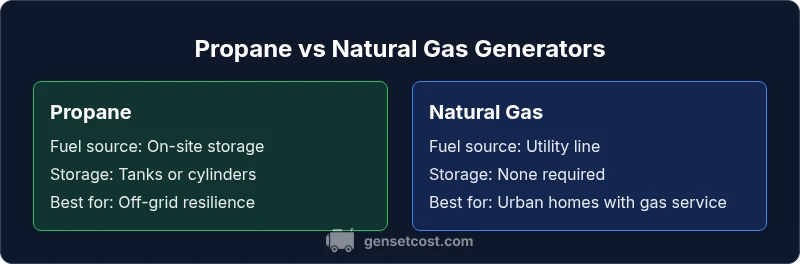
Propane generators store fuel on-site and can run during outages, but require storage tanks and refueling. Natural gas generators draw fuel from the utility line for a steady supply with less storage, yet depend on a reliable gas service. For a detailed side-by-side view, see our full comparison.
Propane vs Natural Gas: The Core Difference for Home Generators
The debate between <strong>generator propane vs gas</strong> often centers on where the fuel comes from, how it is stored, and how reliably it can be delivered during a power outage. Propane is typically stored on-site in tanks or cylinders, offering independence from the grid but demanding storage space and regular refueling. Natural gas, by contrast, uses your home’s existing utility line, reducing on-site storage yet tying you to utility service and potential outages in the gas supply. Understanding these core differences helps homeowners and property managers align their backup power strategy with their property’s layout and outage expectations.
Propane vs gas is not a one-size-fits-all decision. The best choice depends on your land, your access to fuel, and how you plan to respond to outages. In this guide, we examine availability, costs, sizing, and installation considerations to help you weigh the trade-offs for <em>generator propane vs gas</em> in real-world scenarios.
Fuel Availability, Storage & Reliability
Fuel availability is the first practical dividing line between propane and natural gas. Propane requires physical storage—tanks or cylinders—that you must fill or replace on a scheduled basis. The storage location matters for safety, access, and weather protection, and you’ll need to budget for refills during long outages. Natural gas relies on your city’s pipeline network, which can provide a continuous fuel supply without on-site storage. However, reliability depends on the gas utility’s service integrity and local infrastructure. For homes far from the grid or in rural settings, propane can be more dependable simply because it does not depend on a municipal gas line. The Genset Cost team notes that regional fuel markets, delivery infrastructure, and weather patterns all influence long-term fuel reliability in the generator propane vs gas decision.
Shopping for a backup generator means predicting fuel resilience. If your property experiences frequent outages, propane’s ability to be stored on-site can translate into more predictable operation. If your area enjoys stable utility service and you want a low-storage solution, natural gas may win out. Always map your outage scenarios and map fuel logistics before finalizing a decision.
Real-world takeaway: In regions with robust natural gas networks, a natural gas generator can simplify fueling. In remote locations or during extended outages, propane’s portability and on-site storage can be the safer bet.
Cost of Ownership: Fuel Costs, Refueling, and Longevity
Fuel costs shape operating expenses as your generator runs during outages or routine tests. Propane’s price per energy unit fluctuates with regional supply, storage costs, and transportation; bulk purchases can reduce per-gallon cost but will still vary. Natural gas fuel costs, by contrast, are closely tied to utility pricing and local market dynamics, often offering more predictable long-term economics when a steady gas service is available. From a lifetime-cost perspective, propane may require more frequent fueling events and tank maintenance, while natural gas reduces refueling frequency but introduces ongoing connection and regulator considerations. The total cost of ownership for generator propane vs gas hinges on fuel price volatility, fuel availability, and how often you rely on the generator for power protection. Property managers should include installation costs, potential transfer switches, and local utility rates in their budgeting assumptions.
Operational efficiency also plays a role. Propane engines tend to deliver strong surge performance with limited line losses, which can be a benefit for load-heavy emergencies. Natural gas engines may offer smoother operation with a steadier supply, but must accommodate existing pipeline pressures and regulators. When evaluating long-term expenses, compare the total fuel costs across your expected annual runtime, factoring in regional fuel price trends and the likelihood of outages. Genset Cost’s analysis emphasizes that fuel economics often dominate the decision more than the sticker price of the generator itself.
Sizing, Performance & Efficiency
Sizing a generator requires aligning output needs with fuel delivery capabilities. Propane systems typically use a storage tank size paired with a regulator and pressure control to maintain consistent performance. The energy density of propane allows for sizable run times on a single fill, especially for larger portable or standby units. Natural gas systems depend on the gas pressure and flow available from the utility line; if the line is undersized or there are pressure fluctuations, performance may vary during peak loads. Efficiency differences emerge mainly from fuel characteristics and engine tuning rather than fundamental capability—both fuels can support similar standby power levels when properly sized. For <em>generator propane vs gas</em> comparisons, aim to match generator rating to your expected load, seasonality of outages, and local gas infrastructure. This creates more predictable starting behavior and better fuel economy during extended use.
A practical approach is to perform a load analysis and then verify with a professional that the selected model can sustain your essential circuits under the fuel constraints of your chosen option. Remember to consider surge capacity, continuous vs. intermittent run requirements, and the impact of any parallel generators in your design. The best outcomes come from a clearly defined load plan that aligns with your fuel type.
Installation, Safety, and Maintenance
Fueling systems, storage, and fuel delivery hardware introduce different safety considerations. Propane installations require appropriate outdoor storage space, leak detection, shutoff valves, and compliance with local codes. Regular inspection of tanks, hoses, and connections is essential to reduce the risk of leaks and pressure failures. Natural gas installations rely on a properly installed gas service line, regulators, and safe venting. Regular line checks, gas detector placement, and adherence to municipal codes are critical for safety and reliability. Both fuel options benefit from professional installation, a well-maintained transfer switch or automatic standby system, and routine generator maintenance to ensure peak performance during outages.
Maintenance demands differ somewhat. Propane systems are more sensitive to tank-related issues and refills, which means owners should schedule refilling and tank inspection. Natural gas setups emphasize line integrity and regulator checks more than tank upkeep. Regardless of the fuel type, schedule annual service and test runs to verify integrity, and install CO detectors, gas detectors, and proper ventilation near the standby system. The goal is steady, safe operation when you most need power.
When to Choose Propane vs Natural Gas: Practical Scenarios
If you live in a remote area with limited gas service and you anticipate long outages, propane offers independence and resilience thanks to on-site storage. If you’re in an urban or suburban setting with reliable gas infrastructure and you want to minimize on-site fuel handling, natural gas can provide a lower-maintenance option with a steady fuel supply. For property managers overseeing multiple units, evaluating fuel logistics—tank management for propane vs utility-service reliability for natural gas—helps in budgeting and maintenance planning. In practice, the decision often comes down to local fuel costs, space for storage, and how quickly you want to restore power after an outage.
Comparison
| Feature | propane generator | natural gas generator |
|---|---|---|
| Fuel source and storage | Propane requires on-site tanks or cylinders | Natural gas taps from utility lines |
| Delivery & supply reliability | Tank refilling and storage management | Depends on gas line pressure and utility supply |
| Energy density / power delivery | Higher energy density per volume (propane) | Lower energy density per volume but steady supply (natural gas) |
| Installation considerations | Outdoor propane storage and venting requirements | Gas line installation with regulators and permits |
| Maintenance & safety | Tank integrity checks and leak detection | Gas line integrity checks; detectors and regular inspections |
| Fuel cost trends | Prices vary regionally; propane volatility affects costs | Natural gas prices tend to be more stable with pipeline supply |
| Best use scenario | Off-grid resilience and storage flexibility | Urban/suburban homes with existing gas service |
| Best for | Independence from the grid and storage flexibility | Minimal storage needs and steady service |
The Good
- Propane offers on-site storage, independence from the grid, and can power run-time during outages.
- Propane has high energy density per volume, allowing longer runtimes between refills.
- Natural gas avoids on-site fuel storage and refueling altogether, reducing handling.
- Natural gas works well where a reliable gas service exists and maintenance needs are lower.
The Bad
- Propane requires on-site storage, tank maintenance, and periodic refills.
- Natural gas depends on utility service; an outage may affect fuel availability.
- Propane can be more expensive per unit of energy in some regions and requires fuel management.
- Gas-line installation and regulatory compliance can add upfront costs and complexity.
Propane and natural gas each have clear advantages depending on your property and outage plans.
Propane favors independence and flexibility, especially where off-grid capability matters. Natural gas favors convenience and lower on-site fuel handling in areas with reliable pipelines. Choose based on fuel access, space for storage, and local pricing.
People Also Ask
What is the main difference between propane and natural gas generators?
The main difference is the fuel source and storage: propane requires on-site tanks and refueling, while natural gas uses the utility gas line, reducing on-site fuel handling but depending on service reliability.
The key difference is where the fuel comes from and how it’s stored.
Can I convert a propane generator to natural gas later?
Yes, with the appropriate fuel-system kit and professional installation, a converter can adapt the generator to natural gas, but it may affect warranty and efficiency.
Yes, but you’ll likely need a professional install and it may affect warranties.
Which fuel is cheaper to operate overall?
Costs depend on local fuel prices and consumption. Natural gas can be cheaper in regions with stable pipeline pricing, while propane may be cheaper in areas with inexpensive propane supply.
Costs vary by region; natural gas is often steadier, propane can be cheaper where storage costs are low.
Are propane and natural gas generators compatible with standby transfer switches?
Both fuels can be connected to standby transfer switches, but installation specifics vary. A licensed electrician can ensure code-compliant wiring for your setup.
Yes, with proper installation and a standby switch.
What maintenance is required for each fuel type?
Propane requires tank and line leak checks, as well as refueling management. Natural gas emphasizes line integrity and regulator checks; both benefit from annual service and safety detectors.
Regular safety checks and annual service keep both options reliable.
Is propane safer than natural gas for home backup?
Both have safety risks if leaks occur; propane leaks tend to collect near the ground due to heavier-than-air properties, while natural gas leaks are also hazardous but managed with detectors and ventilation. Proper installation and detectors are essential for both.
Both have risks—install detectors and follow safety guidelines for either fuel.
Key Takeaways
- Assess local fuel access before sizing the generator.
- Plan for fuel storage needs if you choose propane.
- Factor regional fuel price volatility into total cost.
- Consult a licensed installer for transfer switches and safety checks.
- Consider long-term outage scenarios to prioritize independence or infrastructure against price stability.