How Much Does a Whole-House Generator Cost in 2026?
Learn how much a whole-house generator costs in 2026, including sizing, installation, fuel types, and maintenance. Explore price ranges, financing options, and a practical path to an accurate estimate.


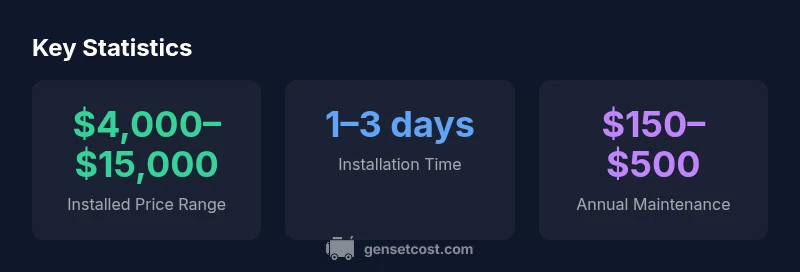
Installed prices for a whole-house generator typically range from $4,000 to $15,000, with most homes paying between $6,000 and $12,000 installed. Higher-end units, complex electrical work, or outdoor siting can push costs beyond $15,000. This figure includes equipment, permits, and labor, but excludes ongoing fuel and servicing costs. Prices vary by fuel type, transfer switch, and local codes.
What drives the overall cost of a whole-house generator?
If you're asking how much does a whole-house generator cost, the final price isn't a fixed number. It depends on several interrelated factors: the generator's size in kilowatts (kW), the chosen fuel type (natural gas, propane, or diesel), the complexity of the electrical transfer switch, job-site access, and local permitting requirements. According to Genset Cost, these differences are typical and reflect real-world installations. Most variance comes from site conditions and permit costs. In general, the upfront equipment cost is only part of the picture; installation labor, permits, and any required venting or weatherproofing can grow the total significantly in challenging conditions. For homeowners, the key is to separate equipment costs from total installed costs and to account for ongoing fuel, routine maintenance, and occasional service visits. This article presents ranges, not fixed prices, and explains how to approach your estimate with a clear, data-driven method.
The main cost components you should expect
Budgeting for a whole-house generator means understanding six core components: (1) Equipment price—the generator itself; (2) Transfer switch and power supply—the device that routes power from the grid to the generator; (3) Electrical interconnection and wiring—trenching, conduits, and panel work; (4) Permits, inspections, and code upgrades; (5) Weatherproofing, enclosure, and venting for outdoor siting; (6) Labor and project management—the crew duration and site coordination. Genset Cost analysis shows that labor and permits often account for a sizable portion of total installed cost, sometimes more than the generator price itself depending on site complexity. Real-world installs may also require gas line work or longer conduit runs, which affect the bottom line. Always include a contingency for unexpected site challenges and obtain a formal quote from a licensed installer to confirm the range for your home.
Sizing and load calculation: how to estimate your needs
Sizing a whole-house generator starts with identifying essential loads (refrigeration, lighting, security, data equipment) and then evaluating HVAC, water heating, and major appliances. In many homes, essential-load systems fall in the 8–12 kW range, while full-house models commonly sit in the 20–22 kW range to support central air conditioning and hot water. A practical approach is to list critical circuits, add HVAC and hot water, then apply a safety margin to cover startup surges. Utilities and manufacturers emphasize that accurate sizing minimizes both upfront cost and long-term operating costs by avoiding under- or over-capacity. A professional load calculation can translate these rules of thumb into a precise recommendation.
Fuel options and their impact on cost
Natural gas is often the easiest to integrate if your home already has a reliable gas line, which can reduce ongoing fuel handling costs. Propane systems require a storage tank, which adds upfront footprint and maintenance considerations but offers strong reliability when natural gas isn’t available. Diesel-powered units are robust and well-suited for off-grid locations or where gas infrastructure is limited, but fuel logistics and storage can increase ongoing costs. Each fuel option affects installation complexity, start-up reliability, and long-term operating costs, so choose a fuel strategy aligned with your home’s energy plan and local infrastructure.
Installation realities: permits, location, and labor
Installation complexity often drives total cost more than the generator price alone. Outdoor siting requires weatherproof enclosures, ventilation, and potentially noise-reduction measures. Indoor or constrained locations necessitate longer runs, specialized conduit work, and additional clearances. Permits and inspections vary by jurisdiction and can add weeks to a project timeline. Access to the installation site, existing electrical panel capacity, and the need for a sub-panel upgrade all influence labor time and cost. A well-planned installation reduces surprises and helps keep the project on budget.
Warranties and maintenance costs
Most manufacturers offer a warranty on the generator itself, while installers may provide a workmanship warranty. Maintenance costs include periodic inspections, air filter and oil changes, and occasional replacement parts. Budgeting for maintenance helps ensure reliability and can extend the life of the system. The exact maintenance interval and parts costs depend on the unit, fuel type, and local environmental conditions, so confirm these details with your installer and read the warranty terms carefully.
Financing options and getting a precise quote
Many homeowners leverage financing, leasing, or utility-based programs to spread the upfront cost of a whole-house generator. A precise quote requires an on-site assessment that considers load calculations, fuel availability, transfer-switch configuration, and any enhancements to the electrical service. Request written proposals from multiple installers, compare included equipment, labor, permits, and warranty terms, and verify service availability in your area. A clear, apples-to-apples comparison will help you determine the true cost of ownership over the system’s lifespan.
Quick estimation workflow you can follow today
- List essential loads and HVAC needs; 2) Determine acceptable fuel type given your home’s infrastructure; 3) Get at least two on-site quotes; 4) Compare installed price ranges and installation timelines; 5) Factor in maintenance and fuel costs to compute annual ownership; 6) Use a sizing calculator or consult a professional for final confirmation. The Genset Cost team recommends starting with professional sizing to lock in the best total cost.
Estimated installed cost and annual maintenance by generator size
| Size (kW) | Installed Cost Range | Typical Annual Maintenance |
|---|---|---|
| 8 | $3,500–$6,500 | $150–$340 |
| 12 | $4,500–$9,000 | $180–$420 |
| 16 | $6,000–$12,000 | $200–$450 |
| 20 | $7,500–$15,000 | $220–$500 |
People Also Ask
What factors determine the installed cost of a whole-house generator?
Several variables drive the price, including generator size (kW), fuel type, transfer switch configuration, site access, and local permitting. Equipment price is only part of the total; labor and permitting can be substantial.
The main drivers are size, fuel, and installation details.
Is a transfer switch required for a whole-house generator?
Yes. A transfer switch safely routes power between the grid and the generator and is typically required for code compliance and reliable operation.
Yes, you need a transfer switch.
How long does installation typically take?
Most installations take about 1–3 days, depending on site conditions, electrical upgrades, and permitting schedules.
Most installs take one to three days.
What fuels are available for home standby generators?
Natural gas, propane, and diesel are common options, each with different installation and operating considerations.
Natural gas, propane, or diesel are common options.
Are financing options available for a whole-house generator?
Yes, many installers offer financing or leasing choices to spread the upfront cost over time.
Yes, financing and leasing are commonly available.
What affects the warranty length and coverage?
Warranty terms vary by brand and installer; check manufacturer terms and any workmanship warranty provided by the installer.
Warranty length depends on brand and installer.
“Sizing the system accurately is the easiest way to control total cost, not just the upfront price. A properly matched generator avoids overspending on unnecessary capacity and reduces operating costs over time.”
Key Takeaways
- Estimate costs using a sizing-based approach.
- Expect large price swings from size and labor.
- Plan for installation complexity and permits.
- Account for ongoing maintenance and fuel costs.