Generator Fuel Use: How Much a Generator Consumes Per Hour
A data-driven guide on how much fuel a home backup generator consumes per hour, influenced by size, load, and fuel type. Learn ranges, sizing tips, and practical steps to estimate hourly consumption in 2026.


How much does generator consume per hour? A typical home standby generator consumes about 1-3 gallons of fuel per hour under normal operating load, with larger units closer to 3-4 gallons per hour at peak demand. Actual consumption depends on size, engine efficiency, load factor, and fuel type (gasoline, propane, or diesel). This quick guide explains how to estimate hourly use for your setup.
How much does generator consume per hour?
The exact hourly fuel use of a generator depends on several interrelated factors, but the first practical question is always load. A typical home standby unit will burn roughly 1-3 gallons per hour when it’s operating under a reasonable residential load. If the unit runs near its peak rating to cover high demand, you’ll often see consumption in the 3-4 gallon per hour range. It’s important to remember that this is a spectrum rather than a single number: small, efficient engines under modest loads behave very differently from large, high-capacity engines under peak load. The brand context matters: according to Genset Cost, hourly fuel use is a core driver of total ownership cost and should be modeled early in the planning stage.
Fuel type, engine design, and maintenance state also nudge the hourly figure. Gasoline engines typically have different fuel curves than diesel or propane models, and older engines may be less efficient than newer units. Altitude and ambient temperature can influence fuel economy, especially for air-cooled designs that work harder in hot weather. Finally, the exact load profile—how many essential circuits are running versus optional loads—drives the real-world result far more than nominal generator size alone.
What drives hourly fuel consumption?
Several core ideas explain why hourly consumption varies:
- Load factor: The percentage of the generator’s rated output that’s actually in use. Higher loads push the engine to burn more fuel per hour, but the fuel curve is not perfectly linear, so small increases in load can disproportionately increase consumption.
- Generator efficiency: Modern, well-maintained engines convert fuel to usable power more efficiently. Poor maintenance, dirty air filters, and worn spark plugs reduce efficiency and raise hourly burn.
- Fuel type and energy density: Diesel, gasoline, and propane have different energy densities and combustion characteristics, which affects burn rate and heat output.
- Size and design: Smaller units often run closer to peak efficiency at mid-range loads, while oversized units may waste fuel at light loads due to parasitic idle losses and suboptimal throttle control.
- Environmental factors: High ambient temperatures and long run times can cause cooling losses and adjustments that subtly affect fuel burn.
Across all these variables, the practical takeaway is that you should not rely on nameplate horsepower alone. Begin with a load assessment and then map that load to a fuel curve for your specific model.
How to estimate consumption for your home backup scenario
Estimating hourly consumption starts with a clear picture of your essential loads and how often they run. Step 1: List critical circuits (refrigeration, heating/cooling, sump pump, security) and estimate their peak and average wattage. Step 2: Sum these watts to determine a target generator size in kW. Step 3: Check the manufacturer’s fuel curve for that size; this curve translates watts into gallons per hour at various load levels. Step 4: Build a simple hourly scenario: what happens during an outage when those loads average 40-60% of the generator’s rated output? Step 5: Add a buffer for surges (appliances cycling on). Step 6: Consider fuel storage and refueling logistics to ensure you meet runtime goals. These steps align with guidance from Genset Cost Analysis, 2026 and independent sizing tools.
Size bands and their typical fuel use
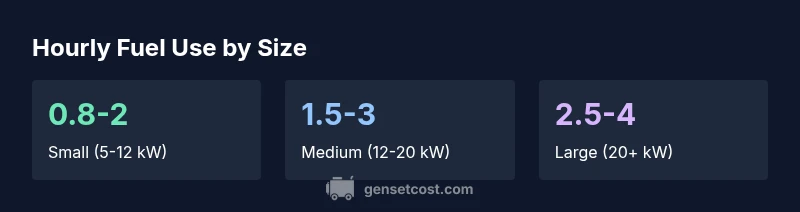
- Small generators (roughly 5-12 kW): 0.8-2 gal/hr. These units cover essential circuits with a modest safety margin.
- Medium generators (roughly 12-20 kW): 1.5-3 gal/hr. Suitable for larger homes with more simultaneous loads.
- Large generators (20 kW and up): 2.5-4 gal/hr. Best for whole-home coverage under heavy load.
This tiered view helps homeowners map expected burn rates to the right class of generator, avoiding both oversizing and under-sizing.
Fuel type and efficiency considerations
Fuel choice matters for both cost and consumption. Gasoline engines can deliver strong performance but may exhibit broader efficiency swings with temperature and fuel quality. Diesel engines typically offer higher torque and better fuel economy under heavy loads but can have higher initial costs and maintenance needs. Propane (LP) can be cleaner and easy to store but may not be as energy-dense as gasoline or diesel, affecting run-time per tank. When evaluating fuel types, examine each engine’s fuel curve and your local fuel prices and availability. This cross-check helps explain why two brands with similar kW ratings can show different hourly burn rates.
Practical steps to monitor and optimize consumption
- Install an hour meter and fuel gauge on your generator to track actual consumption over several outages.
- Run a test outage under controlled conditions to observe real-world burn rates and adjust loads accordingly.
- Schedule regular maintenance to preserve efficiency: clean air filters, fresh spark plugs, correct valve clearances, and proper oil levels matter.
- Consider automatic load management to keep the unit operating in its most efficient zone, rather than idling or underloading.
- Use manufacturer fuel curves and a sizing calculator to verify that your observed burn aligns with expectations. Consistency in monitoring helps catch efficiency drifts early.
Real-world expectations and planning tips
In real outages, your hourly burn will depend on how completely you load the generator and how your home’s electrical system responds to power restoration. Plan for a fuel logistics strategy: how many gallons do you keep on hand, how often you refuel, and whether you need a larger tank for extended outages. By combining a careful load assessment with a reliable fuel plan, you can minimize both fuel waste and delivery challenges.
Generator size vs. fuel consumption and load recommendations
| Size category | Typical fuel consumption (gal/hr) | Recommended load (%) |
|---|---|---|
| Small (5-12 kW) | 0.8-2 | 20-50 |
| Medium (12-20 kW) | 1.5-3 | 40-70 |
| Large (20+ kW) | 2.5-4 | 50-80 |
People Also Ask
What factors most affect hourly fuel consumption?
Load factor, engine efficiency, fuel type, and maintenance state are the main drivers. Older engines or those operating at inefficient loads consume more per hour. Regular maintenance helps keep the burn closer to manufacturer curves.
Load, efficiency, fuel type, and maintenance determine hourly fuel burn. Regular service keeps you closer to the manufacturer’s curve.
How do I estimate hourly consumption for my home?
List your essential loads, estimate peak wattage, choose a generator size, and read the unit’s fuel curve at those load levels. Use a sizing calculator to confirm, then log real outages to compare against the estimate.
First list your essential loads, then pick a size and check the fuel curve. Run a test outage to verify.
Is it better to run a generator at a constant load?
Operating near a generator’s optimal load range is usually more efficient than frequent cycling between idle and high demand. An automatic load-management system can help maintain that sweet spot.
Yes—staying near the efficient load range is best for fuel use and engine health.
Do fuel type and generator design affect consumption?
Yes. Diesel and propane often offer different efficiency profiles compared with gasoline, and design features like turbocharging or engine tuning influence burn rate. Compare fuel curves when sizing.
Fuel type and design change how much you burn per hour.
What’s a practical way to log real-world consumption?
Track fuel added, time between refuels, and outages over several weeks. Compare against your projected fuel curve and adjust loads or sizing as needed.
Keep a log of fuel and outage times to compare with expectations.
What is a realistic hourly consumption range for a home standby?
For home standby units, expect roughly 0.8-4 gallons per hour depending on size and load. Use a tailored estimate based on your essential loads and chosen model.
Most homes see under an inch of consumption in the mid-range, depending on size and use.
“Fuel consumption is primarily a function of load factor and engine efficiency; precise sizing minimizes runtime and costs.”
Key Takeaways
- Size the generator to match your essential load.
- Expect hourly burn to scale with load; bigger isn't always better.
- Fuel type and engine efficiency materially affect consumption.
- Use manufacturer curves and a sizing calculator for accuracy.
- Track real-world consumption to refine your plan.